

On this page
If you have ever walked a dog on a long leash, you know the feeling of a sudden jerk when the leash runs out of slack. In mechanics problems, this event—a slack string becoming taut between two moving masses—is treated as an impulsive interaction.
It might seem complicated to calculate the sudden forces involved, but physics gives us a shortcut. By looking at the momentum before and after the snap, we can bypass the complex forces and find exactly how fast the masses will move.
Why does a jerk act like an inelastic collision?
When an inextensible string reaches its full length, it exerts an impulsive tension—a massive force over a tiny fraction of a second—on both masses. This force pulls the objects toward each other along the line of the string.
According to OpenStax *University Physics*, a perfectly inelastic collision is an interaction where the maximum possible amount of kinetic energy is lost, and the colliding objects "stick together" to share a common final velocity.
Even though the two masses on a string are separated by a distance, they behave exactly this way along the axis of the string. The string forces them to share the same velocity component in that direction. And because the impulsive tension is an internal force within the two-mass system, the total linear momentum along the string is conserved.
How do you find the common velocity?
Because momentum is conserved and the final velocity is shared, the calculation is straightforward. You only need to consider the components of velocity that lie parallel to the string.
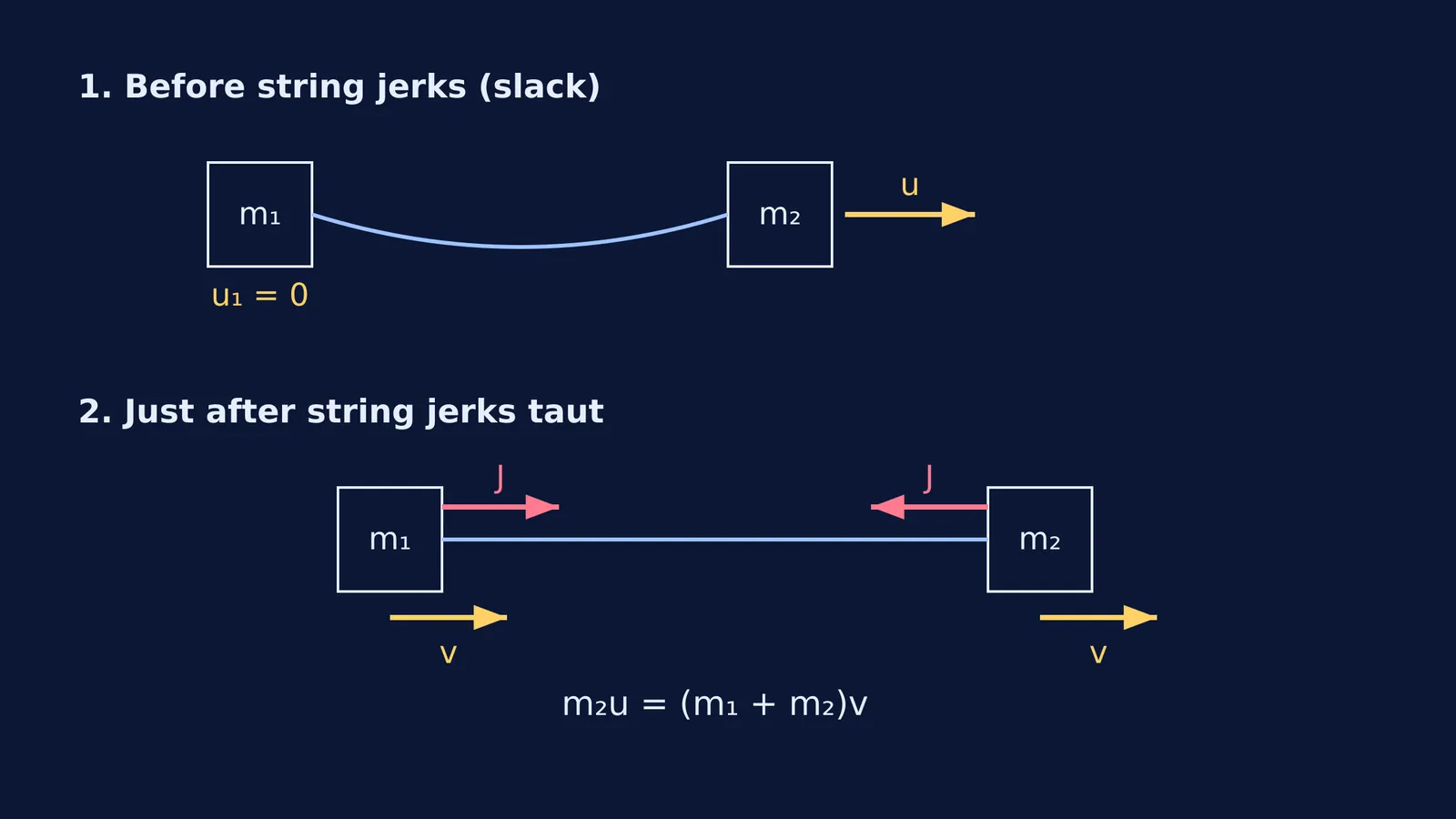
If a mass m₁ is at rest, and a second mass m₂ is moving away with velocity u, the total momentum before the string snaps is just m₂u.
Immediately after the jerk, both masses must move with the same velocity v along the string's direction. The total momentum is now (m₁ + m₂)v.
Setting them equal gives:
m₂u = (m₁ + m₂)v
Which means the common velocity is:
v = (m₂u) / (m₁ + m₂)
If you are practicing these concepts and want to trace the step-by-step logic without getting stuck, the Fermi Concept Library has a lesson for every concept in physics, chemistry, biology, mathematics and computing, each with its place in the map.
How do you calculate the impulse?
Let's put the equations to work. Imagine a 2 kg block resting on a smooth floor. It is connected by a slack string to a 3 kg block. You give the 3 kg block a sharp push, sending it sliding away at 10 m/s.
What is the common speed of the blocks just after the string jerks taut, and what is the magnitude of the impulse in the string?
Find the initial momentum: Only the 3 kg block is moving. Initial momentum = 3 kg × 10 m/s = 30 kg·m/s.
Find the common velocity: After the jerk, the string forces both blocks to share the same velocity v. Final momentum = (2 kg + 3 kg) × v = 5v. Since momentum is conserved: 5v = 30 kg·m/s, so v = 6 m/s. Both blocks move at 6 m/s immediately after the string snaps.
Calculate the impulse: Impulse (J) is the change in momentum for either one of the blocks. It is easiest to calculate it for the block that started at rest (the 2 kg block), because its initial momentum was zero. J = mass × change in velocity = 2 kg × (6 m/s − 0 m/s) = 12 N·s. The impulsive tension in the string is 12 N·s.
For more on how strings exert forces in different scenarios, you can read our guide on monkey climbing a rope: tension when it speeds up or slows down.
What happens if the masses are moving at an angle?
If the 3 kg block in our example had been moving at an angle to the string, the rule still holds, but you must resolve the velocity into components.
The impulsive tension only acts along the line of the string. This means:
The component of velocity parallel to the string undergoes an inelastic collision, forcing the masses to share a common parallel velocity.
The component of velocity perpendicular to the string remains completely unchanged by the jerk.
To find the final speed and direction of the moving block, you would calculate the new parallel velocity using momentum conservation, keep the old perpendicular velocity, and combine them using Pythagoras' theorem. You can see a similar use of velocity components in our breakdown of an oblique elastic collision of equal masses.
Using components correctly is one of the most common places students trip up. If you feed a trickier angle problem into the Fermi Problem Library, the AI tutor will hold a line of reasoning across the session, asking you to identify which velocity component the string tension actually affects before letting you jump to the calculation.


