On this page
Preparing for JEE Main and NEET-UG together? Thermodynamics is one of the easier units to plan for. The official topic lists match, so one round of study covers both. What changes is how each exam asks about it.
Is the Thermodynamics syllabus the same for JEE Main and NEET?
Yes, in substance.
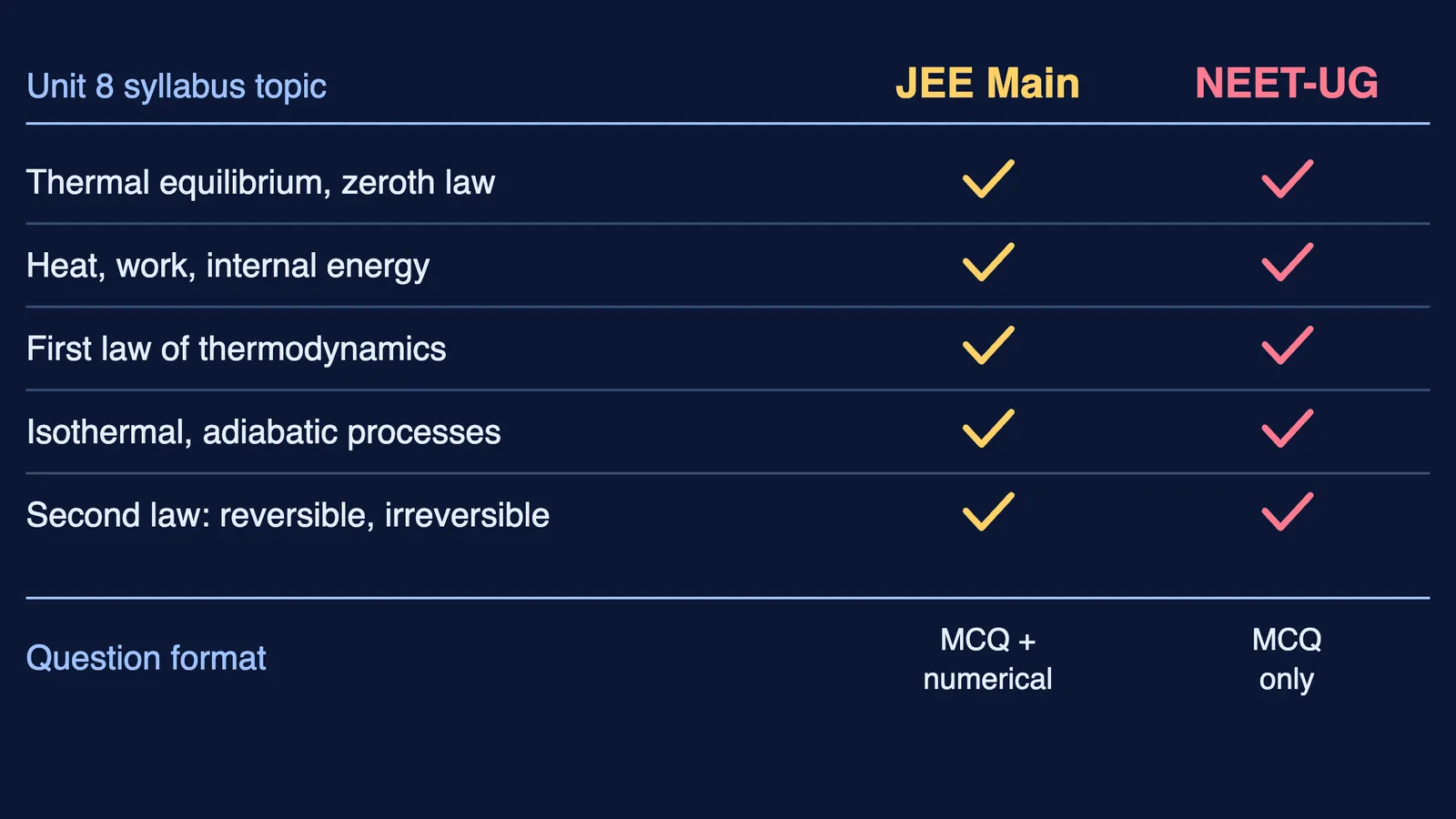
Unit 8 of the Syllabus for JEE (Main) - 2027, linked from the NTA JEE Main website, reads in four parts:
"Thermal equilibrium and the concept of temperature, zeroth law of thermodynamics"
"heat, work and internal energy"
"The first law of thermodynamics, isothermal and adiabatic processes"
"The second law of thermodynamics: reversible and irreversible processes"
Unit 8 of the NMC's updated syllabus for NEET (UG)-2026, dated 22-12-2025, reads:
"Thermal equilibrium, zeroth law of thermodynamics, the concept of temperature"
"Heat, work, and internal energy"
"The first law of thermodynamics, isothermal and adiabatic processes"
"The second law of thermodynamics: reversible and irreversible processes"
The only difference is word order in the first line. No sub-topic appears in one list and not the other. Unit 9, Kinetic Theory of Gases, also matches closely in both, including "applications to specific heat capacities of gases", which is where C_v and C_p come from.
Neither list names the Carnot engine, heat-engine efficiency or a textbook. Chapter 11 of NCERT Class 11 Physics Part II (Reprint 2026-27) covers every listed topic and ends with Section 11.11 on the Carnot engine, its reversible engine. Reversible processes are listed, so read it.
How is the question format different?
The JEE (Main) 2027 information bulletin splits each subject of Paper 1 into Section A, 20 multiple-choice questions, and Section B, 5 questions whose answer is a numerical value. You enter an integer on an on-screen numeric keypad, rounded to the nearest integer. Both sections give +4 for a correct answer and −1 for a wrong one.
The NTA information bulletin for NEET (UG)-2026 sets 180 compulsory questions in 180 minutes, with 45 in Physics. Every question is a multiple-choice question "with four options and single correct answer/best option", marked +4, −1 and 0 if unanswered.
In NEET you can check your answer against four options. In a JEE Main numerical question there are none, so a slip in sign or units costs the mark.
How does the style of questions differ?
These are tendencies you will notice when you work through official past papers, not rules.
NEET questions on this unit tend to be short and direct. They often test a single NCERT statement: what is zero in which process, the sign of work, which quantity is a state function. The arithmetic is light.
JEE Main questions tend to chain two or three steps. A typical one asks you to find a final temperature from an adiabatic relation, then use it to get work or heat. They often borrow from Unit 9 (C_v = 3R/2 for a monatomic gas) or read a P-V graph.
The two examples below test the same idea, an adiabatic expansion, in each style. Both are original. We use R = 8.3 J mol⁻¹ K⁻¹.
NEET-style example. An ideal gas in a cylinder with insulated walls and an insulated piston expands and does 420 J of work on the piston. Which is correct?
(A) ΔU = +420 J, and the temperature rises (B) ΔU = 0, and the temperature is unchanged (C) ΔU = −420 J, and the temperature falls (D) ΔU = −420 J, and the temperature is unchanged
Answer: (C). Insulated means Q = 0. From ΔQ = ΔU + ΔW, ΔU = 0 − 420 = −420 J. NCERT Section 11.8.3 states that in an adiabatic process the work done by the gas comes out of its internal energy, so an ideal gas cools. Trap: (B) treats "no heat" as "no temperature change", which is true only for an isothermal process.
JEE Main-style example (numerical value). Half a mole of a monatomic ideal gas (γ = 5/3) at 900 K expands reversibly and adiabatically until its volume is 27 times the original. How much work, in joules, does the gas do?
Answer: 4980. Step 1: TV^(γ−1) is constant, so T₂ = 900 × (1/27)^(2/3) = 900/9 = 100 K. Step 2: Q = 0, so the work equals the fall in internal energy: W = nC_vΔT = 0.5 × (3/2) × 8.3 × 800 = 4980 J. Trap: the isothermal formula nRT ln 27 gives about 12,310 J; an adiabatic gas cools, so it does far less work.
Same idea, Q = 0 so W = −ΔU. NEET checks the statement; JEE Main also wants the temperature and the arithmetic, with no options.
What should you prepare differently?
For NEET alone, train fast recognition: name the process, write what is zero, choose. For JEE Main, add timed multi-step numericals and P-V cycles without options. For the full single-exam plans, read our guides on how to prepare Thermodynamics for NEET and how to prepare Thermodynamics for JEE Main.
Can't picture why an adiabat falls more steeply than an isotherm? The Fermi Simulation Lab has interactive simulations for the ideas that are easier to see than to read.
How to prepare for both
Read NCERT Chapter 11 once, properly. Sections 11.1 to 11.11 cover everything both syllabi list, plus the Carnot engine. Underline every sentence saying what is zero or constant in a process.
Build one process table. For isothermal, adiabatic, isobaric, isochoric and cyclic processes, write Q, W and ΔU for an ideal gas. It is quick NEET recall and the first step of every JEE Main numerical.
Fix one sign convention. NCERT physics uses ΔQ = ΔU + ΔW, with W done by the gas; chemistry uses ΔU = q + w, with w done on the system. Never mix them inside a question.
Practise in two modes. Do short sets of one-step MCQs at about a minute each, then separate sets of multi-step problems with the options covered, giving a single number as you would in Section B.
Link Units 8 and 9. Know C_v and γ for monatomic and diatomic gases from equipartition; JEE Main-style questions lean on them, and NEET can ask them directly.
Review mistakes by type. Sort each miss as sign, units, wrong process or arithmetic. Our list of common thermodynamic process mistakes in JEE and NEET shows the usual ones.