On this page
If you are preparing for JEE Main and NEET-UG together, Oscillations and Waves is one unit you do not have to learn twice. The official syllabus text is the same for both exams. What changes is the answer format and the kind of thinking each paper rewards, and that decides how you should practise.
Is the Oscillations and Waves syllabus different for JEE Main and NEET?
No. Unit 10 carries the same title and the same topic list in the JEE (Main) 2027 syllabus published by NTA and in the NMC syllabus for NEET (UG)-2026. Read side by side, the two unit texts match almost word for word:
Periodic motion: "time period, frequency, displacement as a function of time", plus periodic functions.
SHM: "Simple harmonic motion (S.H.M.) and its equation", phase, and spring oscillations with "restoring force and force constant".
Energy and the pendulum: "kinetic and potential energies" in SHM, and the simple pendulum with "derivation of expression for its time period".
Waves: longitudinal and transverse waves, the speed of a travelling wave, and the "displacement relation for a progressive wave".
Superposition: the principle of superposition, reflection of waves, "standing waves in strings and organ pipes", fundamental mode, harmonics and beats.
No sub-topic appears in one list and not the other. Neither Unit 10 text names damped or forced oscillations, resonance or the Doppler effect. The Experimental Skills unit (Unit 20) of both syllabi also lists a simple pendulum experiment on "dissipation of energy" and finding the "speed of sound in air" with a resonance tube. That shared scope is the content of NCERT Class 11 Physics Chapter 13, Oscillations and Chapter 14, Waves.
How do the question formats differ?
The bulletins describe different papers. The JEE (Main) 2027 information bulletin says each subject in Paper 1 has 20 multiple-choice questions in Section A and 5 questions in Section B "whose answers are to be filled in as a numerical value". For Section B, the bulletin says "the answer should be rounded off to the nearest integer". Both sections carry +4 for a correct answer and −1 for an incorrect one, so a guessed number in Section B can cost you.
The NEET (UG)-2026 information bulletin lists 45 Physics questions, all multiple choice "with four options and single correct answer", in a 180-minute paper. A correct answer earns +4 and an incorrect one −1. There is no typed-answer format in NEET-UG, so every Oscillations and Waves question you meet there will offer four options.
What style differences will you notice in past papers?
These are tendencies you will see when you work through official past papers, not rules the NTA publishes.
NEET questions tend to test one relation at a time and lean closely on NCERT statements: how the period scales with length, where speed is greatest, which harmonics a closed pipe allows. Speed and recall of exact statements matter.
JEE Main questions more often chain two steps, such as a ratio followed by solving for a length, or combine SHM with energy conservation or ideas from another unit. The numerical-value format removes the option to work backwards from choices.
Both exams use the same NCERT formulas. The difference is how much setting-up you do before you can use them.
Two original examples: the same pendulum idea, two styles
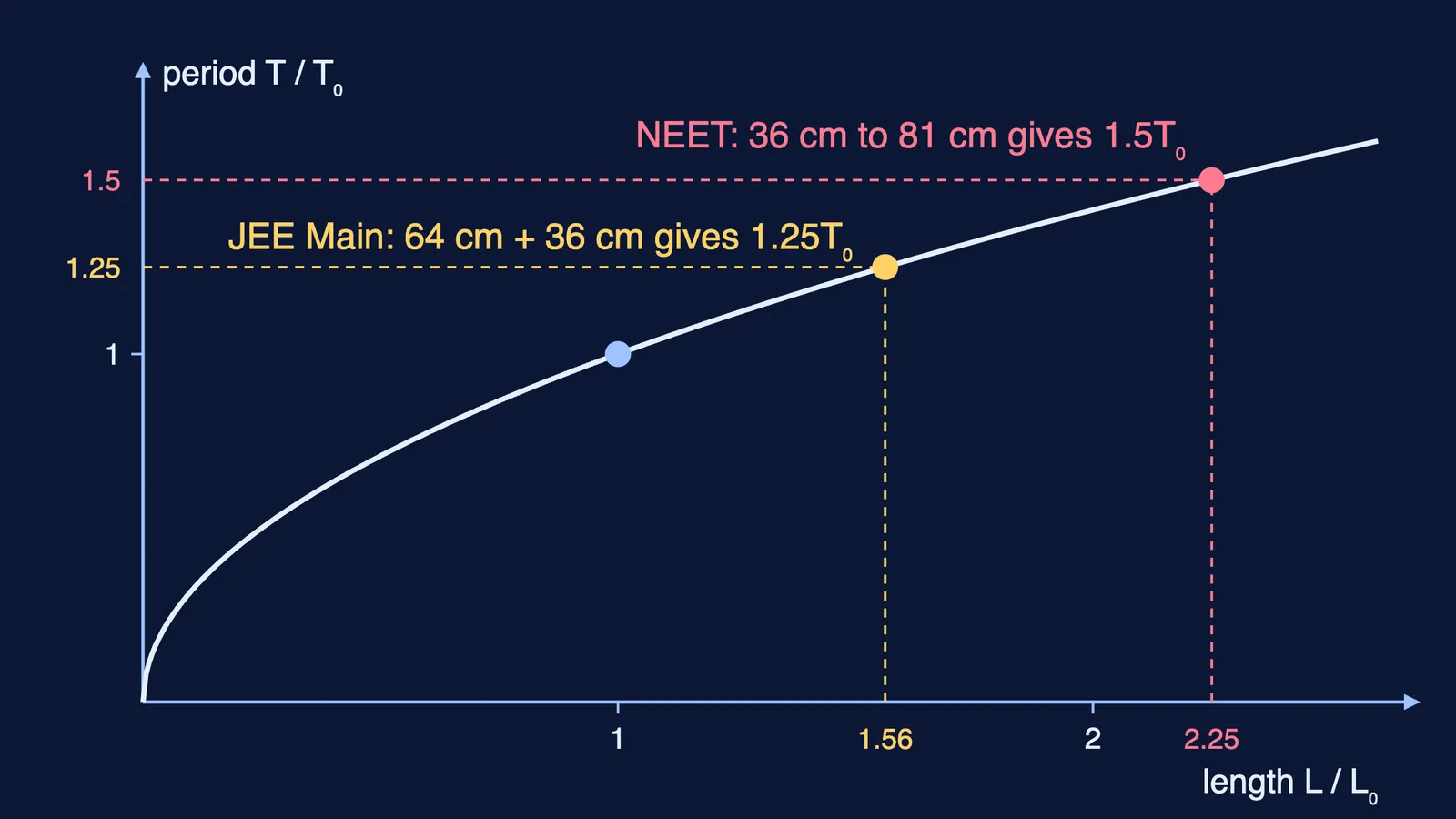
Both questions below test one idea, T = 2π√(L/g) for a simple pendulum at small angles, as derived in NCERT Section 13.8. We wrote them for this post.
NEET style (single correct). A simple pendulum is lengthened from 36 cm to 81 cm, and its bob is replaced by one three times as heavy. If the original period was T, the new period is: (a) T (b) 1.5T (c) 2.25T (d) 4.5T.
Answer: (b) 1.5T. The mass of the bob does not appear in T = 2π√(L/g), so tripling it changes nothing. The period depends on √L, and √(81/36) = 9/6 = 1.5. Option (c) is the trap of using L instead of √L, and (d) wrongly multiplies in the mass.
JEE Main style (numerical value). When the length of a simple pendulum is increased by 36 cm, its period increases by 25%. Find the original length in centimetres.
Answer: 64. Since T ∝ √L, the new-to-old period ratio is 1.25, so the length ratio is 1.25² = 1.5625. Then (L + 36)/L = 1.5625, so 0.5625L = 36 and L = 64 cm. With g = 9.8 m/s², the period goes from about 1.61 s to about 2.01 s, which confirms the 25% rise. There are no options to check against, so the squaring step has to be right.
How to prepare for both
Learn the unit once from NCERT. Read Chapters 13 and 14 line by line, since both syllabi stop at the same topics. Our NEET guide to Oscillations and Waves maps this onto NCERT sections.
Keep a scaling card. For each formula (spring, pendulum, string speed, pipe harmonics), write what doubles, halves or stays fixed. This is the fastest route through NEET ratio questions.
Practise numerical answers with no options. For JEE Main, solve some pendulum, string and pipe problems to a single integer, as Section B requires. Our guide to Oscillations for JEE Main has worked numericals.
Sketch every standing wave. Draw nodes and antinodes for strings, open pipes and closed pipes before calculating; this guards against harmonic-number slips, which cost marks in either paper.
Revise the two shared experiments. The pendulum energy-dissipation graph and the resonance tube are named in both syllabi, so read their method and observations.
Log your errors by type. Mark each miss as formula, scaling, phase or arithmetic, then compare your list with our common SHM and oscillations mistakes in JEE and NEET.
Stuck on why the period grows with √L rather than L? The Fermi Simulation Lab has interactive simulations for the ideas that are easier to see than to read.