On this page
Many marks lost in oscillations come from repeatable slips rather than hard physics. Here are eight, each with the wrong working, why it fails, a fix on fresh numbers and a habit to stop it.
Both the NTA syllabus for JEE (Main) and the NMC syllabus for NEET (UG)-2026 list the same oscillations topics in Unit 10: periodic motion, SHM and its equation, phase, spring oscillations and force constant, kinetic and potential energy, and the simple pendulum. The textbook for all of it is NCERT Class 11 Physics, Chapter 13, Oscillations.
Which time and phase mistakes cost marks in SHM?
Assuming the particle covers equal distances in equal times.
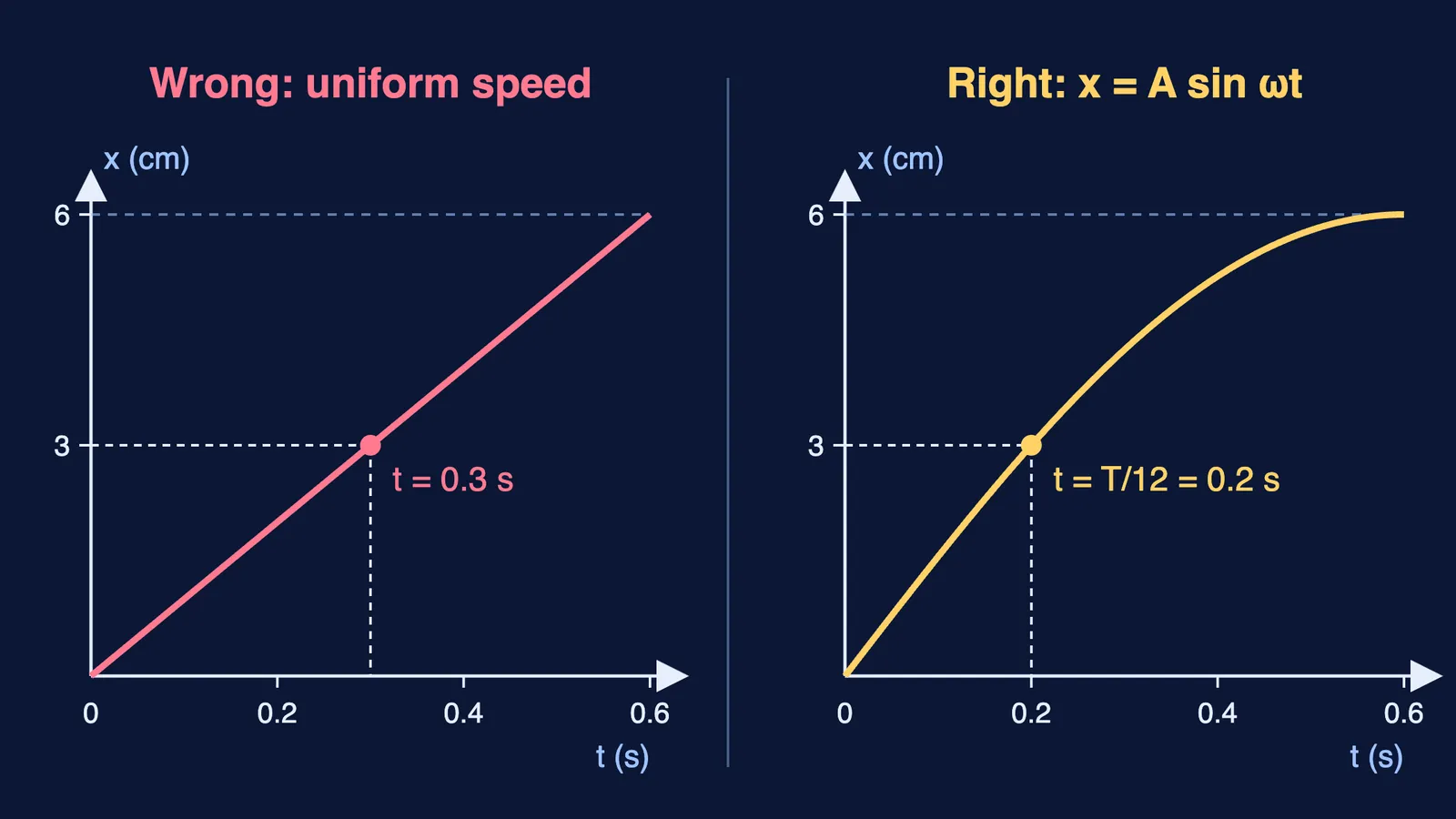
Wrong: A = 6 cm, T = 2.4 s. "Mean to extreme takes T/4 = 0.6 s, so mean to 3 cm takes half that, 0.3 s."
Why it fails: speed in SHM is highest at the mean position and falls to zero at the extreme, so the first half of the distance goes quickly.
Fix: from the mean, x = A sin(ωt). Set 3 = 6 sin(ωt), so ωt = π/6 and t = T/12 = 0.2 s. The remaining 3 cm takes T/6 = 0.4 s.
Habit: write x(t) and solve for the angle; never split time in proportion to distance.
Taking the starting displacement as the amplitude.
Wrong: a 0.4 kg block on a 160 N/m spring is at x = 3 cm and moving at 0.8 m/s at t = 0. "Amplitude = 3 cm."
Why it fails: the amplitude is where the speed is zero. A moving block goes further.
Fix: ω = √(160/0.4) = 20 rad/s. A = √(x₀² + (v₀/ω)²) = √(0.03² + 0.04²) = 0.05 m = 5 cm.
Habit: if a question gives both x₀ and v₀, use both before writing A.
Why do speed and acceleration answers come out wrong?
Using v = ω(A − x) for the speed at a displacement.
Wrong: A = 10 cm, ω = 12 rad/s. At x = 6 cm, "v = 12 × 0.04 = 0.48 m/s."
Why it fails: speed is not linear in x. Energy conservation gives v = ω√(A² − x²), which traces an ellipse on a v–x graph, as shown in why the v–x graph in SHM is an ellipse.
Fix: v = 12 × √(0.10² − 0.06²) = 12 × 0.08 = 0.96 m/s, twice the wrong answer.
Habit: check your formula gives v = 0 at x = A and v = ωA at x = 0.
Writing maximum acceleration as ωA, or using f in place of ω.
Wrong: f = 5 Hz, A = 2 cm. "a_max = ωA = 0.63 m/s²," or "5 × 0.02 = 0.1."
Why it fails: a = −ω²x, so a_max = ω²A. ωA has units of m/s; it is the maximum speed. And ω = 2πf, measured in rad/s.
Fix: ω = 2π × 5 = 31.4 rad/s. v_max = ωA = 0.63 m/s and a_max = ω²A = 31.4² × 0.02 ≈ 19.7 m/s².
Habit: check units at the last line: ωA is m/s, ω²A is m/s².
Which spring and pendulum formulas get misapplied?
Keeping the same spring constant after cutting a spring.
Wrong: a 0.25 kg block on a 90 N/m spring has T = 2π√(0.25/90) = 0.33 s. "Cut the spring into three equal pieces and hang the block from one: still 0.33 s."
Why it fails: under the same force, each third stretches one third as much, so its spring constant is three times larger. A shorter piece of the same spring is stiffer.
Fix: k = 270 N/m, so T = 2π√(0.25/270) = 0.19 s, smaller by a factor of √3.
Habit: when the length of a uniform spring changes, rewrite k with k × length held constant.
Adding a horizontal acceleration straight onto g.
Wrong: a 1.2 m pendulum hangs in a car accelerating horizontally at 4 m/s². "g_eff = 9.8 + 4 = 13.8 m/s², so T = 1.85 s."
Why it fails: the pseudo-force in the car's frame acts horizontally and gravity acts vertically. They add as vectors at right angles, not as numbers.
Fix: with g = 9.8 m/s², g_eff = √(9.8² + 4²) = 10.58 m/s², so T = 2π√(1.2/10.58) = 2.12 s (2.20 s at rest), with the string tilted about 22° from the vertical.
Habit: draw g and the pseudo-acceleration as arrows before adding them; add straight only when they are along the same line, as in a lift.
What goes wrong with energy in SHM?
Thinking that doubling the amplitude doubles the energy.
Wrong: m = 0.2 kg, ω = 15 rad/s, A = 4 cm gives E = ½mω²A² = 0.036 J. "At 8 cm, 0.072 J."
Why it fails: E depends on A², not A.
Fix: E = ½ × 0.2 × 15² × 0.08² = 0.144 J, four times as much.
Habit: before substituting, read off the power of each quantity in the formula and predict the ratio.
Giving kinetic energy the same frequency as the motion.
Wrong: an oscillator has f = 2.5 Hz, so T = 0.4 s. "Kinetic energy also repeats every 0.4 s."
Why it fails: KE = ½mω²A² cos²(ωt) depends on cos², and cos²θ = (1 + cos 2θ)/2. KE peaks at the mean position twice per cycle.
Fix: KE and PE each vary at 2f = 5 Hz, with period T/2 = 0.2 s. Total energy stays constant.
Habit: when a question asks about energy, ask "how many times per cycle does it peak?"
Stuck on why your answer is off? The Fermi Problem Library has worked problems with a step-by-step solver that explains the reasoning rather than printing an answer.
A 60-second self-check before you mark
For the full syllabus, formulas and a practice plan, read the guide to Oscillations and Waves for NEET or Oscillations for JEE Main.