On this page
Preparing for JEE Main and NEET-UG together? Electronic Devices is the rare physics unit where the two official syllabi list exactly the same sub-topics. The differences are in how a question reaches you: the format, and how many steps it chains.
Is the semiconductor syllabus the same for JEE Main and NEET?
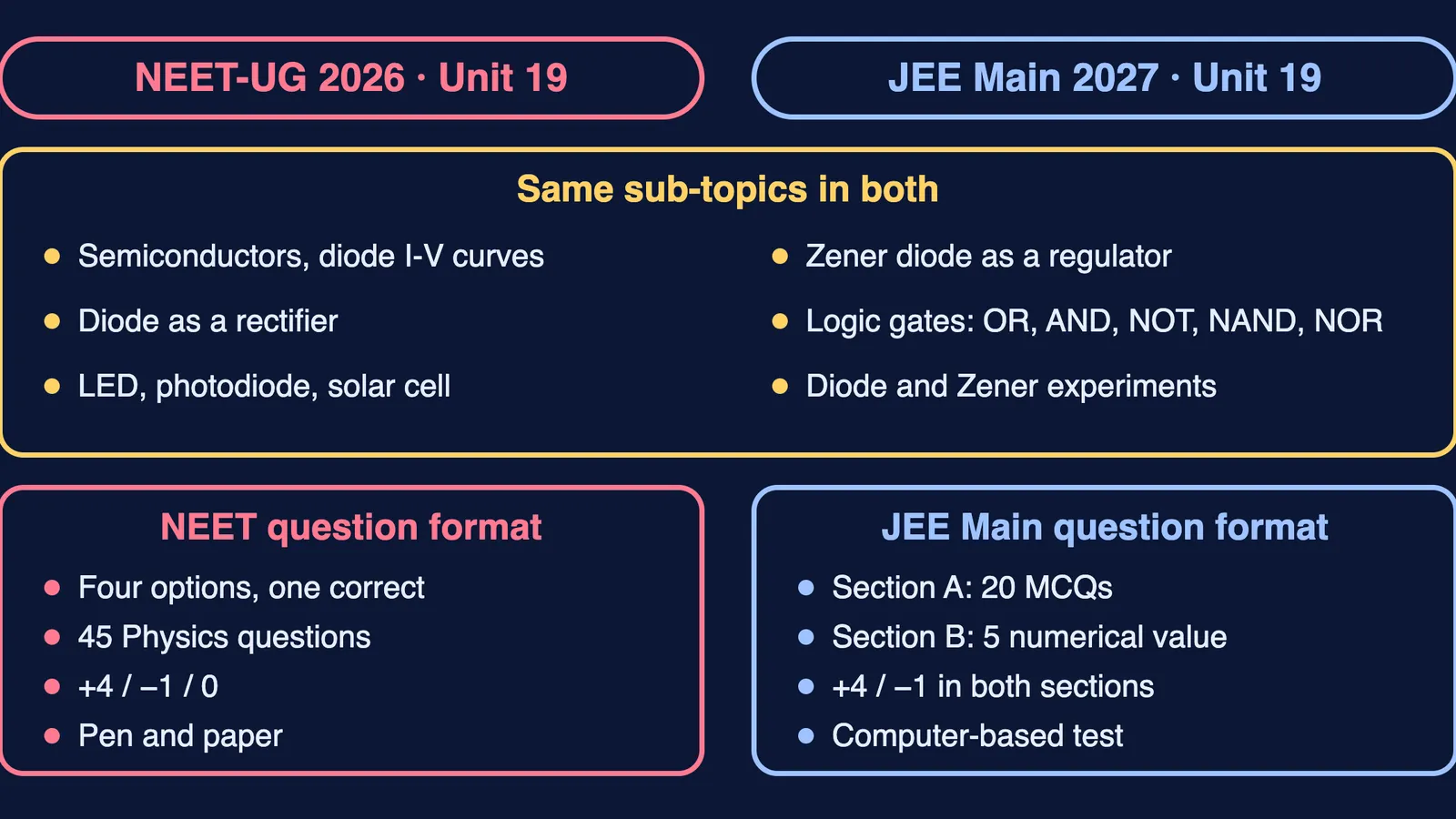
Yes. In the NTA Syllabus for JEE (Main) - 2027, Electronic Devices is Physics Unit 19. In the National Medical Commission's syllabus for NEET (UG)-2026, dated 22 December 2025, it is also Physics Unit 19.
Read side by side, every phrase of the unit appears in both:
"Semiconductors" and "semiconductor diode"
"I-V characteristics in forward and reverse bias"
"diode as a rectifier"
"I-V characteristics of LED", "the photodiode" and "solar cell"
"Zener diode as a voltage regulator"
"Logic gates (OR. AND. NOT. NAND and NOR)"
The wording differs only in small ways. JEE Main opens with "Semiconductors, semiconductor diode" where NEET has "Semiconductors; semiconductor diode", and NEET adds an "and" before "Zener diode". No sub-topic appears in one unit and not the other.
The Experimental Skills unit (Unit 20) matches too. Both list "Characteristic curves of a p-n junction diode" in both biases, the Zener characteristic curves with the reverse breakdown voltage (NEET spells it "break down"), and identifying a diode, LED, resistor and capacitor "from a mixed collection".
How are semiconductor questions asked in JEE Main and NEET?
The JEE (Main) 2027 Information Bulletin sets Paper 1 Physics at 20 questions in Section A and 5 in Section B, for 100 marks, in a computer-based test. Section A is multiple choice. In Section B you enter a numerical value, and the bulletin says it "should be rounded off to the nearest integer." Both sections carry +4 for a correct answer and -1 for a wrong one.
The NEET (UG)-2026 Information Bulletin sets 180 compulsory questions in 180 minutes, with 45 Physics questions worth 180 marks. Every question is a multiple-choice item "with four options and single correct answer/best option", marked +4, -1 or 0 if unanswered, on pen and paper.
So a NEET diode question always has four options. In JEE Main it may have none.
How does the question style differ?
Neither syllabus gives a chapter weightage. What you will notice in official past papers is a difference in tendency, not topics.
NEET leans on recall and single steps. Many items read like an NCERT statement turned into a choice: which bias widens the depletion region, which gate gives this truth table, which device works in reverse bias. Precise reading decides them.
JEE Main leans on circuits. A question tends to chain two or three ideas: decide which diode conducts, model it, then solve the network. Zener circuits with a load and multi-gate combinations are typical.
Numerical-value questions punish unit slips. With no options, an answer in amperes instead of milliamperes is simply wrong. Read the unit the question asks for before you type.
What does the same idea look like in each exam?
Here is one idea, the dynamic resistance of a diode, written both ways. The NCERT chapter on semiconductor electronics defines it as the ratio of a small change in voltage to a small change in current: rd = ΔV/ΔI. Both questions below are original and use an LED.
NEET style. A student plots the forward I-V curve of a red LED and notices that, above the knee, the curve gets steeper as the current rises. Which statement about the LED in this region is correct?
(A) Its dynamic resistance decreases as the current increases
(B) Its dynamic resistance increases as the current increases
(C) Its dynamic resistance equals V/I at every point
(D) Its dynamic resistance stays the same at all currents
Answer: (A). rd = ΔV/ΔI is the inverse of the slope of the I-V curve. A steeper curve means a larger ΔI for the same ΔV, so rd falls. (C) confuses dynamic resistance with static resistance V/I, and (D) would need a straight-line characteristic.
JEE Main style (numerical value). An LED's forward characteristic is a straight line from (1.90 V, 5 mA) to (2.10 V, 25 mA). Model the LED in this region as a fixed voltage in series with its dynamic resistance. It must carry 15 mA from a 5.0 V supply through a series resistor. Find the resistance in ohms.
Answer: 200. First the model: rd = 0.20/0.020 = 10 Ω, and the fixed voltage is 1.90 − 0.005 × 10 = 1.85 V. At 15 mA the LED voltage is 1.85 + 0.015 × 10 = 2.00 V, inside the 1.90 V to 2.10 V line. Then the circuit: R = (5.0 − 2.00)/0.015 = 200 Ω.
The extra steps are the point. Drop the 10 Ω and you get 210 Ω; use a flat 1.90 V and you get about 207 Ω. Both look plausible, and no options warn you.
How to prepare for both
Learn the unit once. The syllabus text is shared, so one set of notes on bands, doping, bias, rectifiers, the LED, photodiode, solar cell, Zener and gates serves both exams.
Draw every I-V curve from memory. Ordinary diode in both biases, LED, photodiode, solar cell and Zener.
For JEE Main, solve circuits in a fixed order. Decide which diodes conduct, choose a model (ideal, fixed drop, or drop plus rd), solve, then check your assumption.
For NEET, drill short statements. Write true/false lines on depletion width, majority carriers, rectifier output frequency and gate truth tables, and answer them fast.
Practise the experiments. Both syllabi list the diode and Zener characteristic curves, so know what is plotted, which bias is used and where breakdown appears.
Practise without options. Cover the options on some MCQs and write the answer in the unit asked, rounded to the nearest integer as the JEE Main bulletin says.
Stuck on a diode circuit that will not come out? The Fermi Problem Library has worked problems with a step-by-step solver that explains the reasoning rather than printing an answer.
For the full exam-specific plans, read how to prepare Electronic Devices for NEET and how to prepare semiconductors for JEE Main.