On this page
If you are preparing for JEE Main, NEET-UG or both, Properties of Solids and Liquids is one unit you can study once. The official syllabus text is the same for both exams. What changes is how a question reaches you: the format, the time you have for it, and how many steps it hides.
Is the Properties of Solids and Liquids syllabus the same for JEE Main and NEET?
Yes, line for line. Both documents call it Unit 7, "Properties of Solids and Liquids": the NTA Syllabus for JEE (Main) - 2027 and the NMC updated syllabus for NEET (UG)-2026. Read side by side, the four blocks match:
Elasticity: elastic behaviour, the stress-strain relationship, Hooke's law, and Young's, bulk and rigidity moduli.
Fluids: both list "Pressure due to a fluid column", Pascal's law, "effect of gravity on fluid pressure", viscosity, Stokes' law, terminal velocity, streamline and turbulent flow, critical velocity and Bernoulli's principle.
Surface tension: both list angle of contact, "excess of pressure across a curved surface", drops, bubbles and capillary rise.
Heat: both list thermal expansion, specific heat capacity, calorimetry, latent heat, and conduction, convection and radiation.
Only punctuation and capital letters differ. No sub-topic appears in one unit and not the other.
Unit 20, Experimental Skills, also matches, with four experiments from this unit: Young's modulus of a metallic wire, surface tension by capillary rise, viscosity from the terminal velocity of a sphere, and specific heat capacity by the method of mixtures.
Your textbook goes a little further than either unit. NCERT Class 11 Physics covers Poisson's ratio and elastic potential energy in Chapter 8, sections 8.5.4 and 8.5.5, and Newton's law of cooling in Chapter 10, section 10.10. Neither unit text names them, but they sit in the same NCERT chapters, so read them with the rest of the chapter.
How do the question formats differ?
The JEE (Main) 2027 Information Bulletin gives Paper 1 physics two sections: 20 multiple-choice questions in Section A and 5 numerical-value questions in Section B. For Section B you type the answer on an on-screen keypad, "rounded off to the nearest integer". Both sections carry +4 for a correct answer and −1 for a wrong one, and the paper is computer-based.
The NEET (UG)-2026 Information Bulletin gives physics 45 questions, all MCQs "with four options and single correct answer/best option". The whole paper is 180 questions in 180 minutes, with +4 for a correct answer and −1 for a wrong one.
So NEET physics has no numerical-value section, and in JEE Main Section B there are no options to check your result against.
How does the style differ in practice?
These are tendencies you will notice in official past papers, not rules.
NEET questions in this unit tend to be one idea, one or two lines of working, and close to an NCERT statement or formula. Speed and exact recall tend to decide them.
JEE Main questions more often join two ideas, such as pressure with volume conservation, or Stokes' law with buoyancy. They often hide a geometry or unit step too.
Both reward knowing which quantity scales with what: r² for terminal velocity, 1/r for capillary rise, piston area for the force in a hydraulic lift.
What does the same idea look like in each exam?
Here is one idea, pressure at equal levels in a U-tube (NCERT Chapter 9, section 9.2), written once in each style. Both questions are original; the answers were checked in Python. Take ρ(water) = 1000 kg/m³.
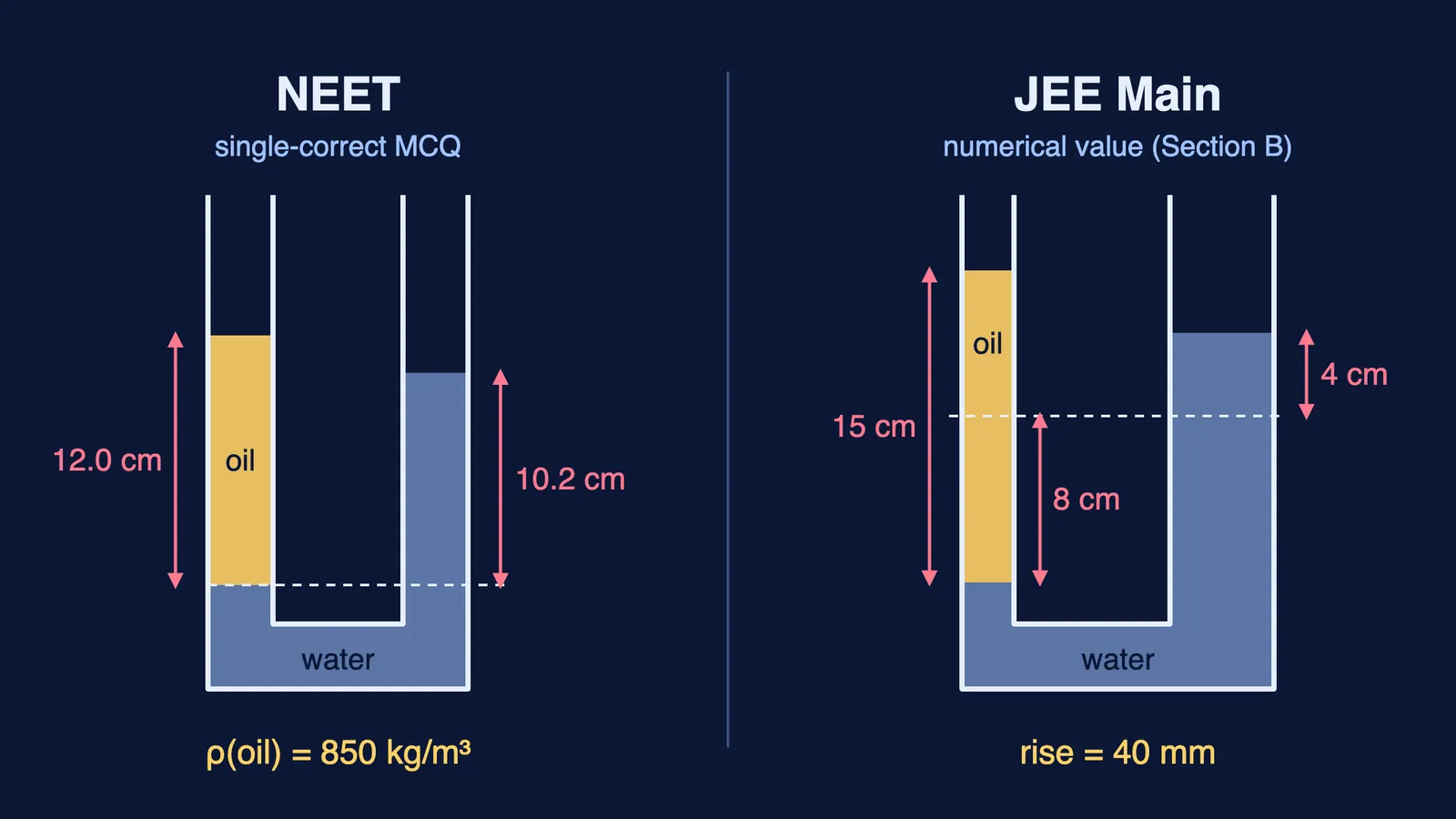
NEET style. A U-tube with arms of equal width holds water. Oil is poured into the left arm until the oil column is 12.0 cm tall. The water in the right arm then stands 10.2 cm above the oil-water boundary. What is the density of the oil?
(A) 150 kg/m³ (B) 850 kg/m³ (C) 1000 kg/m³ (D) 1176 kg/m³
Answer: (B). Pressure is equal at the level of the boundary in both arms, so ρ(oil) × 12.0 = 1000 × 10.2, giving 850 kg/m³. Option (D) comes from flipping the ratio. Oil is lighter than water, so it must be below 1000.
JEE Main style (numerical value). A U-tube has a left arm of cross-section 1.0 cm² and a right arm of 2.0 cm², and holds water level in both. You pour 15.0 cm of oil (density 800 kg/m³) into the left arm. By how many millimetres does the water in the right arm rise?
Answer: 40. Let the boundary in the left arm drop by x and the right-arm water rise by y.
Volume: the water that leaves the left arm enters the right one, so 1.0 × x = 2.0 × y, and y = x/2.
Pressure at the boundary level: 800 × 15.0 = 1000 × (x + y), so x + y = 12.0 cm.
Solve: 1.5x = 12.0, so x = 8.0 cm and y = 4.0 cm, or 40 mm.
How to prepare for both
Learn the unit once from NCERT Chapters 8, 9 and 10. One set of notes serves both exams. Use the Properties of Solids and Liquids for NEET preparation guide and the Properties of Solids and Liquids for JEE Main preparation guide for exam-specific plans.
Make a scaling card. For each formula, note what the answer grows with: L/r² for wire extension, r² for terminal velocity, 1/r for capillary rise. A wrong scaling is the quickest route to a wrong option.
For JEE Main, finish every fluid question with a sketch. Mark what moves, what is conserved (volume, mass flow, heat) and where pressures are equal, before you write an equation.
Practise answers without options. Cover the choices on MCQs and work to a number first, then round to an integer as Section B requires.
Fix the usual slips by topic. Work through the elasticity mistakes in JEE and NEET, then list your own slips in fluids, surface tension and heat, and note which ones you repeat.
Stuck on the second step of a multi-step numerical like the U-tube above? The Fermi Problem Library has worked problems with a step-by-step solver that explains the reasoning rather than printing an answer.