On this page
Many kinetic theory questions in JEE Main and NEET-UG take only a few lines of algebra, so one small slip can decide the answer. Here are eight common ones, each with the wrong working, the physics, an original example and a habit that stops it.
Both exams list this as Unit 9, Kinetic Theory of Gases: the NMC NEET (UG)-2026 syllabus and the current NTA Syllabus for JEE (Main) name the same topics, from the ideal gas equation and rms speed to equipartition, specific heats and mean free path. The formulas below follow NCERT Class 11 Physics, Chapter 12, Kinetic Theory (Reprint 2026-27).
Why do kelvin and unit slips give wrong answers in kinetic theory?
NCERT's ideal gas equation and every result built on it use absolute temperature, with R = 8.314 J mol⁻¹ K⁻¹ (NCERT Chapter 12).
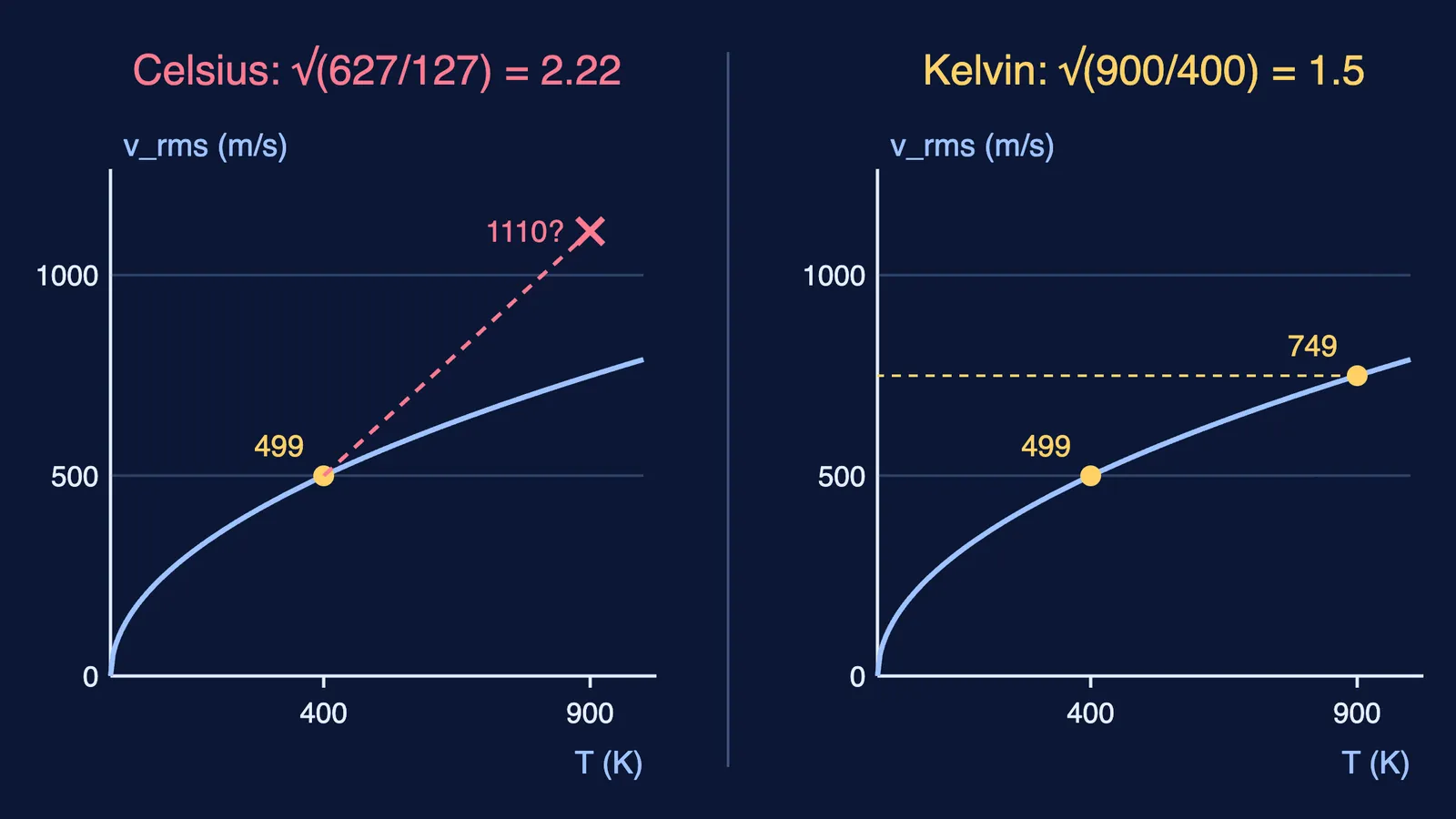
Taking a ratio of temperatures in Celsius.
Wrong: argon is heated from 127 °C to 627 °C, so v_rms rises by √(627/127) ≈ 2.22.
Why it fails: v_rms = √(3RT/M) is proportional to √T only when T is absolute. Zero on the Celsius scale is not zero molecular motion.
Fix: 127 °C = 400 K and 627 °C = 900 K, so the ratio is √(900/400) = 1.5. With M = 0.040 kg/mol, v_rms goes from about 499 m/s to 749 m/s. The wrong ratio predicts about 1110 m/s.
Habit: convert to kelvin on the first line, before you write any ratio.
Putting molar mass in g/mol into √(3RT/M).
Wrong: helium at 250 K, v_rms = √(3 × 8.314 × 250 / 4) ≈ 39.5 m/s.
Why it fails: R is in joules, so M must be in kg/mol for the answer to come out in m/s.
Fix: M = 0.004 kg/mol gives v_rms = √(3 × 8.314 × 250 / 0.004) ≈ 1249 m/s. The wrong answer is √1000, about 31.6 times, too small.
Habit: write "kg/mol" beside M every time you substitute it.
Which energy formula does the question actually want?
NCERT gives the average translational kinetic energy of a molecule as (3/2)k_BT for any ideal gas, and its equipartition law gives ½k_BT to each quadratic energy term, so a vibrational mode carries k_BT (NCERT Chapter 12, Sections 12.4 to 12.6 and Points to Ponder).
Using (3/2)RT per mole when the question asks for total internal energy.
Wrong: internal energy of 0.5 mol of oxygen at 320 K = 0.5 × (3/2) × 8.314 × 320 ≈ 1995 J.
Why it fails: (3/2) covers translation only. A rigid diatomic molecule also rotates about two axes, so f = 5.
Fix: U = 0.5 × (5/2) × 8.314 × 320 ≈ 3326 J. If the question says "translational" kinetic energy, 1995 J is right, so read that word.
Habit: underline "translational", "rotational" or "total" before choosing f.
Giving a vibrational mode only ½k_BT.
Wrong: a diatomic gas that also vibrates has f = 3 + 2 + 1 = 6, so U = 3RT per mole.
Why it fails: a vibration has both kinetic and potential energy, two squared terms, so it carries k_BT.
Fix: U = (3/2 + 1 + 1)RT = (7/2)RT per mole. At 1000 K that is about 29.1 kJ per mole, not 24.9 kJ, and C_v = (7/2)R ≈ 29.1 J mol⁻¹ K⁻¹.
Habit: count each vibrational mode as two.
Averaging γ by moles for a gas mixture.
Wrong: 2 mol helium and 3 mol nitrogen, so γ = (2 × 5/3 + 3 × 7/5)/5 ≈ 1.507.
Why it fails: energies add, and γ is a ratio of heat capacities. A mole-weighted average of ratios is not the ratio of the totals.
Fix: C_v = (2 × 3/2 + 3 × 5/2)R / 5 = 2.1R, so C_p = 3.1R and γ = 31/21 ≈ 1.476.
Habit: average C_v first, then add R, then divide.
Where do speed and pressure calculations go wrong?
NCERT derives P = (1/3)nm⟨v²⟩ and notes that ⟨v²⟩ is not always equal to (⟨v⟩)² (NCERT Chapter 12).
Squaring the average speed to get the rms speed.
Wrong: four molecules move at 100, 300, 500 and 700 m/s, so v_rms = average = 400 m/s.
Why it fails: rms means square, then average, then take the root.
Fix: ⟨v²⟩ = (1 + 9 + 25 + 49) × 10⁴ / 4 = 2.1 × 10⁵ m²/s², so v_rms ≈ 458 m/s, higher than the mean speed.
Habit: say "root of the mean of the squares" as you write the steps.
Treating gas pressure as ½ρv², like kinetic energy per volume.
Wrong: a gas of density 0.80 kg/m³ with v_rms = 600 m/s has P = ½ × 0.80 × 600² = 144 kPa.
Why it fails: only one of the three velocity components pushes on a given wall, which is where the 1/3 comes from. ½ρv² is the kinetic energy per unit volume, which is (3/2)P.
Fix: P = (1/3)ρv_rms² = (1/3) × 0.80 × 360000 = 96 kPa.
Habit: remember PV = (2/3)E, so pressure is two-thirds of the kinetic energy per volume.
What trips students up on mean free path?
NCERT gives the mean free path as l = 1/(√2 nπd²), with d the molecular diameter (NCERT Section 12.7).
Putting the molecular radius in place of d.
Wrong: molecules of radius 1.5 × 10⁻¹⁰ m at n = 2.5 × 10²⁵ m⁻³ give l = 1/(√2 × 2.5 × 10²⁵ × π × (1.5 × 10⁻¹⁰)²) ≈ 4.0 × 10⁻⁷ m.
Why it fails: two molecules collide when their centres come within one diameter, so the collision area uses d, not r.
Fix: d = 3.0 × 10⁻¹⁰ m gives l ≈ 1.0 × 10⁻⁷ m, four times shorter.
Habit: if the question says "radius", double it before squaring.
What should you check in the last 60 seconds?
Stuck on why your answer is off by a factor? The Fermi Problem Library has worked problems with a step-by-step solver that explains the reasoning rather than printing an answer.
For a full study plan, read how to prepare Kinetic Theory of Gases for NEET or how to prepare Kinetic Theory of Gases for JEE Main, and keep the kinetic theory formulas with worked examples beside you while you practise.