On this page
Kinetic Theory is Chapter 12 of the NCERT Class 11 Physics Part 2 textbook (Reprint 2026-27). The CBSE Physics syllabus for 2026-27 sets its scope, from the perfect gas equation to mean free path. This sheet follows that list in NCERT's notation, with SI units. For the theory, see our Kinetic Theory Class 11 chapter guide.
Constants (NCERT values): R = 8.314 J mol⁻¹ K⁻¹, kB = R/NA = 1.38 × 10⁻²³ J K⁻¹, NA = 6.02 × 10²³ mol⁻¹. T is in kelvin (K).
What are the ideal gas equation and gas law formulas?
Ideal gas equation: PV = µRT = NkBT, with P in Pa, V in m³, µ = number of moles (mol), N = number of molecules (a pure number). Real gases obey it best at low pressure and high temperature.
Number of moles: µ = M/M₀ = N/NA, with M = mass of the sample (kg) and M₀ = molar mass (kg mol⁻¹).
Density form: P = ρRT/M₀, with ρ = density (kg m⁻³).
Boyle's law (µ and T fixed): PV = constant, in Pa m³ (= J).
Charles' law (µ and P fixed): V₁/T₁ = V₂/T₂, V in m³, T in K.
Dalton's law of partial pressures (ideal gas mixture): P = P₁ + P₂ + …, with Pᵢ = µᵢRT/V in Pa.
Worked example: 0.50 mol of gas at 27 °C (300 K) in a 10.0 L (0.010 m³) flask: P = (0.50 × 8.314 × 300)/(0.010) ≈ 1.25 × 10⁵ Pa.
Watch for: litres left as litres (1 L = 10⁻³ m³) and °C not converted to K.
How do you find the work done in compressing a gas?
Work done by the gas: W = ∫P dV from V₁ to V₂, in J; negative for compression.
Isothermal, quasi-static compression of an ideal gas: work done on the gas W_on = µRT ln(V₁/V₂), in J, from V₁ to a smaller V₂. NCERT derives this isothermal result in Chapter 11, Thermodynamics.
Worked example: 0.20 mol at 300 K is compressed slowly and isothermally from 4.0 L to 1.0 L. W_on = 0.20 × 8.314 × 300 × ln 4 ≈ 692 J.
Watch for: the sign. Work done by the gas here is −692 J; check which one the question wants.
How does kinetic theory explain pressure and temperature?
Assumptions: point-like molecules in random motion, elastic collisions, no forces between collisions.
Pressure: P = (1/3) n m ⟨v²⟩, in Pa, with n = N/V = number density (m⁻³), m = mass of one molecule (kg), ⟨v²⟩ = mean of squared speed (m² s⁻²).
Energy form: PV = (2/3)E, where E = N × (1/2)m⟨v²⟩ is total translational kinetic energy (J).
Kinetic meaning of temperature: average translational kinetic energy per molecule (1/2)m⟨v²⟩ = (3/2)kBT, in J. It is the same for every gas.
rms speed: v_rms = √⟨v²⟩ = √(3kBT/m) = √(3RT/M₀), in m s⁻¹, with M₀ in kg mol⁻¹.
Two gases at one T: (v_rms)₁/(v_rms)₂ = √(M₀₂/M₀₁).
Worked example: oxygen (M₀ = 0.032 kg mol⁻¹) at 400 K. v_rms = √(3 × 8.314 × 400/0.032) ≈ 558 m s⁻¹. Average kinetic energy per molecule = 1.5 × 1.38 × 10⁻²³ × 400 ≈ 8.28 × 10⁻²¹ J. Hydrogen (0.002 kg mol⁻¹) at 400 K has a v_rms 4 times larger, since √(0.032/0.002) = 4.
Watch for: M₀ in g mol⁻¹. Using 32 for 0.032 makes v_rms about 31.6 times too small. And ⟨v²⟩ ≠ (⟨v⟩)².
What are the equipartition and specific heat formulas?
Equipartition (statement only): at equilibrium, each translational or rotational degree of freedom has average energy (1/2)kBT (J); each vibrational mode has kBT (kinetic plus potential).
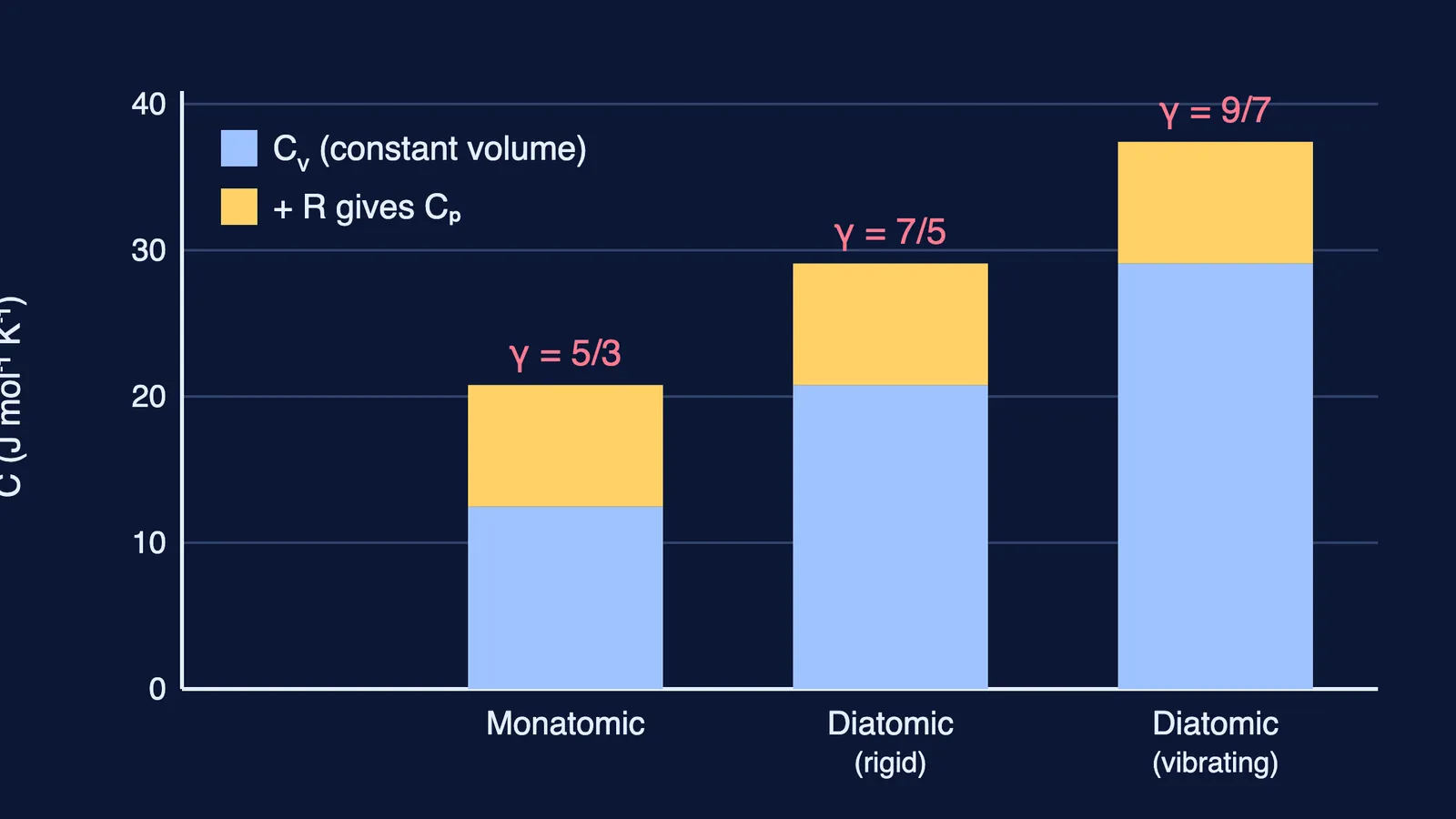
For any ideal gas: Cp − Cv = R, with molar specific heats Cp and Cv in J mol⁻¹ K⁻¹. γ = Cp/Cv (no unit).
Monatomic (3 translational): U = (3/2)RT per mole (J mol⁻¹), Cv = (3/2)R, Cp = (5/2)R, γ = 5/3.
Rigid diatomic (3 translational + 2 rotational): U = (5/2)RT, Cv = (5/2)R, Cp = (7/2)R, γ = 7/5.
Diatomic with one vibrational mode: U = (7/2)RT, Cv = (7/2)R, Cp = (9/2)R, γ = 9/7.
Polyatomic (3 translational + 3 rotational + f vibrational modes): Cv = (3 + f)R, Cp = (4 + f)R, in J mol⁻¹ K⁻¹, γ = (4 + f)/(3 + f).
Heat: Q = µCvΔT (constant volume) or µCpΔT (constant pressure), in J, ΔT in K.
Worked example: 3.0 mol of a rigid diatomic gas is heated by 20 K. At constant pressure, Q = 3.0 × 3.5 × 8.314 × 20 ≈ 1746 J. At constant volume, Q = 3.0 × 2.5 × 8.314 × 20 ≈ 1247 J. The extra 499 J goes into expansion work.
Watch for: counting a vibrational mode as (1/2)kBT; it adds a full kBT.
What is the mean free path formula?
Mean free path (average distance between collisions): l = 1/(√2 n π d²), in m, with n = number density (m⁻³) and d = molecular diameter (m).
Number density from the gas equation: n = P/(kBT), in m⁻³.
Worked example: a gas at 300 K and 1.01 × 10⁵ Pa with d = 3.0 × 10⁻¹⁰ m. n = 1.01 × 10⁵/(1.38 × 10⁻²³ × 300) ≈ 2.44 × 10²⁵ m⁻³, so l = 1/(√2 n π d²) ≈ 1.0 × 10⁻⁷ m, about 340 diameters.
Watch for: moles per m³ in place of n, or d left in ångström (1 Å = 10⁻¹⁰ m).
How to revise this formula sheet
Derive the chain P = (1/3)nm⟨v²⟩ → PV = (2/3)E → (1/2)m⟨v²⟩ = (3/2)kBT → v_rms. Our step-by-step kinetic theory derivations cover each step.
Write units beside every number, especially kg mol⁻¹ for M₀ and m³ for V.
Rebuild the U, Cv, Cp, γ card for the three gas types from memory until it is quick.
Sanity-check sizes: NCERT notes v_rms is of the order of the speed of sound.
Practise with the kinetic theory case study questions for Class 11.
If an idea here is hard to picture, the Fermi Simulation Lab has interactive simulations for ideas that are easier to see than to read.