On this page
Chapter 12 of the rationalised NCERT Class 11 Physics textbook (Part 2), Kinetic Theory, starts from one picture, molecules bouncing elastically off the walls of a box, and builds five results from it and from equipartition. Here is each derivation, step by step. The CBSE Physics syllabus for 2026-27 lists equipartition of energy as "statement only", so we use it without proof. For the chapter overview and question types, see our Kinetic Theory Class 11 physics guide.
Pressure of an ideal gas: where does P = (1/3) n m ⟨v²⟩ come from?
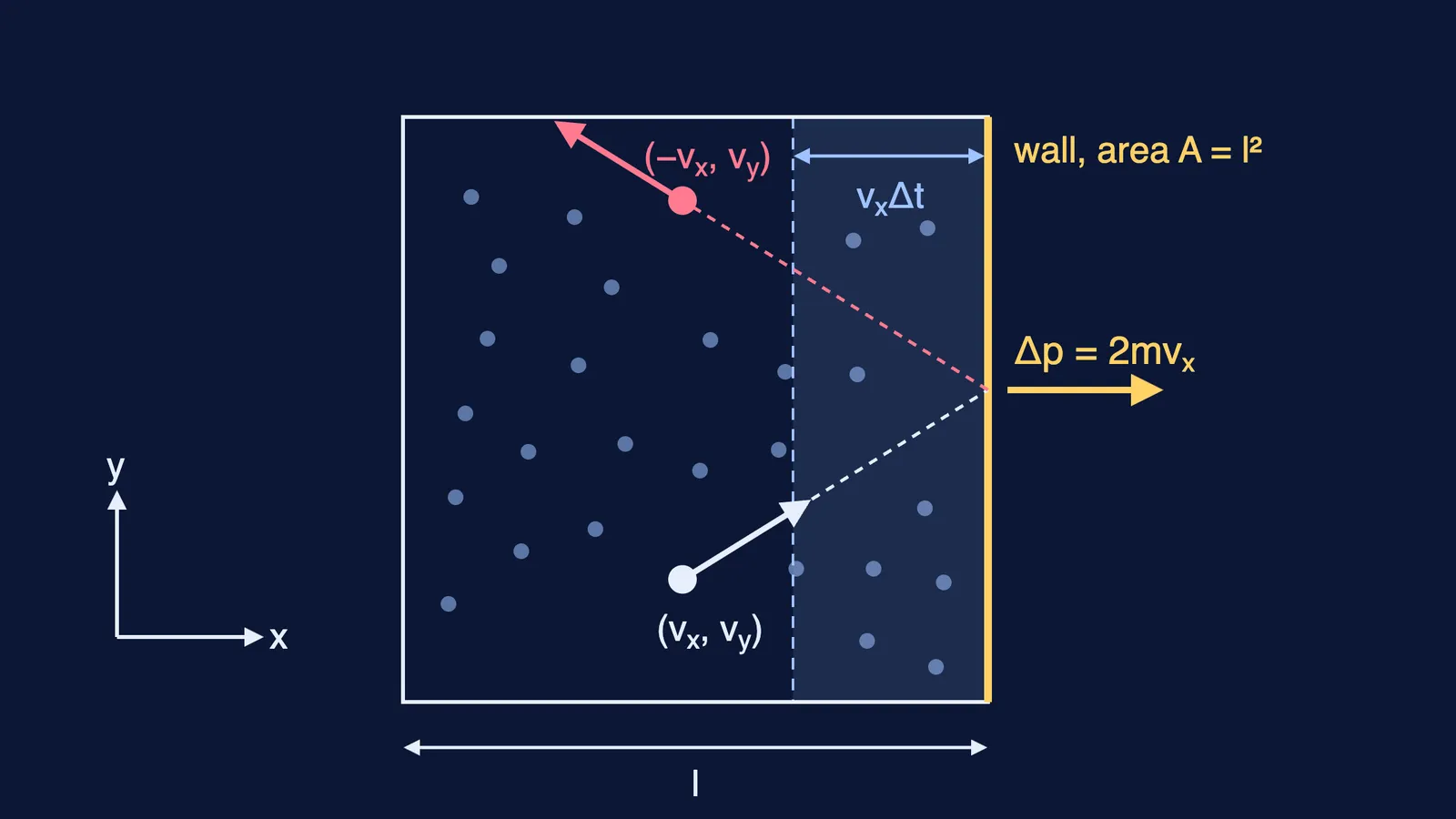
Setup: gas in a cube of side l; a molecule of mass m, velocity (vx, vy, vz), hits the wall of area A = l² normal to the x-axis. Collisions are elastic.
The collision reverses vx only, so the molecule's momentum changes by −2m·vx and the wall receives +2m·vx.
In a short time Δt, only molecules within a distance vx·Δt of the wall can reach it: a slab of volume A·vx·Δt.
With n molecules per unit volume, the slab holds n·A·vx·Δt molecules; half move towards the wall: (1/2)·n·A·vx·Δt hits.
Momentum delivered in Δt: Q = (2m·vx) × (1/2)·n·A·vx·Δt = n·m·A·vx²·Δt.
Pressure is force per area, force is momentum per time: P = Q/(A·Δt) = n·m·vx².
Molecules have a spread of speeds, so replace vx² by its average ⟨vx²⟩.
No direction is special, so ⟨vx²⟩ = ⟨vy²⟩ = ⟨vz²⟩ = (1/3)⟨v²⟩, where ⟨v²⟩ is the mean of the squared speed.
Result: P = (1/3) n m ⟨v²⟩. A and Δt cancel, so box shape does not matter.
Watch for: writing the momentum change as m·vx instead of 2m·vx, or forgetting the factor 1/2 for molecules moving away from the wall.
Kinetic interpretation of temperature: average KE = (3/2) kB T
Setup: the pressure result above, plus the ideal gas equation written per molecule, PV = N·kB·T (N molecules, Boltzmann constant kB).
Multiply the pressure result by V and use N = nV: PV = (1/3) N m ⟨v²⟩.
Rewrite as PV = (2/3) N × (1/2) m ⟨v²⟩. The bracket is the average translational kinetic energy of one molecule.
Call the total translational kinetic energy E = N × (1/2) m ⟨v²⟩, so PV = (2/3) E.
Set (2/3) E equal to N·kB·T: E = (3/2) N kB T, and divide by N.
Result: average kinetic energy per molecule = (1/2) m ⟨v²⟩ = (3/2) kB T. It depends only on temperature, not on pressure, volume or which gas it is.
Watch for: calling E the total internal energy. Here E is only the translational part; rotation and vibration add more for diatomic and polyatomic gases.
RMS speed of gas molecules: vrms = √(3kBT/m) = √(3RT/M)
Setup: the temperature result, for molecules of mass m; M is the molar mass in kg/mol.
Start from (1/2) m ⟨v²⟩ = (3/2) kB T.
Solve: ⟨v²⟩ = 3kBT/m.
Define vrms as the square root of the mean squared speed: vrms = √(3kBT/m).
With Avogadro's number NA, m·NA = M and kB·NA = R.
Result: vrms = √(3kBT/m) = √(3RT/M). Lower molar mass means a higher vrms at the same T.
Watch for: putting M in g/mol. For nitrogen at 300 K the NCERT chapter gets about 516 m/s with M = 0.028 kg/mol; using 28 makes the answer about 32 times too small.
Specific heats from equipartition: Cv, Cp and γ
Setup: one mole of ideal gas; by equipartition, each translational or rotational degree of freedom carries (1/2)kBT per molecule and each vibrational mode kBT. Use Cv = dU/dT and Cp − Cv = R.
Monatomic gas: 3 translational degrees of freedom, so U = (3/2) kBT × NA = (3/2) RT.
Differentiate: Cv = (3/2) R; then Cp = (5/2) R and γ = Cp/Cv = 5/3.
Rigid diatomic gas (a dumbbell): 3 translational + 2 rotational, so U = (5/2) RT, Cv = (5/2) R, Cp = (7/2) R, γ = 7/5.
Diatomic with one vibrational mode: add RT, so U = (7/2) RT, Cv = (7/2) R, Cp = (9/2) R, γ = 9/7.
Polyatomic, 3 translational + 3 rotational + f vibrational modes: Cv = (3 + f) R, Cp = (4 + f) R.
Result: γ = 5/3 (monatomic), 7/5 (rigid diatomic), (4 + f)/(3 + f) (polyatomic). Cp − Cv = R for every ideal gas.
Watch for: counting a vibrational mode as (1/2)kBT. It has kinetic and potential energy, so it contributes kBT.
Mean free path: l = 1/(√2 n π d²)
Setup: molecules are spheres of diameter d, n per unit volume; follow one molecule at average speed ⟨v⟩, others held still at first.
It hits any molecule whose centre comes within d of its own centre, so it sweeps a cylinder of cross-section πd².
In time Δt that cylinder has volume πd²⟨v⟩Δt and contains nπd²⟨v⟩Δt molecules: that many collisions.
Time between collisions: τ = 1/(nπ⟨v⟩d²).
Distance between collisions: l = ⟨v⟩τ = 1/(nπd²).
The other molecules also move; using their relative speed gives an extra factor √2 in the denominator.
Result: l = 1/(√2 n π d²). The mean free path falls as the gas gets denser or the molecules get bigger.
Watch for: using (π/4)d² for the target area. Centres touch at separation d, so the collision radius is d, not d/2.
How should you practise these derivations?
Draw the cube, the wall and the slab of width vx·Δt before writing a line.
Write the chain (pressure, PV = (2/3)E, (3/2)kBT, vrms) on one page and redo it from memory until it flows.
Check units at the end of every result: n·m·⟨v²⟩ should come out in pascals, and l in metres.
For specific heats, list degrees of freedom by molecule type and work out Cv, Cp and γ each time instead of memorising them.
Test yourself with the kinetic theory case study questions for Class 11, then the assertion-reason set.
If the bouncing-molecule picture feels abstract, the Fermi Simulation Lab has interactive simulations for ideas that are easier to see than to read.