On this page
Kinetic Theory is Chapter 12 of the CBSE Class XI Physics syllabus for 2026-27, covering gas laws, rms speed, equipartition, specific heats and mean free path. Every statement below was checked against NCERT Class 11 Physics, Chapter 12 Kinetic Theory (Reprint 2026-27). Treat these as practice items, not a model of any exam paper.
How do you answer assertion-reason questions?
Judge each line true or false on its own. Only if both are true, ask: is R the direct reason for A?
Use these keys for Q1 to Q6:
(A) Both A and R are true and R is the correct explanation of A.
(B) Both A and R are true but R is NOT the correct explanation of A.
(C) A is true but R is false.
(D) A is false but R is true.
More on the method: assertion-reason question strategy.
Assertion-reason questions on kinetic theory
Q1 (easy). Assertion (A): At 300 K, a helium atom and a nitrogen molecule have the same average translational kinetic energy. Reason (R): The average translational kinetic energy of a molecule of an ideal gas depends only on its absolute temperature.
Answer: (A). Both are true and R explains A. NCERT gives this energy as (3/2)kBT for any ideal gas.
Trap: assuming heavier means more energy.
Q2 (easy). Assertion (A): A real gas obeys PV = µRT more closely at low pressure and high temperature. Reason (R): At low pressure, the molecules themselves fill a larger fraction of the container's volume.
Answer: (C). A is true. R is false: at low pressure the molecules are far apart, so their own volume is a smaller fraction and their interactions are negligible.
Trap: reading low pressure as crowded.
Q3 (medium). Assertion (A): For one mole of an ideal gas, Cp − Cv = R holds for helium and for oxygen alike. Reason (R): A rigid oxygen molecule has five degrees of freedom while a helium atom has three.
Answer: (B). Both are true, but R does not explain A. Cp − Cv = R holds for any ideal gas because heating at constant pressure also does work PΔV = RΔT per mole. Degrees of freedom set Cv, not the gap.
Trap: accepting a true, related fact as the cause.
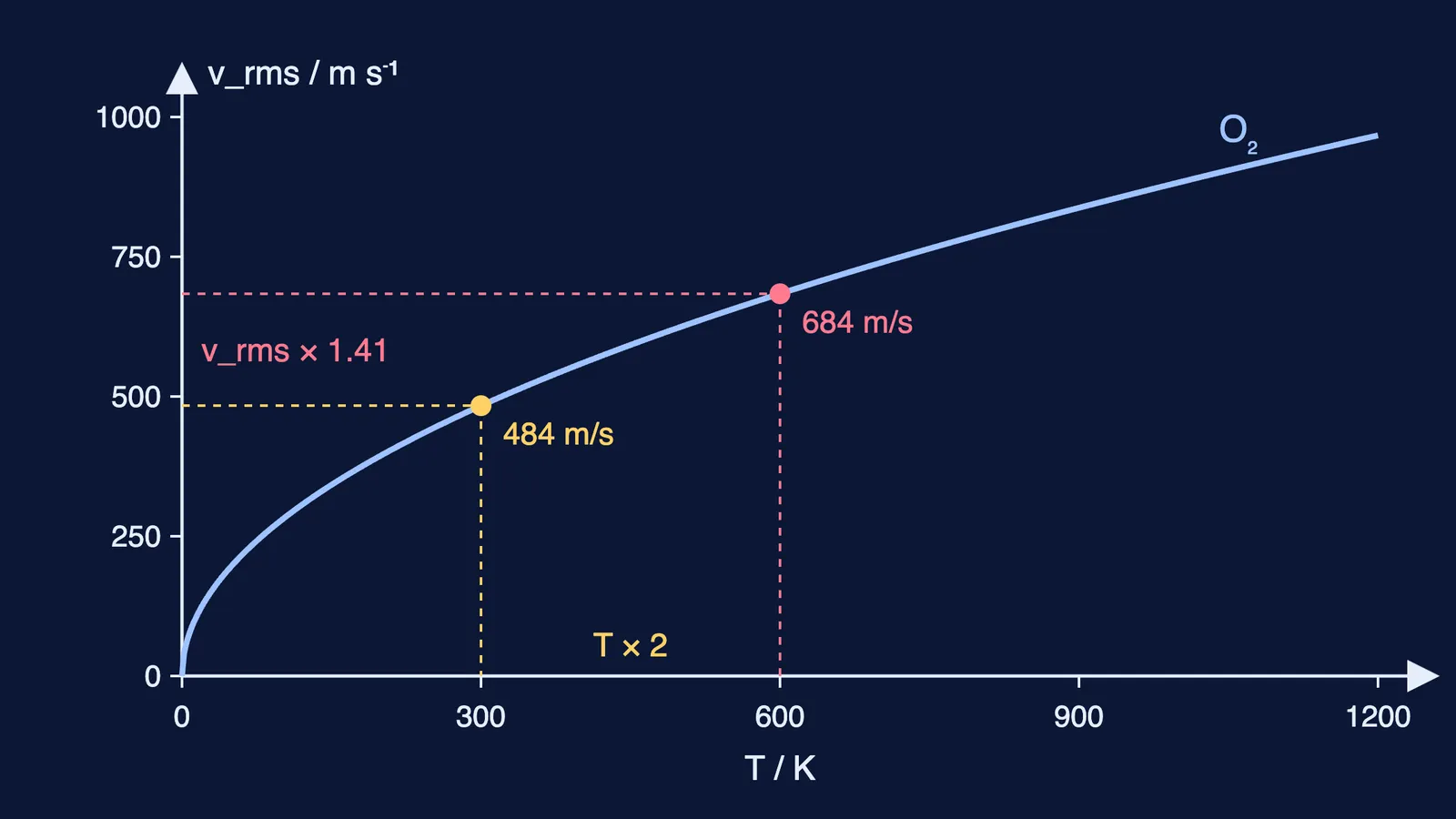
Q4 (medium). Assertion (A): Doubling the absolute temperature of a gas doubles the rms speed of its molecules. Reason (R): The mean of the squared speed of the molecules is proportional to the absolute temperature.
Answer: (D). A is false: vrms = √(3kBT/m), so doubling T multiplies vrms by √2, about 1.41 (oxygen: 484 m/s at 300 K, 684 m/s at 600 K). R is true.
Trap: forgetting the square root.
Q5 (medium). Assertion (A): Pumping more gas into a rigid cylinder at constant temperature shortens the mean free path. Reason (R): The mean free path is inversely proportional to the number density of molecules.
Answer: (A). Both are true and R explains A: l = 1/(√2 nπd²), so raising n shortens l.
Trap: thinking only temperature changes l.
Q6 (hard). Assertion (A): The pressure of an ideal hydrogen-nitrogen mixture equals the sum of the pressures each gas would exert alone in the same vessel at the same temperature. Reason (R): At the same temperature, hydrogen and nitrogen molecules have the same rms speed.
Answer: (C). A is Dalton's law of partial pressures, true. R is false: the gases share the same average kinetic energy, so the lighter hydrogen moves faster (about 1930 m/s against 520 m/s at 300 K).
Trap: equal energy is not equal speed.
Statement I and Statement II questions
Use these keys for Q7 to Q10:
(A) Both statements are correct.
(B) Both statements are incorrect.
(C) Statement I is correct, Statement II is incorrect.
(D) Statement I is incorrect, Statement II is correct.
Q7 (medium). Statement I: Each vibrational mode of a molecule contributes kBT, not ½kBT, to its average energy. Statement II: By equipartition, each translational degree of freedom carries an average energy of kBT.
Answer: (C). Statement I is correct: a vibrational mode has kinetic and potential terms, each worth ½kBT. Statement II is wrong: translation carries ½kBT per degree of freedom.
Trap: giving every mode the same share.
Q8 (medium). Statement I: The kinetic-theory pressure of an ideal gas does not depend on the container's shape. Statement II: The internal energy of a fixed amount of ideal gas depends only on its temperature, not on its pressure or volume.
Answer: (A). Both are correct. NCERT notes the cube in the derivation is only a convenience. And U = (3/2)µRT for a monatomic gas has no P or V in it.
Trap: thinking isothermal compression raises internal energy.
Q9 (hard). Statement I: The rms speed of oxygen molecules (M = 32 g/mol) at 27 °C is about 300 m/s. Statement II: The mean free path of air molecules at STP is about equal to the average spacing between them.
Answer: (B). Both are wrong. √(3 × 8.314 × 300/0.032) ≈ 484 m/s. NCERT estimates the mean free path of air at STP as about 2.9 × 10⁻⁷ m, roughly 1500 molecular diameters, about a hundred times the few-nanometre spacing.
Trap: using 27 for T, or M in grams.
Q10 (hard). Statement I: Raising the temperature of 3 mol of argon in a sealed steel tank by 20 K needs about 1247 J of heat. Statement II: A gas of rigid non-linear triatomic molecules has γ = Cp/Cv = 4/3.
Answer: (D). Statement I is wrong: the volume is fixed, so Q = 3 × 1.5 × 8.314 × 20 ≈ 748 J; 1247 J is the constant-pressure figure. Statement II is correct: three translational and three rotational degrees of freedom give Cv = 3R, Cp = 4R.
Trap: using Cp for a rigid container.
How should you use this set?
Attempt all ten without notes, marking each line T or F first.
For every miss, write what you misjudged: A, R, or the link.
Redo the misses after three days, then try our kinetic theory JEE Main practice questions.
If molecular motion still feels abstract, the Fermi Simulation Lab has interactive simulations for the ideas that are easier to see than to read. For marks and the derivation, read Kinetic Theory Class 11 physics: CBSE marks, derivation, questions.