On this page
Capacitor questions in JEE Main and NEET-UG look short, but many of them hide one decision: what stays fixed when something changes. Below are eight slips, each with the wrong working, the physics, a fix on fresh numbers and a habit. Field-versus-potential and sign errors belong to electrostatics in general, so we leave those out and stay with capacitors and dielectrics.
Everything here sits inside the capacitor topics listed in the NMC NEET (UG) 2026 syllabus and the NTA JEE (Main) physics syllabus: capacitance, series and parallel combinations, the parallel plate capacitor with and without a dielectric, and stored energy. Formulas follow Chapter 2 of NCERT Class 12 Physics Part I, with ε₀ = 8.85 × 10⁻¹² F/m.
Battery connected or disconnected: what stays fixed?
Keeping V fixed after the battery is removed.
Wrong: a 4 µF capacitor charged to 50 V is disconnected, then a slab with K = 2.5 fills the gap. "C becomes 10 µF, so U = ½ × 10 µF × (50 V)² = 12.5 mJ."
Why it fails: once the battery is gone, no charge can enter or leave the plates. Q is fixed; V is free to change.
Fix: Q = 4 µF × 50 V = 200 µC. New C = 10 µF, so V = 200 µC / 10 µF = 20 V. Energy falls from 5.0 mJ to U = Q²/2C = 2.0 mJ.
Habit: write "battery on: V fixed" or "battery off: Q fixed" before any formula.
Keeping Q fixed while the battery stays on.
Wrong: a 6 µF capacitor stays on a 12 V battery while the plate gap is doubled. "Q stays 72 µC, so V = 24 V and U = 864 µJ."
Why it fails: the battery holds V at 12 V, so charge flows back to the battery as C drops.
Fix: C = 3 µF, Q = 36 µC, U = ½CV² = 216 µJ, half the original 432 µJ.
Habit: pick the energy form whose variable is fixed: ½CV² with the battery on, Q²/2C with it off.
Why don't capacitors combine like resistors?
Adding series capacitors directly.
Wrong: 4 µF and 12 µF in series across 16 V give 16 µF, with 8 V on each.
Why it fails: NCERT shows that in series each capacitor carries the same charge, so the reciprocals add: 1/C = 1/C₁ + 1/C₂ (NCERT, Section 2.14). Capacitors in parallel add directly, the reverse of resistors.
Fix: C = 3 µF, Q = 48 µC. The 4 µF capacitor takes 12 V and the 12 µF takes 4 V: the smaller capacitor takes the larger voltage.
Habit: in series, find the common Q first, then V = Q/C for each.
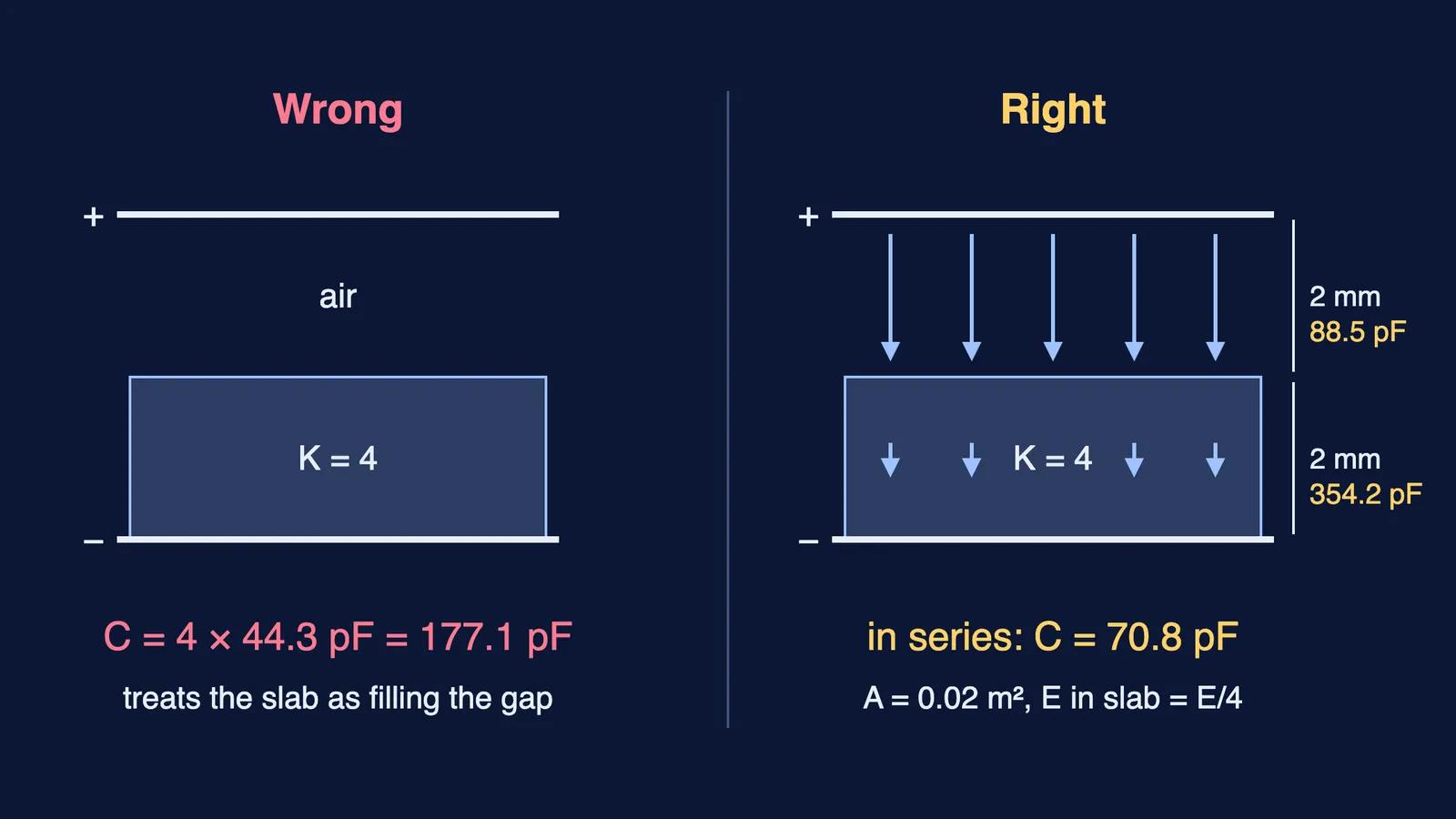
Multiplying by K when the slab is thinner than the gap.
Wrong: plates of area 0.02 m², 4 mm apart, so C₀ = 44.3 pF. A 2 mm slab with K = 4 goes in, and "C = 4 × 44.3 = 177.1 pF."
Why it fails: NCERT's C = ε₀KA/d holds when the dielectric fills the region between the plates. A slab parallel to the plates leaves an air layer, and the two layers act in series.
Fix: the 2 mm air layer gives 88.5 pF and the 2 mm slab gives 354.2 pF. In series, C = 70.8 pF. The general result is C = ε₀A/(d − t + t/K). A conducting slab is the limit of very large K; our post on a capacitor with a metal slab inserted works through it.
Habit: slab stacked along the gap means series; slab beside the gap means parallel.
Using series when the dielectric fills half the area.
Wrong: the same plates, but K = 4 fills the full 4 mm gap over half the area. A student stacks them in series.
Why it fails: both halves see the same plates and the same V, so they are in parallel.
Fix: C = ε₀(A/2)(1 + K)/d = 110.7 pF.
Habit: ask "same V or same Q?" for each part before choosing.
Where does the energy go, and what sets C?
Assuming energy is conserved when charge is shared.
Wrong: a 4 µF capacitor at 30 V is joined to an uncharged 2 µF capacitor, and the student equates energies before and after.
Why it fails: charge is conserved, not stored energy. NCERT's Example 2.10 explains that energy is lost as heat and electromagnetic radiation while the transient current flows (NCERT, Section 2.15).
Fix: Q = 120 µC is shared over 6 µF, so the common voltage is 20 V. Energy goes from 1.8 mJ to 1.2 mJ; 0.6 mJ is lost.
Habit: conserve Q to find V, then compute energy separately.
Thinking C changes with Q or V.
Wrong: "C = Q/V, so doubling V halves C."
Why it fails: NCERT states that C is independent of Q or V and depends only on geometry and the dielectric (NCERT, Section 2.11).
Fix: a 5 µF capacitor holds 50 µC at 10 V and 100 µC at 20 V. Q/V is 5 µF both times.
Habit: change C only when A, d or K changes.
Which unit slips still give a believable answer?
Mixing cm² and mm in ε₀A/d.
Wrong: A = 50 cm², d = 0.5 mm, "C = 8.85 × 10⁻¹² × 50/0.5 = 885 pF."
Why it fails: ε₀ is in SI units, so A must be in m² and d in m.
Fix: C = 8.85 × 10⁻¹² × (50 × 10⁻⁴)/(0.5 × 10⁻³) = 88.5 pF. The wrong answer is ten times too big but still looks reasonable, which is why it survives.
Habit: convert every length to metres on the first line.
A 60-second self-check before you mark
For the wider plan, see our guides to Electrostatics for NEET and Electrostatics for JEE Main.
Stuck on why your answer is off? The Fermi Problem Library has worked problems with a step-by-step solver that explains the reasoning rather than printing an answer.