On this page
The JEE Main 2027 syllabus and the NMC NEET-UG 2026 syllabus list the same Unit 18 topics: alpha-particle scattering, the Bohr model, energy levels, the hydrogen spectrum, nuclear size, mass defect, binding energy per nucleon, fission and fusion. Radioactivity is not in either list, so this post leaves it out.
Each of the eight slips below has the wrong working, why it fails, a fix and a habit. For the full chapter plan, read our Atoms and Nuclei guide for NEET and the Atoms and Nuclei guide for JEE Main.
Which Bohr model mistakes trip students up in JEE and NEET?
Giving kinetic energy the same minus sign as total energy.
Wrong: "In the n = 5 state, E = −0.544 eV, so K = −0.544 eV."
Why it fails: kinetic energy is never negative. NCERT Chapter 12 shows that in hydrogen K = e²/8πε₀r and U = −e²/4πε₀r, so the total energy E = −e²/8πε₀r. That makes K = −E and U = 2E.
Fix: E₅ = −13.6/25 = −0.544 eV, so K = +0.544 eV and U = −1.088 eV. Check: K + U = −0.544 eV.
Habit: write "K = −E, U = 2E" in the margin before any energy question.
Scaling the orbital period like the radius.
Wrong: "r grows as n², so going from n = 2 to n = 4 makes the period 4 times longer."
Why it fails: the period is T = 2πr/v. From NCERT's Bohr results, r grows as n², and the quantisation condition mvr = nh/2π then makes v fall as 1/n. So T grows as n² ÷ (1/n) = n³.
Fix: T₄/T₂ = (4/2)³ = 8, not 4.
Habit: build new ratios from r and v; never guess the power of n.
Why do hydrogen spectrum answers come out wrong?
Using one level's energy instead of the gap.
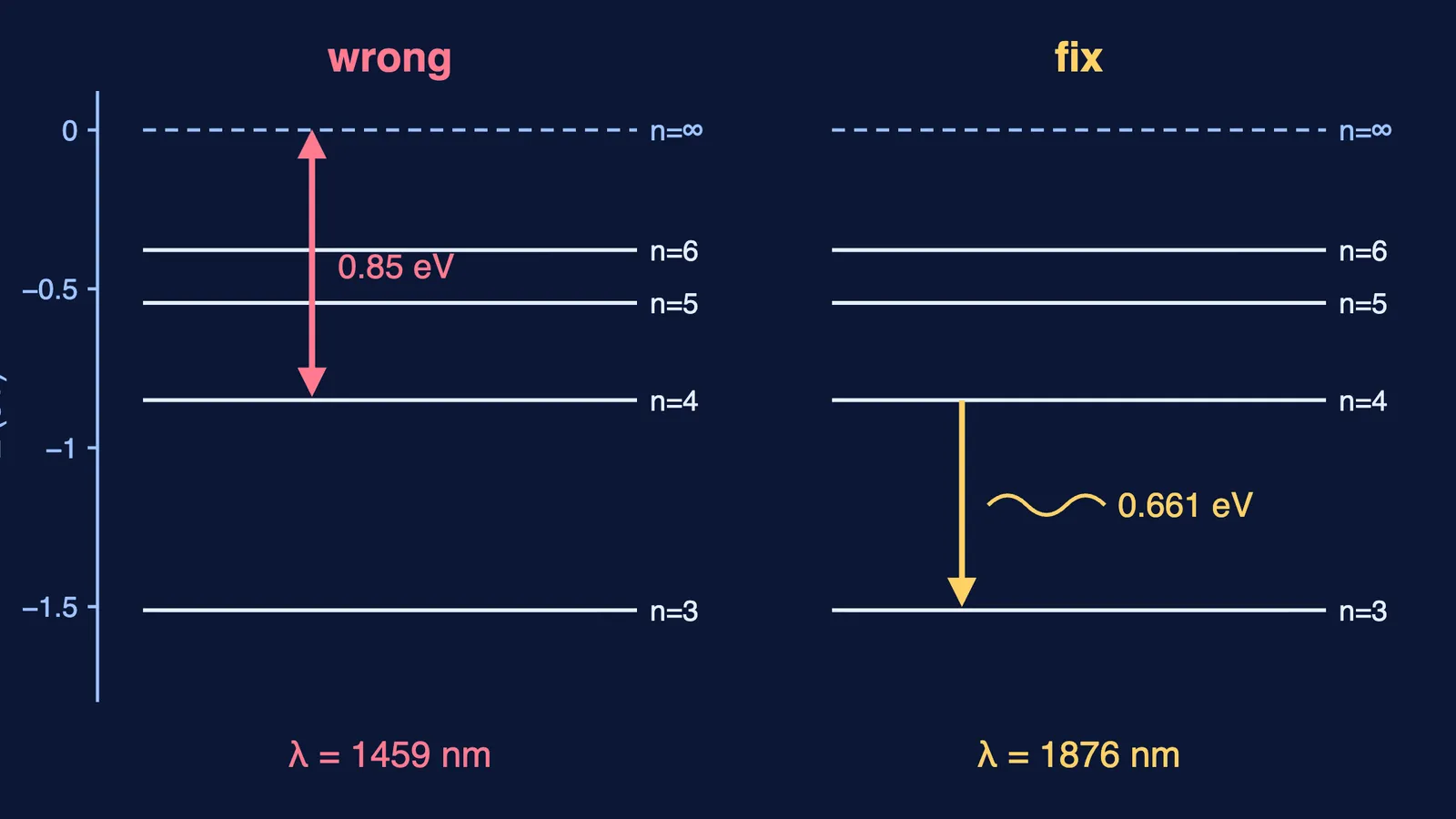
Wrong: "For the 4 → 3 drop, the photon carries |E₄| = 0.85 eV, so λ = 1240/0.85 ≈ 1459 nm."
Why it fails: NCERT section 12.5 gives the photon energy as hν = Eᵢ − E_f, the difference between two levels. 0.85 eV is the energy to free the electron from n = 4, not the photon from this drop.
Fix: ΔE = 13.6(1/9 − 1/16) = 0.661 eV. With hc ≈ 1240 eV nm (from NIST's Planck constant in eV s times the speed of light), λ = 1240/0.661 ≈ 1876 nm, in the infrared.
Habit: every photon energy has two n values in it; if yours has one, stop.
Counting lines for many atoms when the question has one.
Wrong: "An electron sits in n = 6, so up to 15 lines can appear."
Why it fails: 15 = n(n − 1)/2 counts every pair of levels, which only a large sample of atoms can show. A single atom only moves down, so it visits each lower level at most once; it gives the most lines when it steps down one level at a time.
Fix: a gas of atoms in n = 6 can give 6 × 5/2 = 15 lines; one atom can give at most 6 − 1 = 5.
Habit: underline "an atom" or "a sample" before you count.
Treating an electron beam like a photon beam.
Wrong: "11.0 eV does not match any gap from the ground state, so ground-state hydrogen hit by 11.0 eV electrons stays unexcited."
Why it fails: NCERT notes that atoms are excited by collisions with electrons or by absorbing a photon of the right frequency. A photon is absorbed only if its energy matches a gap (or exceeds the 13.6 eV ionisation energy). A colliding electron can hand over part of its energy and keep the rest.
Fix: the first two gaps are 10.2 eV and 12.09 eV. An 11.0 eV photon passes through unabsorbed. An 11.0 eV electron can lift an atom to n = 2 and leave with about 0.8 eV.
Habit: ask "photon or particle?" before you test for an exact match.
Where do mass defect and binding energy sums go wrong?
Mixing proton masses with atomic masses.
Wrong: for lithium-7 (3 protons, 4 neutrons), using the proton mass 1.007276 u (NIST CODATA) with the atomic mass of lithium-7.
Why it fails: tables list atomic masses, which include the electrons. NCERT Chapter 13 gives the electron mass as 0.00055 u, so three electrons are left over on one side. Use the hydrogen-atom mass instead, and the electrons cancel.
Fix: from the AME2020 mass table, m(¹H) = 1.007825 u, m(n) = 1.008665 u and m(⁷Li) = 7.016003 u. ΔM = 3(1.007825) + 4(1.008665) − 7.016003 = 0.042132 u. With 1 u = 931.5 MeV/c², B = 39.25 MeV, or 5.61 MeV per nucleon. The proton-mass version gives 37.71 MeV, about 1.5 MeV short.
Habit: atomic mass on one side means hydrogen-atom masses on the other.
Ranking stability by total binding energy.
Wrong: "Uranium-238 has more binding energy than iron-56, so it is more tightly bound."
Why it fails: NCERT treats binding energy per nucleon as the average energy needed to separate a nucleus into its nucleons, so it is the fair measure of how tightly a nucleus is held. Totals just grow with size.
Fix: from AME2020, uranium-238 has 7.570 MeV per nucleon (about 1802 MeV in total) and iron-56 has 8.790 MeV per nucleon (about 492 MeV in total). Iron is more tightly bound. Our binding energy per nucleon curve explainer shows the whole trend.
Habit: compare per-nucleon values, never totals.
Flipping the sign of the energy released.
Wrong: for two carbon-12 nuclei fusing into magnesium-24, writing Q = B(reactants) − B(products) and getting a negative answer.
Why it fails: energy is released when the products are more tightly bound, so Q = B(products) − B(reactants).
Fix: AME2020 gives 7.680 MeV per nucleon for carbon-12 and 8.261 MeV per nucleon for magnesium-24. Q = 24(8.261 − 7.680) ≈ 13.9 MeV released. The mass route agrees: (2 × 12.000000 − 23.985042) u × 931.5 ≈ 13.9 MeV.
Habit: released energy is positive; if your Q is negative, recheck which side is which.
What should you check before you move on?
Stuck on why your answer is off? The Fermi Problem Library has worked problems with a step-by-step solver that explains the reasoning rather than printing an answer.