On this page
Electromagnetic Waves is a short chapter with a few easy-to-make slips. Each of the eight below has the wrong working, the physics that breaks it, a fix on fresh numbers, and a habit to stop it coming back.
The chapter is Unit 15 in both the NTA's Syllabus for JEE (Main) - 2027 and the NMC's NEET (UG)-2026 syllabus: displacement current, the characteristics and transverse nature of electromagnetic waves, the spectrum and its applications. The textbook match is Chapter 8 of NCERT Class 12 Physics Part I, Reprint 2026-27. Take c = 3.0 × 10⁸ m/s (NIST gives exactly 299 792 458 m/s) and μ₀ = 4π × 10⁻⁷ T m/A.
Where do students go wrong with displacement current?
Thinking there is no current, so no magnetic field, between the plates.
Wrong working: "No charge crosses the gap, so B = 0 there." Why it fails: while the capacitor charges, the changing electric field gives a displacement current i_d = ε₀ dΦ_E/dt, and NCERT section 8.2 shows it equals the conduction current in the wires and produces a magnetic field just like it.
Fix: circular plates of radius 4.0 cm charge with 0.36 A in the leads. A loop of radius 6.0 cm between the plates encloses all of i_d, so B = μ₀i/(2πr) = (4π × 10⁻⁷ × 0.36)/(2π × 0.060) = 1.2 μT. Habit: in the gap, replace "no current" with "i_d = i".
Using the full displacement current for a loop inside the plates.
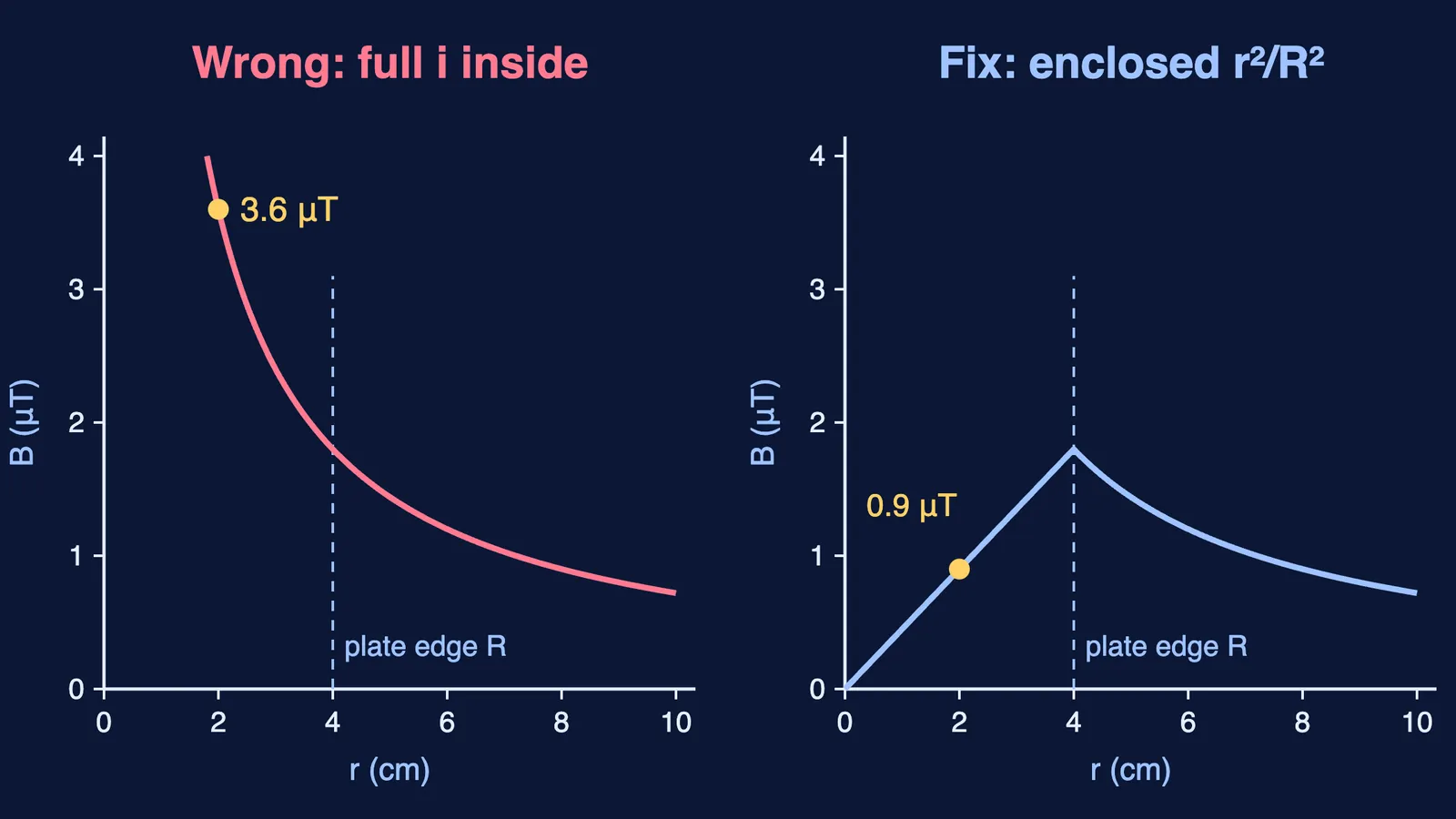
Wrong working: at r = 2.0 cm on the same capacitor, B = μ₀i/(2πr) = 3.6 μT. Why it fails: i_d is spread uniformly over the plate area, so a loop of radius r encloses only the fraction r²/R².
Fix: B = μ₀i r/(2πR²) = (4π × 10⁻⁷ × 0.36 × 0.020)/(2π × 0.040²) = 0.90 μT, a quarter of the wrong answer. B rises linearly to 1.8 μT at the plate edge, then falls as 1/r, as the diagram above shows. Habit: before writing Ampere-Maxwell, ask "is my loop inside or outside the plates?"
Why do B₀ and field directions keep coming out wrong?
Multiplying by c instead of dividing.
Wrong working: E₀ = 48 V/m, so B₀ = cE₀ = 1.44 × 10¹⁰ T. Why it fails: NCERT's Eq. 8.10 is B₀ = E₀/c, and no lab field comes near 10¹⁰ T.
Fix: B₀ = 48/(3.0 × 10⁸) = 1.6 × 10⁻⁷ T, or 160 nT. Habit: E₀/B₀ is a speed, so the B number must be tiny.
Taking B × E, or ignoring the direction of travel.
Wrong working: a wave travels along −x with E along +y, and B is written as +z "because the three are perpendicular". Why it fails: perpendicularity allows ±z; only E × B pointing along the direction of travel picks one.
Fix: we need ŷ × B = −x̂. Since ŷ × (−ẑ) = −x̂, B points along −z. Habit: write the cross product out every time, E first.
Treating E and B as a quarter-cycle out of phase.
Wrong working: "they are at right angles, so when E is largest, B is zero." Why it fails: perpendicular in space is not out of step in time. In a plane wave in vacuum, both vary as sin(kz − ωt), per NCERT section 8.3, so they peak and vanish together and E = cB at every instant.
Fix: at a point where E is 15 V/m at some instant, B there is 15/(3.0 × 10⁸) = 50 nT, not its maximum. Habit: "perpendicular in space, in phase in time".
How do you read a wave equation without losing 2π?
Reading λ as 1/k, or ν as ω.
Wrong working: for E_z = 18 sin(50πy − 1.5π × 10¹⁰ t) V/m, λ = 1/k = 1/(50π) ≈ 6.4 mm. Why it fails: NCERT defines k = 2π/λ and ω = 2πν.
Fix: λ = 2π/(50π) = 0.040 m = 4.0 cm; ν = ω/2π = 7.5 × 10⁹ Hz, and νλ = 3.0 × 10⁸ m/s checks out. B₀ = 18/c = 60 nT, and the wave moves along +y. Habit: after finding λ and ν, multiply them; if you do not get c, a 2π is missing.
Changing the frequency in a medium, or dividing by εr instead of √εr.
Wrong working: a 12 GHz microwave enters a non-magnetic medium with εr = 6.25, so v = c/6.25 = 4.8 × 10⁷ m/s and the frequency drops too. Why it fails: in a medium v = 1/√(με), so with μr = 1, v = c/√εr; and the frequency is set by the source, so it does not change.
Fix: v = 3.0 × 10⁸/2.5 = 1.2 × 10⁸ m/s. The frequency stays 12 GHz, and λ falls from 2.5 cm to v/ν = 1.0 cm. Habit: across a boundary, ν stays; v and λ change together.
Which spectrum slips cost easy marks?
Assuming higher-frequency waves travel faster.
Wrong working: "1.0 × 10¹⁶ Hz radiation reaches a detector 1.2 km away sooner than a 6.0 GHz signal." Why it fails: all electromagnetic waves travel at c in vacuum, whatever the frequency, as NCERT's Points to Ponder note; frequency only decides the band.
Fix: with λ = c/ν, 6.0 GHz gives 5.0 cm (microwave), 3.0 × 10¹⁴ Hz gives 1.0 μm (infrared) and 1.0 × 10¹⁶ Hz gives 30 nm (ultraviolet), using the bands in NCERT's Table 8.1. All three cover 1.2 km in 4.0 μs. Habit: convert every frequency to a wavelength, then place it in the table, which runs by decreasing wavelength from radio to gamma rays.
For the full chapter plan, see our Electromagnetic Waves for NEET guide and our Electromagnetic Waves for JEE Main guide.
A 60-second self-check before you mark
Run these on every answer in this chapter, then redo any question you got wrong two days later, without the solution. When you want a fresh set to test the habits, try our JEE Main practice questions on electromagnetic waves.
Still not sure why your answer is off? The Fermi Problem Library has worked problems with a step-by-step solver that explains the reasoning rather than printing an answer.