On this page
The slips in this chapter tend to be a sign, a component or a formula used outside its range, not hard algebra. Below are eight frequent slips, each with the wrong working, the physics, a fix on our own numbers and a habit to keep.
The scope is the same for both exams. Unit 13 of the NTA Syllabus for JEE (Main) - 2027 and of the NMC NEET (UG)-2026 syllabus lists Biot-Savart for a circular loop, Ampere's law for a long wire and a solenoid, forces on moving charges and conductors, torque on a loop and the galvanometer. The textbook is NCERT Class 12 Physics Chapter 4, Moving Charges and Magnetism. Take μ₀ = 4π × 10⁻⁷ T m/A and e = 1.60 × 10⁻¹⁹ C.
Why do I get the direction of the magnetic force wrong?
Treating an electron like a positive charge.
Wrong: an electron moves along +x at 2.0 × 10⁶ m/s in a 0.40 T field along +y; v × B points along +z, so the force is along +z.
Why: F = qv × B, and q is negative for an electron, so the force is opposite to v × B.
Fix: the size is evB = 1.60 × 10⁻¹⁹ × 2.0 × 10⁶ × 0.40 = 1.28 × 10⁻¹³ N, and the direction is −z.
Habit: find v × B first, then flip it if the charge is negative.
Subtracting fields between antiparallel wires.
Wrong: two long wires 10 cm apart carry 6.0 A and 4.0 A in opposite directions; at the midpoint, B = μ₀(6 − 4)/(2π × 0.05) = 8.0 × 10⁻⁶ T.
Why: with opposite currents, the right-hand rule gives both fields the same direction between the wires. They add.
Fix: B = 2 × 10⁻⁷ × (6.0 + 4.0)/0.05 = 4.0 × 10⁻⁵ T. Our right-hand thumb rule guide shows the grip.
Habit: draw a dot or a cross for each wire's field at the point before adding.
Which magnetic field formula applies where?
Using the centre formula at a point on the axis.
Wrong: a 3.0 cm loop carries 5.0 A; at 4.0 cm along its axis, B = μ₀I/(2R) = 1.05 × 10⁻⁴ T.
Why: μ₀I/(2R) holds only at the centre. On the axis, B = μ₀IR²/[2(R² + x²)^(3/2)], NCERT section 4.5.
Fix: R² + x² = 25 cm², so (R² + x²)^(3/2) = 1.25 × 10⁻⁴ m³ and B = (4π × 10⁻⁷ × 5.0 × 9.0 × 10⁻⁴)/(2 × 1.25 × 10⁻⁴) = 2.26 × 10⁻⁵ T, under a quarter of the wrong answer.
Habit: put x = 0 into your axial formula; it must give back μ₀I/(2R).
Using μ₀I/(2πr) inside a thick wire.
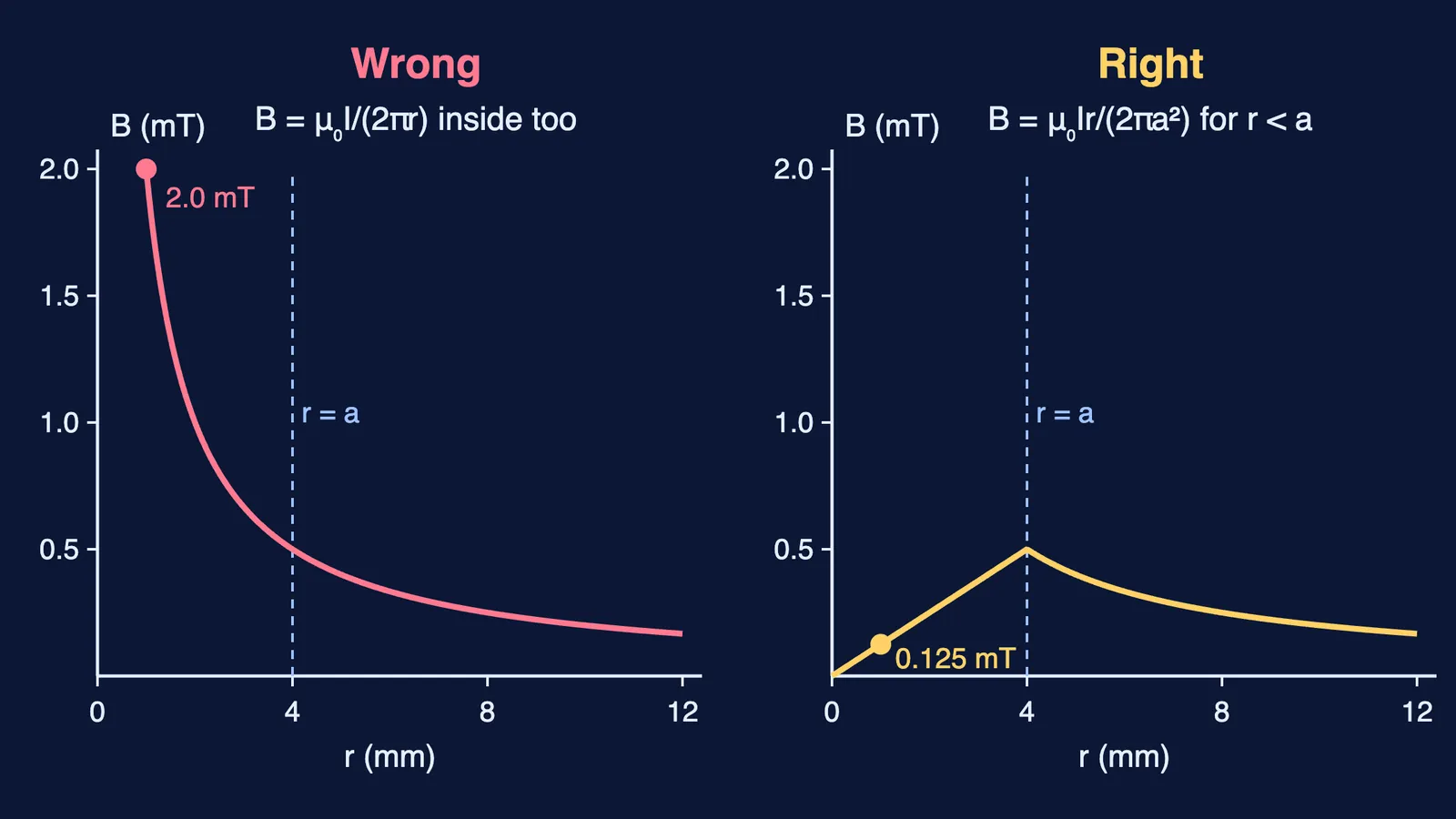
Wrong: a wire of radius 4.0 mm carries 10 A spread evenly; at r = 1.0 mm, B = 2 × 10⁻⁷ × 10/0.001 = 2.0 × 10⁻³ T.
Why: an Amperian loop inside the wire encloses only the fraction r²/a² of the current, so B = μ₀Ir/(2πa²), rising linearly to the surface (NCERT Example 4.7). The picture at the top plots both.
Fix: B = 2 × 10⁻⁷ × 10 × 0.001/(0.004)² = 1.25 × 10⁻⁴ T, 16 times smaller.
Habit: before Ampere's law, ask how much current your loop actually encloses.
Where do charged-particle path questions go wrong?
Using the full speed for both radius and pitch.
Wrong: an electron moves at 3.0 × 10⁶ m/s at 60° to a 2.0 mT field; pitch = 2πmv/(eB) = 5.36 cm.
Why: only the perpendicular part, v sin θ, bends the path; the parallel part, v cos θ, carries the charge along B (NCERT section 4.3).
Fix: with m = 9.11 × 10⁻³¹ kg, r = mv sin 60°/(eB) = 7.4 mm, and pitch = 2πmv cos 60°/(eB) = 2.68 cm.
Habit: split v into parts along and across B before writing any formula.
Comparing radii with r ∝ m/q when the energy is fixed.
Wrong: a proton and an alpha particle each have 1.0 MeV in a 0.50 T field; the alpha has about four times the mass and twice the charge, so its radius is double.
Why: r = mv/(qB) assumes equal speeds. At equal kinetic energy K, mv = √(2mK), so r = √(2mK)/(qB) ∝ √m/q.
Fix: √4/2 = 1, so the circles are almost the same size, about 29 cm each here (0.289 m and 0.288 m with exact masses).
Habit: rewrite r in terms of whatever the question holds fixed (v, K or accelerating voltage) before comparing.
What goes wrong with torque and galvanometer questions?
Taking θ as the angle between the coil's plane and B.
Wrong: a 40-turn coil of area 12 cm² carries 0.50 A, its plane at 30° to a 0.25 T field; τ = NIAB sin 30° = 3.0 × 10⁻³ N m.
Why: in τ = NIAB sin θ, θ is the angle between B and the normal to the coil (its magnetic moment), here 60°.
Fix: τ = 40 × 0.50 × 12 × 10⁻⁴ × 0.25 × sin 60° = 5.2 × 10⁻³ N m.
Habit: draw the normal arrow on the coil and measure θ from it.
Using the full range instead of I − Ig for the shunt.
Wrong: a 100 Ω galvanometer reads full scale at 10 mA; for a 0-50 mA ammeter, S = IgG/I = 20 Ω.
Why: the shunt carries only the current the coil does not, I − Ig. Both share the same voltage, IgG.
Fix: S = (0.010 × 100)/(0.050 − 0.010) = 25 Ω, in parallel. The shortcut fails whenever Ig is not tiny next to I.
Habit: write "same voltage across coil and shunt" as an equation, then solve.
Stuck on why your answer is off? The Fermi Problem Library has worked problems with a step-by-step solver that explains the reasoning rather than printing an answer, so you can see which step went wrong.
A 60-second self-check before you mark
For the full chapter plan, see our guides to moving charges and magnetism for JEE Main and magnetic effects of current for NEET.