On this page
This sheet follows NCERT Class 11 Physics, Chapter 5 (Reprint 2026-27) and Unit IV of the CBSE 2026-27 Physics syllabus. Units are SI throughout. Not included: the coefficient of restitution, which this NCERT chapter does not use.
For concepts and solved numericals, see our Work, Energy and Power Class 11 notes; for where each result comes from, see the step-by-step derivations.
What is the formula for work done by a force?
Constant force: W = F·d = Fd cos θ (J). F is the force (N), d the displacement (m), θ the angle between them.
Sign: W > 0 for θ < 90°, W = 0 at θ = 90°, W < 0 for θ > 90°. Friction opposing motion (θ = 180°) does W = −Fd (J).
Variable force in one dimension: W = ∫ F(x) dx from xᵢ to x_f (J), the area under the F–x graph; area below the axis counts negative.
1 J = 1 N m; dimensions [ML²T⁻²].
Worked example: a 40 N pull at 60° to the floor drags a box 6 m, so W = 40 × 6 × cos 60° = 120 J. Friction of 12 N over the same 6 m does −72 J.
Watch for: θ is the angle between force and displacement, not between force and the vertical.
What does the work-energy theorem say?
Kinetic energy: K = ½mv² (J), with m in kg and speed v in m s⁻¹.
Work-energy theorem: K_f − K_i = W_net (J), the total work done by all the forces acting.
Constant-acceleration form: ½mv² − ½mu² = Fs (J), from v² − u² = 2as; F is the constant net force (N), s the displacement (m), u and v the initial and final speeds.
Worked example: a 1,200 kg car at 15 m s⁻¹ has K = ½ × 1200 × 15² = 135,000 J. Stopping it in 45 m needs an average braking force of 135,000 / 45 = 3,000 N.
Watch for: W_net includes friction and gravity, not only the applied force.
What are the formulas for potential energy and mechanical energy?
Conservative force: F(x) = −dV/dx (N), so Vᵢ − V_f = ∫ F(x) dx from xᵢ to x_f (J), with V the potential energy (J).
Gravity near the earth: V = mgh (J), g = 9.8 m s⁻², h in m above your chosen zero; ignores the variation of g with height.
Hooke's law: F_s = −kx (N), k the spring constant (N m⁻¹), x the extension or compression from natural length (m).
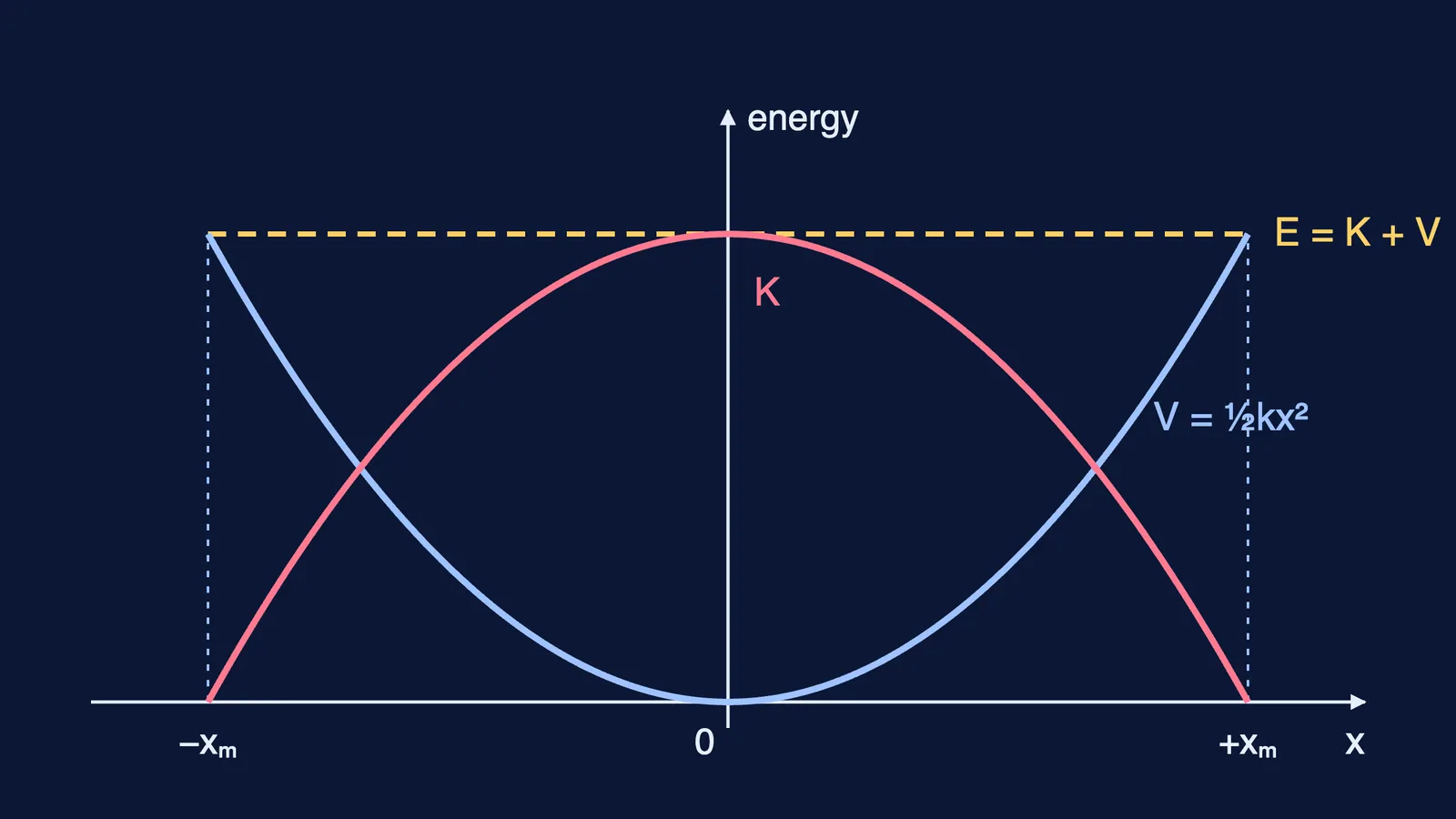
Spring work from xᵢ to x_f: W_s = ½kxᵢ² − ½kx_f² (J); spring potential energy V = ½kx² (J).
Conservation (only conservative forces do work): Kᵢ + Vᵢ = K_f + V_f (J).
With friction or other non-conservative forces: E_f − E_i = W_nc (J), where E = K + V and W_nc is the work those forces do (J).
Free fall from rest through height H (m): v = √(2gH) (m s⁻¹).
Spring released from rest at x_m (m): maximum speed v_m = √(k/m) x_m (m s⁻¹), at x = 0.
Vertical circle, bob on a light string of length L (m), string just slack at the top: v = √(5gL) at the bottom, √(3gL) level with the centre, √(gL) at the top (m s⁻¹).
Worked example: a spring with k = 600 N m⁻¹ compressed 0.12 m stores ½ × 600 × 0.12² = 4.32 J. On a smooth floor it launches a 0.06 kg ball at √(2 × 4.32 / 0.06) = 12 m s⁻¹.
Watch for: fix the zero of potential energy once and keep it for the whole problem.
If K and V trading places is hard to picture, the Fermi Simulation Lab has interactive simulations for ideas easier to see than to read.
Power formulas and units
Average power: P_av = W / t (W), work in J, time in s.
Instantaneous power: P = dW/dt = F·v (W), v the velocity (m s⁻¹).
1 W = 1 J s⁻¹; 1 hp = 746 W; dimensions [ML²T⁻³].
1 kWh = 10³ W × 3600 s = 3.6 × 10⁶ J, a unit of energy, not power.
Worked example: a pump lifts 500 kg of water through 12 m in 2 minutes. W = 500 × 9.8 × 12 = 58,800 J, so P_av = 58,800 / 120 = 490 W, about 0.66 hp.
Watch for: convert minutes or hours to seconds before dividing.
Collision formulas in one and two dimensions
Momentum is conserved in every collision: m₁v₁ᵢ + m₂v₂ᵢ = m₁v₁f + m₂v₂f (kg m s⁻¹); masses in kg, i and f mean before and after, velocities signed.
Kinetic energy is conserved only in elastic collisions, and only once contact is over.
Completely inelastic, m₂ at rest: v_f = m₁v₁ᵢ / (m₁ + m₂) (m s⁻¹); kinetic energy lost ΔK = ½ · m₁m₂/(m₁ + m₂) · v₁ᵢ² (J).
Elastic, head-on, m₂ at rest: v₁f = (m₁ − m₂)v₁ᵢ / (m₁ + m₂), v₂f = 2m₁v₁ᵢ / (m₁ + m₂) (m s⁻¹). Equal masses swap velocities.
Two dimensions, m₂ at rest, angles from the original direction: m₁v₁ᵢ = m₁v₁f cos θ₁ + m₂v₂f cos θ₂ and 0 = m₁v₁f sin θ₁ − m₂v₂f sin θ₂ (kg m s⁻¹).
Equal masses, elastic glancing collision, one at rest: θ₁ + θ₂ = 90°.
Worked example: a 2 kg ball at 5 m s⁻¹ hits a 3 kg ball at rest. Elastic: v₁f = (2 − 3) × 5 / 5 = −1 m s⁻¹ and v₂f = 2 × 2 × 5 / 5 = 4 m s⁻¹. If they stick: v_f = 2 m s⁻¹ and 15 J is lost.
Watch for: a negative v₁f means the ball bounced back.
How to revise this formula sheet
Derive the work-energy theorem from v² − u² = 2as once.
Read work as the area under an F–x graph, including negative area.
Test elastic-collision results on equal masses.
In energy problems, name the zero of potential energy and the non-conservative forces first.
Then test yourself with the Work, energy and power case study questions for Class 11.