On this page
The rationalised NCERT Class 11 Physics Part I, Chapter 5: Work, Energy and Power (reprint 2026-27) works out a handful of results in its own text and examples: the work-energy theorem for a variable force, conservation of mechanical energy, the potential energy of a spring, a bob in a vertical circle, and collisions in one dimension. The CBSE Class XI Physics syllabus for 2026-27 covers these topics in Unit IV.
For notes and solved numericals on the whole chapter, see our Work, Energy and Power Class 11 guide.
How do you derive the work-energy theorem for a variable force?
Setup: a particle of mass m moves along the x-axis under a net force F(x) that changes with position; v is its speed and K = ½mv² its kinetic energy.
Differentiate K with time: dK/dt = mv(dv/dt).
By Newton's second law, m(dv/dt) = F, so dK/dt = Fv.
Write v as dx/dt: dK/dt = F(dx/dt), so dK = F dx.
Integrate from the initial position xᵢ (kinetic energy Kᵢ) to the final position x_f (kinetic energy K_f).
Result: K_f − Kᵢ = ∫F dx from xᵢ to x_f = W, the work done by the net force.
Where students slip: using one force instead of the net force.
Conservation of mechanical energy: K + V stays constant
Setup: a body moves through a small displacement Δx under a conservative force F(x), with potential energy V(x) defined by F = −dV/dx.
The work-energy theorem gives ΔK = F(x)Δx.
For a conservative force, ΔV = −F(x)Δx.
Add the two: ΔK + ΔV = 0, so Δ(K + V) = 0.
Apply it to a ball dropped from rest at height H: mgH = mgh + ½mv_h² at height h.
Result: K + V is constant, and for the falling ball v_h² = 2g(H − h).
Where students slip: applying it when friction or air drag does work; those forces are not conservative.
Potential energy of a spring: V(x) = ½kx²
Setup: a block on a smooth floor is tied to a light spring obeying Hooke's law, F_s = −kx, where k is the spring constant and x the displacement from the relaxed position.
Work by the spring as the block moves from 0 to x_m: W_s = ∫(−kx)dx = −½kx_m².
From xᵢ to x_f, W_s = ½kxᵢ² − ½kx_f², which depends only on the end points, so the spring force is conservative.
Take V = 0 at x = 0; then V(x) = ½kx², and −dV/dx = −kx gives back the force.
Released from rest at x_m, energy conservation gives ½kx_m² = ½kx² + ½mv², so the speed is largest at x = 0.
Result: V(x) = ½kx², and the maximum speed is v_m = x_m√(k/m).
Where students slip: dropping the minus sign; the spring does negative work while being stretched.
Why is v₀ = √(5gL) at the bottom of a vertical circle?
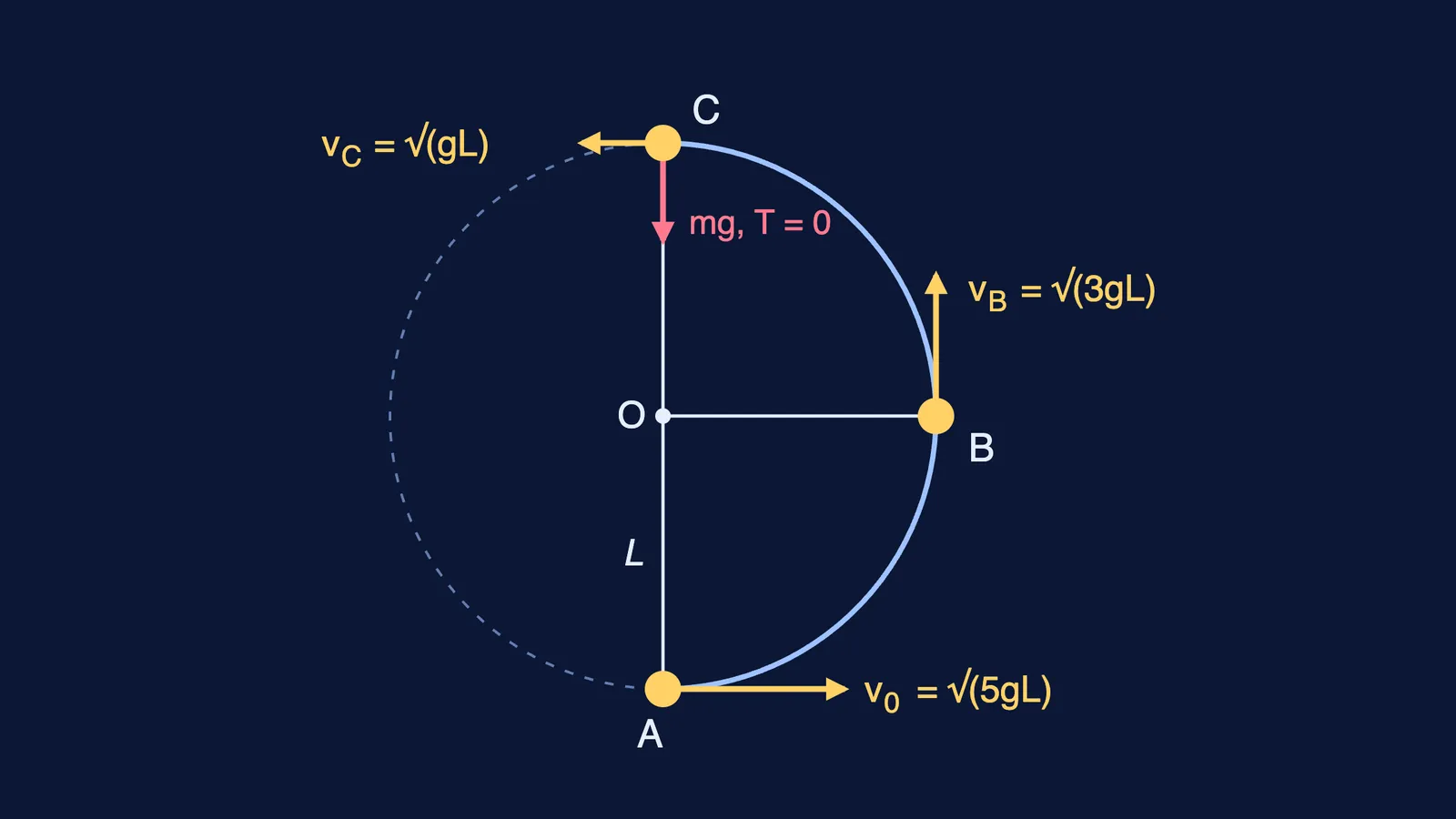
Setup: NCERT Example 5.7 (the diagram at the top): a bob of mass m on a light string of length L is given speed v₀ at the lowest point A, so that the string goes slack only at the top, C; B is level with the centre.
Tension never does work (the string is always at right angles to the motion), so mechanical energy is conserved. Take V = 0 at A.
At C the tension is zero, so gravity alone provides the centripetal force: mg = mv_C²/L, which gives v_C = √(gL).
Energy at C: E = ½mv_C² + 2mgL = (5/2)mgL.
Equate with ½mv₀² at A: v₀ = √(5gL). At B, ½mv_B² + mgL = (5/2)mgL, so v_B = √(3gL).
Result: v₀ = √(5gL), v_B = √(3gL), v_C = √(gL), and K_B/K_C = 3.
Where students slip: setting v_C = 0 at the top; the string would then slack before C.
Completely inelastic collision: v_f = m₁v₁ᵢ/(m₁ + m₂)
Setup: mass m₁ moving at v₁ᵢ hits mass m₂ at rest in a straight line, and the two move together afterwards at v_f.
Momentum is conserved: m₁v₁ᵢ = (m₁ + m₂)v_f.
Solve: v_f = m₁v₁ᵢ/(m₁ + m₂).
Kinetic energy lost: ΔK = ½m₁v₁ᵢ² − ½(m₁ + m₂)v_f².
Put in v_f and factor out ½m₁v₁ᵢ²: ΔK = ½m₁v₁ᵢ²[1 − m₁/(m₁ + m₂)].
Result: v_f = m₁v₁ᵢ/(m₁ + m₂), and ΔK = ½[m₁m₂/(m₁ + m₂)]v₁ᵢ², which is always positive.
Where students slip: conserving kinetic energy here. Only momentum is conserved when the bodies stick together.
Elastic collision in one dimension: v₁f = (m₁ − m₂)v₁ᵢ/(m₁ + m₂)
Setup: the same two masses, but now both momentum and kinetic energy are conserved; v₁f and v₂f are the final velocities.
Momentum: m₁v₁ᵢ = m₁v₁f + m₂v₂f.
Kinetic energy (the halves cancel): m₁v₁ᵢ² = m₁v₁f² + m₂v₂f².
Rewrite both as m₁(v₁ᵢ − v₁f) = m₂v₂f and m₁(v₁ᵢ − v₁f)(v₁ᵢ + v₁f) = m₂v₂f², then divide: v₂f = v₁ᵢ + v₁f.
Put this back into the momentum equation and solve for v₁f, then v₂f.
Result: v₁f = (m₁ − m₂)v₁ᵢ/(m₁ + m₂) and v₂f = 2m₁v₁ᵢ/(m₁ + m₂).
Special cases: equal masses swap velocities, and a light ball hitting a very heavy one bounces back with v₁f ≈ −v₁ᵢ.
Where students slip: dividing the equations before grouping the m₁ terms together.
How should you practise the work, energy and power derivations?
Name the conservation law first. Energy for the spring, the falling ball and the vertical circle; momentum for the sticky collision; both for the elastic one.
Check signs on work. Friction and the spring's own pull do negative work; tension in the vertical circle does none.
Test limits. Put m₁ = m₂ or m₂ ≫ m₁ into the collision results and check the answer makes physical sense.
Reproduce from a blank page. Write each derivation without notes, then compare with Eqs. 5.8a to 5.27 in the chapter and mark the first line that differs.
Watch the energy swap. Fermi Simulation Lab has interactive simulations for ideas that are easier to see than to read, which helps with pictures like kinetic and potential energy trading places.
When the derivations come easily, try them inside longer questions with the Work, energy and power case study questions for Class 11.