On this page
These eight original questions mix single-correct, one-or-more-correct and numerical types; each answer names the trap.
What does JEE Advanced test in work, energy and collisions?
The official JEE (Advanced) 2026 syllabus lists kinetic and potential energy, work and power, conservation of linear momentum and mechanical energy, systems of particles, centre of mass and its motion, impulse, and elastic and inelastic collisions. For theory and a plan, read our guide on how to prepare work, energy and collisions for JEE Advanced.
How should you attempt this set?
Cover the answers; allow 35 minutes; take g = 10 m/s².
Split the motion into stages; note what each conserves.
Judge every option of a one-or-more-correct question separately.
Retry misses two days later.
Easy: can you track where the energy goes?
Q1 (easy, single correct). A uniform chain 1.2 m long lies on a smooth table with 0.4 m of it hanging over the edge. It is released from rest. Its speed as the last link leaves the table is
(A) 2.00 m/s (B) 2.83 m/s (C) 3.27 m/s (D) 3.46 m/s
Answer: (C). The centre of mass falls (L² − a²)/2L, so v² = g(L² − a²)/L = 10 × 1.28/1.2, giving v ≈ 3.27 m/s.
Trap: (D) drops the whole chain's centre of mass by L/2, ignoring the part already hanging.
Q2 (easy, numerical). A ball hits a smooth horizontal floor at 5 m/s, at 37° to the vertical (take sin 37° = 0.6). The coefficient of restitution is 0.5. What percentage of its kinetic energy is lost in the bounce?
Answer: 48. Horizontal 3 m/s is kept; vertical 4 m/s becomes 2 m/s. v² falls from 25 to 13, a loss of 12/25.
Trap: 75 applies (1 − e²) to all the kinetic energy.
Medium: potential curves, springs and moving belts
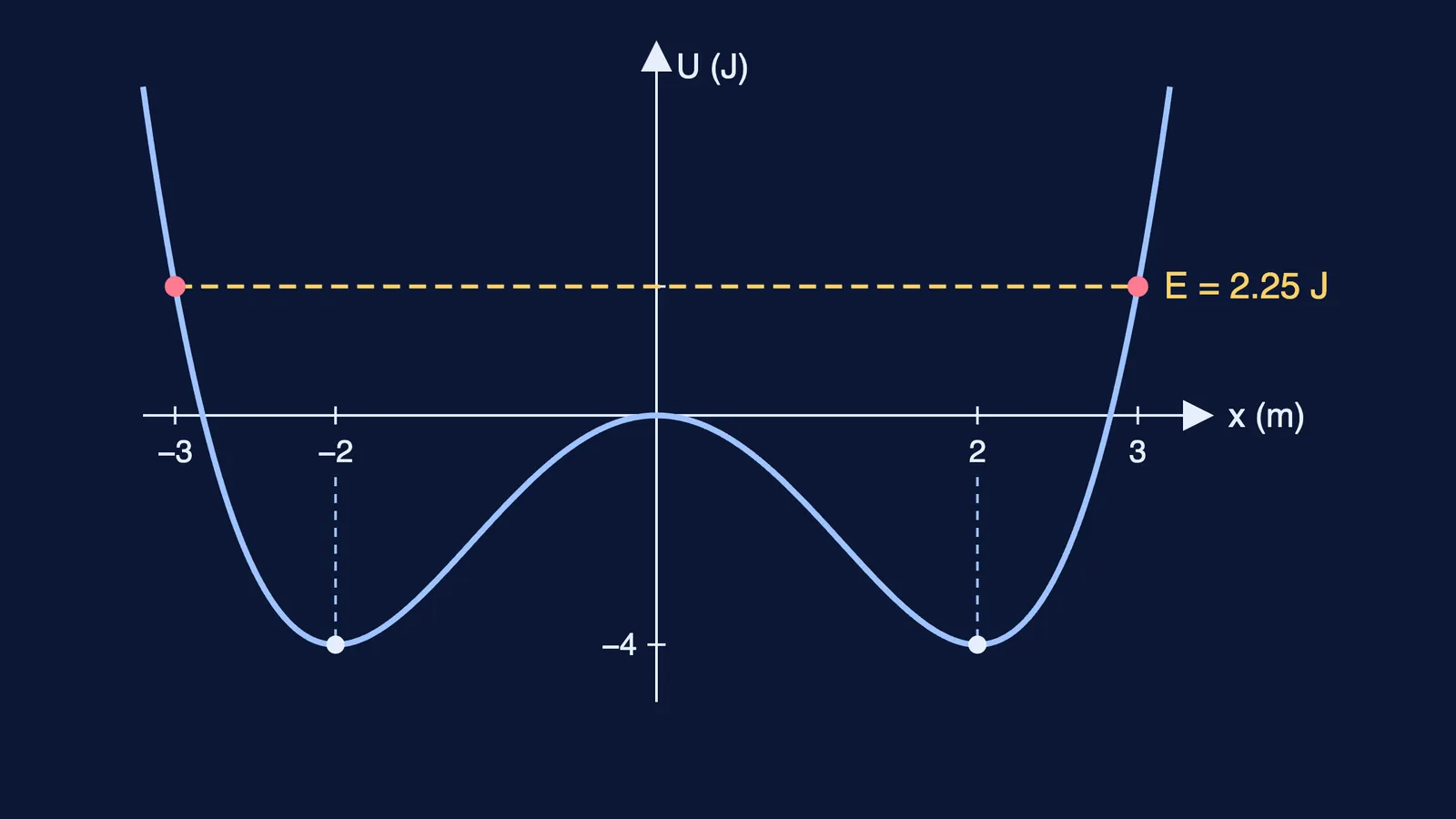
Q3 (medium, one or more correct). A 0.5 kg particle moves along x with potential energy U(x) = x⁴/4 − 2x² joules (x in metres). Which are correct?
(A) x = 0 is stable equilibrium. (B) At x = 1 m the force is 3 N along +x. (C) Released from rest at x = 3 m, it never reaches x = −2 m. (D) Released from rest at x = 3 m, its maximum speed is 5 m/s.
Answer: (B), (D). F = −dU/dx = 4x − x³, which is +3 N at x = 1 m. U has minima of −4 J at x = ±2 m and a maximum of 0 at x = 0, which is unstable. From x = 3 m, E = 2.25 J clears the hump, so it swings to x = −3 m; kinetic energy peaks at 6.25 J, so v = 5 m/s.
Trap: (C) keeps the particle in the right-hand well.
Q4 (medium, single correct). On a smooth floor, a 1 kg block at 6 m/s hits a light spring (2400 N/m) fixed to a 2 kg block at rest. The maximum compression is
(A) 0.05 m (B) 0.07 m (C) 0.10 m (D) 0.12 m
Answer: (C). At maximum compression both move at 2 m/s, so kinetic energy falls from 18 J to 6 J: ½kx² = 12 J, x = 0.10 m.
Trap: (D) puts all 18 J into the spring. Only the kinetic energy about the centre of mass is available.
Q5 (medium, single correct). Sand drops vertically at 2 kg/s onto a conveyor belt kept moving at 3 m/s. The power the motor must supply is
(A) 6 W (B) 9 W (C) 18 W (D) 27 W
Answer: (C). F = ṁv = 6 N and P = Fv = 18 W. Half becomes heat while the sand slips.
Trap: (B) counts only the sand's kinetic energy.
Hard: can you chain momentum and energy?
Q6 (hard, single correct). Balls A, B and C (masses m, 2m, 4m) sit in a line on a smooth floor. A is sent at speed u into B, which then hits C. All collisions are elastic and head-on. The fraction of A's initial kinetic energy that ends up in C is
(A) 8/81 (B) 16/25 (C) 64/81 (D) 8/9
Answer: (C). B leaves at 2u/3 and A rebounds at u/3. C leaves at 4u/9 and B rebounds at 2u/9, slower than A, so there are no more collisions. C's share is 4 × (4/9)² = 64/81.
Trap: (B) is C's share if A hit it directly; the middle ball passes on more.
Q7 (hard, one or more correct). A 3 kg cart on a smooth floor has a smooth quarter-circle track of radius 0.6 m cut into it. A 1 kg block is released from rest at the top of the track. When the block reaches the lowest point,
(A) the block moves at 3 m/s relative to the ground. (B) the cart has shifted 0.15 m. (C) the track pushes on the block with 25 N. (D) the track pushes on the block with about 36.7 N.
Answer: (A), (B), (D). Momentum and energy give the block 3 m/s and the cart 1 m/s backwards. The centre of mass stays put horizontally, so the cart shifts mR/(m + M) = 0.15 m. At the bottom the normal force is vertical, so the cart is not accelerating; relative to it the block moves at 4 m/s, so N = 10 + 4²/0.6 ≈ 36.7 N.
Trap: (C) uses the ground speed in mv²/R.
Q8 (hard, numerical). A 0.2 kg ball moving horizontally hits a 0.4 kg bob hanging from a light 0.72 m string. The coefficient of restitution is 0.5. Find the least speed of the ball, in m/s, for the bob to complete a vertical circle.
Answer: 12. The bob leaves at u(1 + e)/3 = u/2; the ball stops dead. A string needs √(5gL) = 6 m/s at the bottom, so u = 12 m/s.
Trap: 10.7 gets the bob to the top at zero speed, enough for a rod but not a string.
What should you do after this set?
7 or 8 right: try timed mixed papers.
4 to 6 right: redo the misses.
Below 4: warm up with our 8 JEE Main questions on work, energy and power, then return.
If one step keeps failing, the Fermi Problem Library has worked problems with a step-by-step solver that explains the reasoning rather than printing an answer.