On this page
These are eight frequent slips in waves questions: travelling waves, standing waves and beats. Each comes with the wrong working, the physics that breaks it, a fix on our own numbers and a habit to keep.
What do JEE Main and NEET test in waves?
Both exams put waves inside Unit 10, Oscillations and Waves. NTA's Syllabus for JEE (Main) and the NMC's NEET (UG)-2026 syllabus list the same topics: wave speed, the progressive wave equation, superposition, reflection, standing waves in strings and organ pipes, harmonics and beats. All of it is in NCERT Class 11 Physics Chapter 14, Waves (Reprint 2026-27).
If you have not worked through the chapter yet, start with our guides on how to prepare waves and sound for JEE Main and how to prepare Oscillations and Waves for NEET.
Why do wave-equation questions go wrong?
Reading the direction from one minus sign.
Wrong: y = 0.05 sin(600t − 2.0x) has a minus in front of x, so "the wave moves along −x".
Why it fails: direction comes from the relative sign of the x and t terms, not from either sign alone. A crest is where the phase is constant, so 600t − 2.0x = constant means x grows as t grows.
Fix: opposite signs, so the wave moves along +x at v = ω/k = 600/2.0 = 300 m/s.
Habit: set the phase constant and ask whether x must rise or fall as t rises.
Treating wave speed as particle speed.
Wrong: for y = 3.0 mm × sin(2.5x − 500t), "each particle moves at 200 m/s".
Why it fails: 200 m/s = ω/k is how fast the pattern travels. Each particle only oscillates up and down; its velocity is ∂y/∂t, with a maximum of aω.
Fix: maximum particle speed = 0.003 × 500 = 1.5 m/s, while the wave speed stays 200 m/s.
Habit: before writing a speed, say aloud whether it belongs to the pattern or to a bit of string.
Guessing which way a point on a snapshot moves.
Wrong: "the wave moves right, so every particle moves right" or "it is on a rising slope, so it moves up".
Why it fails: in a transverse wave the particle moves perpendicular to the wave. For a wave travelling along +x, y depends on x − vt, which gives particle velocity = −v × (slope ∂y/∂x).
Fix: a wave moves along +x at 200 m/s, and at one point the string's slope is +0.05. Particle velocity = −200 × 0.05 = −10 m/s, so that point is moving down.
Habit: shift the snapshot slightly in the wave's direction and see whether the point ends up higher or lower.
Which wave-speed slips cost marks?
Putting volume density into v = √(T/μ).
Wrong: a steel wire of density 7800 kg/m³ and radius 0.50 mm under 96 N gives v = √(96/7800) ≈ 0.11 m/s.
Why it fails: μ is mass per unit length, in kg/m, which NCERT calls the linear mass density. Volume density has the wrong unit, and the answer is absurdly small.
Fix: μ = ρπr² = 7800 × π × (0.50 × 10⁻³)² ≈ 6.13 × 10⁻³ kg/m, so v = √(96/0.00613) ≈ 125 m/s.
Habit: write the unit of μ next to it before you take the square root.
Thinking higher pressure means faster sound.
Wrong: sound travels at 340 m/s at 1 atm, so at 2 atm and the same temperature it travels at 340 × √2 ≈ 481 m/s.
Why it fails: in v = √(γP/ρ), doubling the pressure of a gas at constant temperature also doubles its density, so P/ρ does not change. NCERT's exercise 14.4 asks you to explain exactly this: speed of sound in air is independent of pressure.
Fix: still 340 m/s. Pressure alone does not change it; temperature (in kelvin) and humidity do.
Habit: when one quantity in a ratio changes, ask what happens to the other one.
What goes wrong with standing waves?
Calling one loop a whole wavelength.
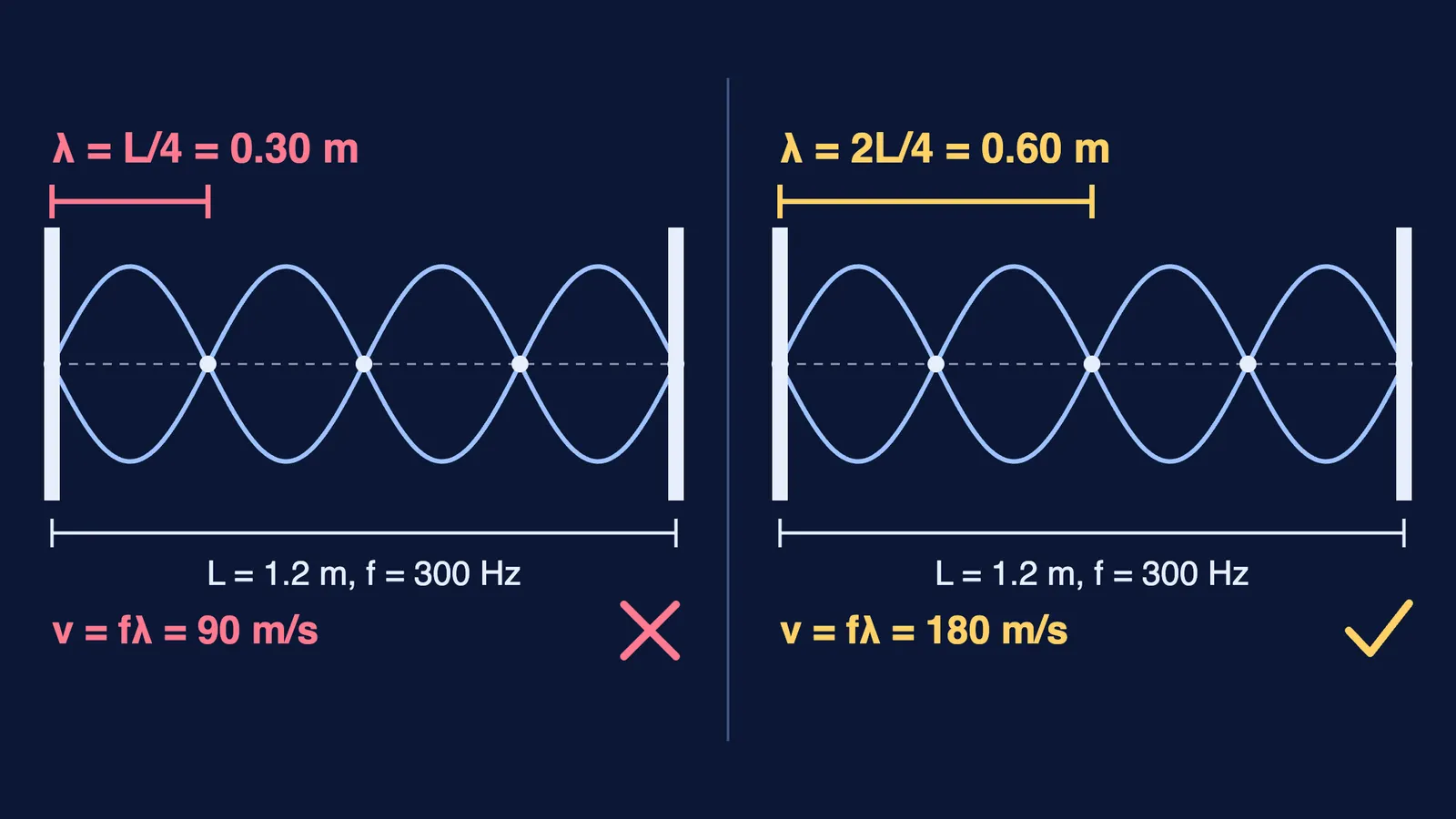
Wrong: a 1.2 m string fixed at both ends vibrates at 300 Hz with 4 loops, so λ = 1.2/4 = 0.30 m and v = 300 × 0.30 = 90 m/s.
Why it fails: adjacent nodes are λ/2 apart, so one loop is half a wavelength. The hero diagram above shows both readings side by side.
Fix: λ = 2L/n = 2 × 1.2/4 = 0.60 m, so v = 300 × 0.60 = 180 m/s.
Habit: mark nodes on your sketch and count two loops for each λ.
Giving standing-wave points different phases like a travelling wave.
Wrong: for y = 4 sin(2.5πx) cos(300πt) mm, points at x = 0.1 m and x = 0.3 m are 0.2 m apart, so they "differ in phase".
Why it fails: in a standing wave, all particles between two adjacent nodes move in the same phase with different amplitudes, as NCERT's chapter summary states. Crossing a node flips the phase by π.
Fix: nodes sit at x = 0, 0.4 m, 0.8 m. Both points are in the first loop, each with amplitude 4 sin(0.25π) ≈ 2.83 mm, and they move in phase. A point at x = 0.5 m, past the node, has the same amplitude but moves opposite to them.
Habit: locate the nodes first, then sort points by loop. For a related question, see where a standing wave's amplitude is half its maximum.
Stuck on why a standing wave still looks wrong in your head? The Fermi Simulation Lab has interactive simulations for the ideas that are easier to see than to read.
Why do beat answers come out halved?
Taking the envelope frequency as the beat frequency.
Wrong: two forks of 512 Hz and 506 Hz add to an amplitude term cos(2π × 3t), so "3 beats per second".
Why it fails: loudness peaks whenever that amplitude term reaches +1 or −1, which happens twice in each of its cycles. NCERT's section 14.7 shows the beat frequency is ν₁ − ν₂.
Fix: 512 − 506 = 6 beats per second.
Habit: after any beats algebra, check that your answer equals the plain difference of the two frequencies.
A 60-second self-check before you mark
Redo each slip on a fresh example the next day.