On this page
Waves is Chapter 14 of the NCERT Class 11 Physics Part II textbook (Reprint 2026-27) and sits in Unit X of the CBSE 2026-27 Physics syllabus. For solved numericals, read our Waves Class 11 chapter guide. The Doppler effect is not in the current chapter or syllabus, so it is left out.
What is a wave, and what kinds are there?
Wave: a travelling disturbance that carries energy while the medium only oscillates in place. Example: a cork on a pond bobs as ripples pass but does not drift outward. Don't confuse with: wind, which is air itself moving.
Mechanical wave: a wave that needs a material medium, so it cannot cross a vacuum. Example: sound, waves on a string.
Electromagnetic wave: a wave that needs no medium; in vacuum all of them travel at c = 299,792,458 m/s, as the NCERT chapter states. Example: light.
Transverse wave: particles oscillate at right angles to the direction of travel. Example: a pulse on a string. It needs a medium that resists shearing, so it travels in solids, not inside liquids or gases.
Longitudinal wave: particles oscillate along the direction of travel. Example: sound in air. It travels in solids, liquids and gases. Don't confuse with: transverse wave; steel carries both kinds, air only longitudinal.
Compression and rarefaction: regions of a longitudinal wave where the medium is squeezed (higher density) or spread out (lower density).
Progressive (travelling) wave: a wave whose pattern moves through the medium.
How do you describe a travelling wave?
A sinusoidal wave moving along +x is y(x, t) = a sin(kx − ωt + φ).
Displacement y(x, t): how far the element at x is from its rest position at time t; SI unit metre. For longitudinal waves it is written s(x, t).
Amplitude (a): the largest displacement, always positive; SI unit metre.
Crest and trough: the points of maximum positive and maximum negative displacement.
Phase: the whole argument kx − ωt + φ, which fixes the displacement at any place and instant.
Initial phase angle (φ): the phase at x = 0, t = 0; SI unit radian.
Wavelength (λ): the shortest distance between two points in the same phase, such as neighbouring crests; SI unit metre.
Angular wave number (k): k = 2π/λ; SI unit rad/m.
Period (T): time for one full oscillation of an element; SI unit second.
Frequency (ν): oscillations per second, ν = 1/T; SI unit hertz. The source sets it.
Angular frequency (ω): ω = 2π/T = 2πν; SI unit rad/s. Don't confuse with: frequency ν; a 50 Hz wave has ω of about 314 rad/s.
Wave speed (v): how fast a crest (any fixed phase) moves; v = λν = ω/k, SI unit m/s. Don't confuse with: an element's own velocity, which keeps changing as it oscillates.
What decides the speed of a wave?
The medium sets the speed, not the frequency. Numbers here are from the NCERT chapter.
Linear mass density (μ): mass per unit length of a string, SI unit kg/m; wave speed on a string is v = √(T/μ), T being tension in newtons. Example: a steel wire with μ = 6.9 × 10⁻³ kg/m under 60 N carries transverse waves at 93 m/s.
Bulk modulus (B): B = −ΔP/(ΔV/V); SI unit pascal. Longitudinal waves in a fluid travel at v = √(B/ρ), ρ being density; in a solid bar Young's modulus replaces B.
Newton's formula: v = √(P/ρ), assuming constant temperature. It gives 280 m/s for air at STP, about 15% below the measured 331 m/s.
Laplace correction: compressions are too fast for heat to flow, so B = γP (adiabatic) and v = √(γP/ρ). With γ = 7/5, air gives 331.3 m/s.
What happens when waves meet or reflect?
Principle of superposition: overlapping waves add their displacements algebraically, and each carries on as if the others were absent. Example: equal, opposite pulses cancel briefly, then pass through unchanged.
Interference: for two equal waves differing in phase by φ, the resultant amplitude is 2a cos(φ/2).
Constructive interference: waves in phase (φ = 0 or a multiple of 2π) give amplitude 2a. Don't confuse with: destructive interference, φ = π, where they cancel.
Reflection at a rigid boundary: the wave returns inverted, a phase change of π, because the fixed end cannot move. Don't confuse with: an open boundary, such as an organ pipe's open end, with no phase change.
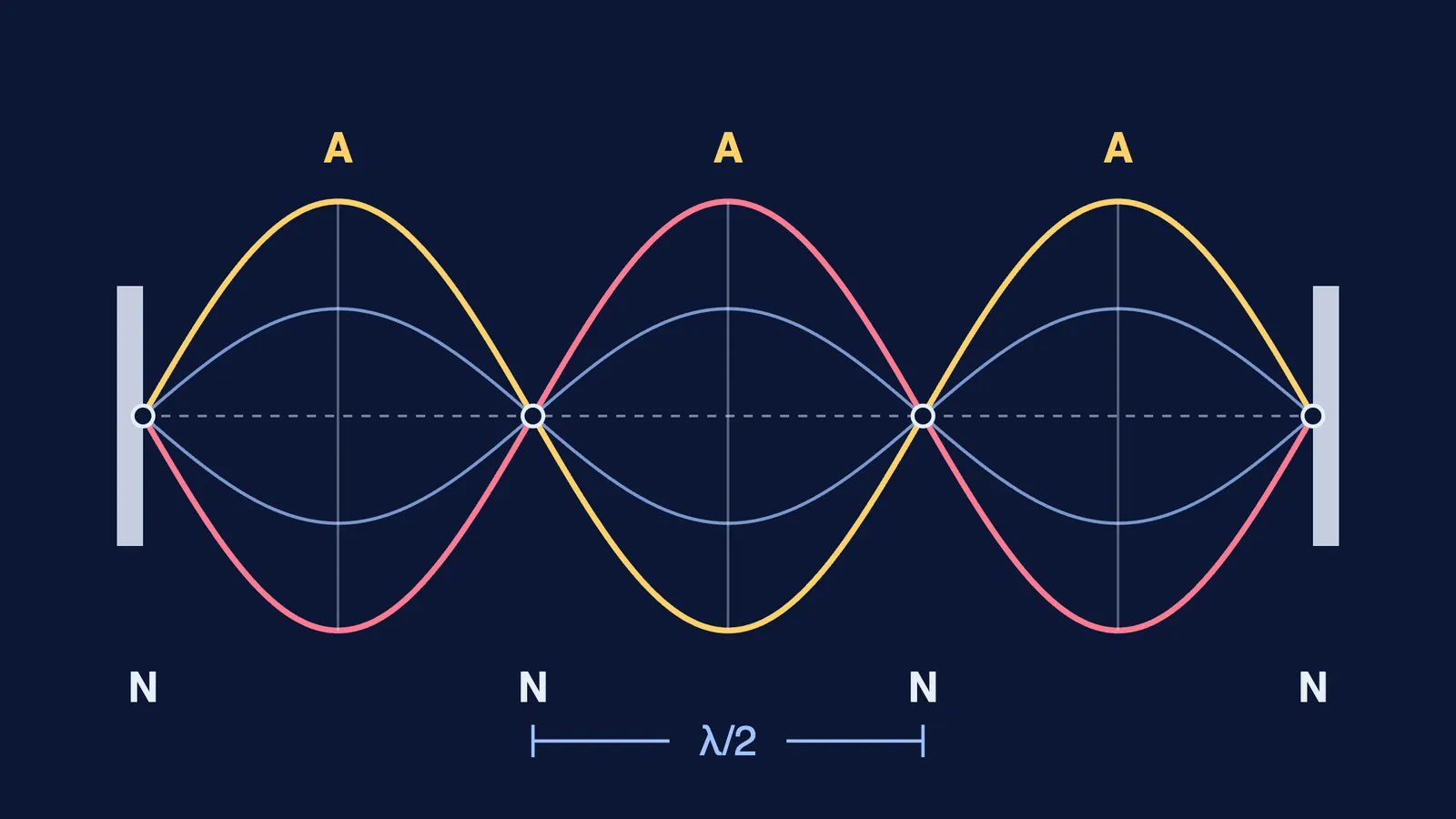
Standing (stationary) wave: two identical waves travelling in opposite directions give y = 2a sin kx cos ωt, a pattern that does not move along.
Node and antinode: a node never moves; an antinode swings widest. Neighbouring nodes are λ/2 apart.
What are normal modes, harmonics and beats?
Numbers here come from Example 14.5 and Fig. 14.16 of the NCERT chapter.
Normal modes: the only frequencies at which a string fixed at both ends or an air column can hold a standing wave.
Fundamental mode (first harmonic): the lowest one; v/2L for a string of length L fixed at both ends.
Harmonics: strings and open pipes give all harmonics, nv/2L; a pipe closed at one end gives only odd ones, v/4L, 3v/4L, 5v/4L. Example: at 330 m/s, a 30.0 cm open pipe has a 550 Hz fundamental; closed at one end, 275 Hz.
Resonance: a large response when a source drives a system near one of its natural frequencies.
Beats: the rise and fall in loudness when two close frequencies sound together, at |ν₁ − ν₂| per second. Example: 11 Hz and 9 Hz give 2 Hz beats. Don't confuse with: the pitch heard, the average of the two.
How to learn these terms
Learn mix-ups as pairs: transverse vs longitudinal, progressive vs standing, node vs antinode, Newton vs Laplace, ν vs ω.
Draw a string and a closed pipe in their first three modes; mark every N and A.
Write each relation with SI units: v = λν, k = 2π/λ, ω = 2πν.
Test yourself with our assertion-reason traps on waves and oscillations and the waves and sound guide for JEE Main.
If a term still feels abstract, the Fermi Concept Library gives every concept in physics its own lesson.