On this page
This sheet groups the Waves formulas by topic, with each symbol's SI unit, the condition it needs, a worked example and the slip to watch for.
The CBSE Class XI Physics syllabus 2026-27 covers wave speed, the progressive-wave relation, superposition, reflection, standing waves in strings and organ pipes, harmonics and beats for Chapter 14. The formulas follow NCERT Class 11 Physics Part 2, Chapter 14 (Reprint 2026-27). The Doppler effect is not in the rationalised chapter, so it is left out. See also our Waves Class 11 physics guide with solved numericals.
What are the formulas for a progressive wave?
Symbols: y = displacement (m); a = amplitude (m); x = position (m); t = time (s); k = angular wave number (rad/m); ω = angular frequency (rad/s); φ = phase constant (rad); λ = wavelength (m); T = period (s); ν = frequency (Hz); v = wave speed (m/s). Sign convention: (kx − ωt) moves towards +x, (kx + ωt) towards −x.
Wave moving along +x: y(x, t) = a sin(kx − ωt + φ) (m)
Angular wave number: k = 2π/λ (rad/m)
Period T = 2π/ω (s); frequency ν = 1/T = ω/2π (Hz)
Wave speed: v = ω/k = λ/T = λν (m/s)
Worked example: for y = 0.004 sin(50x − 300t) in SI units, k = 50 rad/m and ω = 300 rad/s, so λ = 2π/50 ≈ 0.126 m, ν = 300/2π ≈ 47.7 Hz and v = ω/k = 300/50 = 6.0 m/s.
Watch for: reading the coefficient of x as λ. It is k, so λ = 2π/k.
How do you calculate the speed of a wave?
Symbols: T = tension in the string (N; not the period here); μ = linear mass density (kg/m); B = bulk modulus (Pa); Y = Young's modulus (Pa); ρ = density (kg/m³); P = gas pressure (Pa); γ = ratio of specific heats Cp/Cv (no unit).
Transverse wave on a stretched string: v = √(T/μ) (m/s)
Longitudinal wave in a fluid: v = √(B/ρ) (m/s)
Longitudinal wave in a thin solid bar (lateral expansion negligible): v = √(Y/ρ) (m/s)
Sound in a gas, Newton's formula (assumes isothermal changes, B = P): v = √(P/ρ) (m/s)
Sound in a gas with the Laplace correction (adiabatic changes, B = γP): v = √(γP/ρ) (m/s)
Worked example: a string with tension 90 N and μ = 0.010 kg/m gives v = √(90/0.010) ≈ 94.9 m/s. For air at P = 1.01 × 10⁵ Pa, ρ = 1.20 kg/m³, γ = 1.4: Newton gives ≈ 290 m/s, Laplace ≈ 343 m/s.
Watch for: using the whole string's mass for μ. Divide mass (kg) by length (m) first.
Superposition and reflection of waves
Principle of superposition: y = f₁(x − vt) + f₂(x − vt) + ... + fₙ(x − vt), the algebraic sum of the displacements (m)
Two equal waves (amplitude a, same ω and direction), phase difference φ (rad): y(x, t) = 2a cos(φ/2) sin(kx − ωt + φ/2), amplitude 2a cos(φ/2) (m)
Constructive at φ = 0, 2π...: amplitude 2a (m); destructive at φ = π: 0
Reflection at a rigid boundary: phase change of π (rad); at an open boundary: no phase change
Worked example: two waves of amplitude 3.0 mm each with phase difference π/3 give a resultant amplitude 2 × 3.0 × cos(π/6) ≈ 5.20 mm.
Watch for: using cos φ instead of cos(φ/2), which gives 3.0 mm here.
What are the formulas for standing waves in strings and pipes?
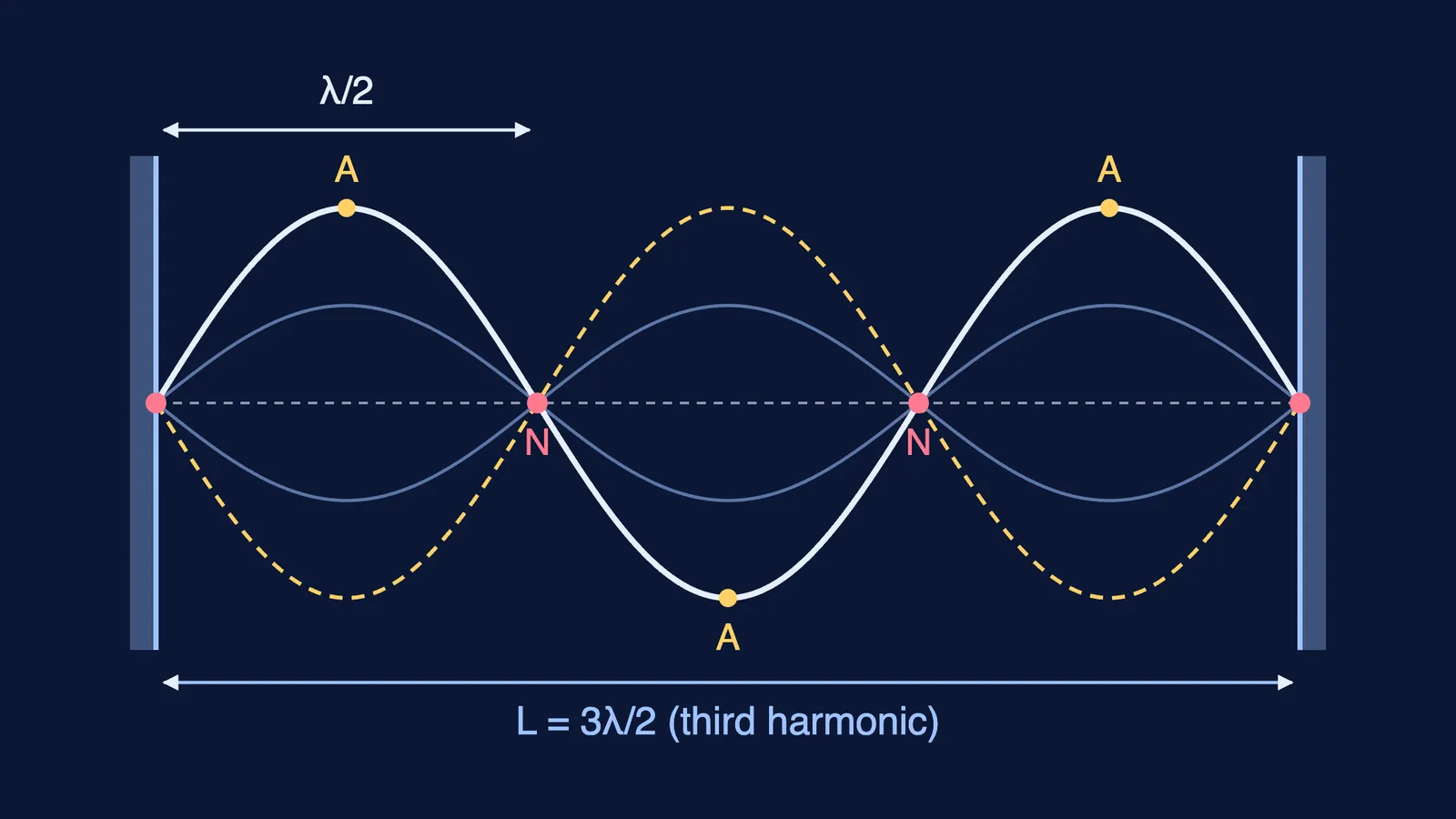
Symbols: L = length of the string or air column (m); n = mode number (no unit); v = wave speed (m/s); ν = frequency (Hz). Conditions: fixed string ends and closed pipe ends are nodes; open ends are antinodes.
Standing wave (two equal waves, opposite directions): y(x, t) = [2a sin kx] cos ωt (m)
Nodes: x = nλ/2, n = 0, 1, 2... (m); antinodes: x = (n + ½)λ/2, n = 0, 1, 2... (m); node to node is λ/2
String fixed at both ends: L = nλ/2, so λ = 2L/n (m) and ν = nv/2L (Hz), n = 1, 2, 3...
Pipe closed at one end: ν = (n + ½)v/2L (Hz), n = 0, 1, 2...; fundamental v/4L, then odd harmonics 3v/4L, 5v/4L...
Pipe open at both ends: ν = nv/2L (Hz), n = 1, 2, 3...; all harmonics are present
Worked example: a 0.80 m string with v = 240 m/s has fundamental 240/(2 × 0.80) = 150 Hz and third harmonic 450 Hz. A 0.25 m pipe with v = 340 m/s has fundamental 340/(4 × 0.25) = 340 Hz if closed at one end (next mode 1020 Hz) and 340/(2 × 0.25) = 680 Hz if open at both ends.
Watch for: calling 3v/4L a closed pipe's second harmonic. Only odd harmonics exist; it is the third.
Beats
Symbols: ν₁, ν₂ = frequencies of two sound waves (Hz), each of amplitude a (m); ω₁, ω₂ = angular frequencies (rad/s). Condition: |ν₁ − ν₂| ≪ ν₁, ν₂.
Resultant at one point: s = 2a cos[(ω₁ − ω₂)t/2] cos[(ω₁ + ω₂)t/2] (m)
Beat frequency = |ν₁ − ν₂| (Hz)
Worked example: a 512 Hz tuning fork and an unknown fork give 5 beats per second. The unknown frequency is 507 Hz or 517 Hz; one more test, such as loading a fork with wax and noting whether the beat rate rises or falls, decides which.
Watch for: halving the difference. Loudness peaks twice per cycle of cos[(ω₁ − ω₂)t/2], so the beat frequency is |ν₁ − ν₂|.
How to revise this formula sheet
Start each numerical from v = λν and k = 2π/λ.
Keep the two T's apart: tension (N) in √(T/μ), period (s) in T = 2π/ω.
For strings and pipes, sketch the mode before picking a formula; nodes are always λ/2 apart.
Revise the working behind these results with our step-by-step Waves Class 11 derivations, then test yourself on the oscillations and waves case study questions.
If standing waves are hard to picture, try the Fermi Simulation Lab: interactive simulations for ideas easier to see than to read.