On this page
Waves is Chapter 14 of the rationalised NCERT Class 11 Physics Part II textbook, and the CBSE 2026-27 Class XI Physics curriculum lists its topics: wave speed, the progressive wave, superposition, reflection, standing waves in strings and organ pipes, and beats. Below, its six derivations, rebuilt step by step. For the chapter overview, see our Waves Class 11 guide with solved numericals.
Throughout, y(x, t) = a sin(kx − ωt + φ): a is amplitude, k = 2π/λ angular wave number, ω = 2πν angular frequency.
Speed of a travelling wave: v = ω/k = λν
Setup: y = a sin(kx − ωt) moving along +x; follow one crest.
A crest has fixed phase: kx − ωt = constant.
Differentiate with respect to time: k(dx/dt) − ω = 0.
The crest's speed is v = dx/dt = ω/k.
Put ω = 2πν and k = 2π/λ: v = (2πν)/(2π/λ).
Result: v = ω/k = λν; the wave moves one wavelength per period.
Where students slip: treating v as a particle's speed. Particles only oscillate; v is the speed of the pattern.
Speed of a transverse wave on a string: v = √(T/μ)
Setup: a stretched string with tension T and mass per unit length μ = m/L. NCERT uses dimensional analysis here.
Assume only T and μ matter.
Dimensions: [T] = [MLT⁻²] and [μ] = [ML⁻¹].
Divide: [T/μ] = [L²T⁻²], which is the square of a speed.
So v = C√(T/μ), where C is a dimensionless constant this method cannot find.
The exact treatment gives C = 1.
Result: v = √(T/μ), set by the string alone, not by frequency.
Where students slip: using total mass m instead of μ. NCERT's 0.72 m, 5.0 × 10⁻³ kg wire at 60 N has μ = 6.9 × 10⁻³ kg/m and v ≈ 93 m/s.
How is the speed of sound in a gas derived, from Newton to Laplace?
Setup: a longitudinal wave in an ideal gas, with bulk modulus B = −ΔP/(ΔV/V) and density ρ.
The same dimensional argument as for the string gives v = √(B/ρ).
Newton assumed the compressions are isothermal, so PV = constant.
Differentiate: V ΔP + P ΔV = 0, so −ΔP/(ΔV/V) = P, which means B = P.
Newton's formula: v = √(P/ρ). For air at STP NCERT gets about 280 m/s, about 15% below the measured 331 m/s.
Laplace: compressions are too fast for heat flow, so they are adiabatic: PV^γ = constant, γ = Cp/Cv.
Differentiate: γPV^(γ−1) ΔV + V^γ ΔP = 0, which gives B = γP.
With γ = 7/5 for air, v = √(γP/ρ) gives about 331 m/s.
Result: v = √(γP/ρ) for sound in an ideal gas (the Laplace correction to Newton's √(P/ρ)).
Where students slip: writing PV = constant in the Laplace step, or putting γ outside the root.
Standing waves on a string fixed at both ends: ν = nv/2L
Setup: two equal waves travel in opposite directions on a string of length L clamped at x = 0 and x = L.
Write them as y₁ = a sin(kx − ωt) and y₂ = a sin(kx + ωt).
Superpose: y = y₁ + y₂, and use sin(A + B) + sin(A − B) = 2 sin A cos B.
y = 2a sin kx cos ωt. With kx and ωt in separate factors, the pattern does not travel.
Nodes, where sin kx = 0: kx = nπ, so x = nλ/2. Antinodes: x = (n + ½)λ/2.
A node is needed at x = L too, so L = nλ/2, giving λ = 2L/n.
Use ν = v/λ.
Result: ν = nv/2L, n = 1, 2, 3, …; the fundamental is v/2L and all harmonics are present.
Where students slip: starting n at 0; the string's first mode is n = 1.
Air column closed at one end: ν = (n + ½)v/2L
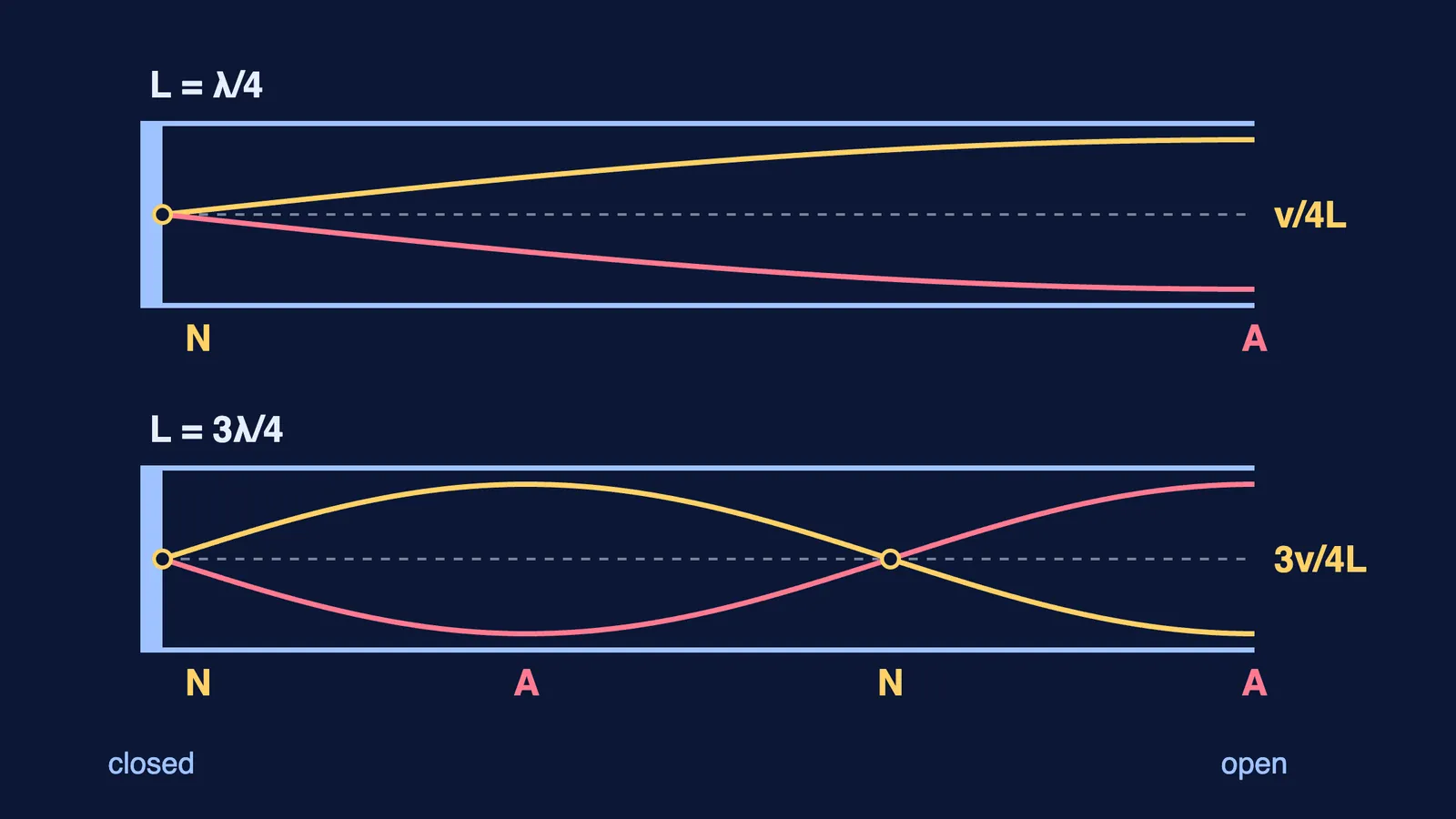
Setup: a pipe of length L, closed at x = 0 (displacement node) and open at x = L (antinode), as in the diagram above.
Reuse the standing-wave form; the closed end is already a node.
An antinode at x = L needs L = (n + ½)λ/2, n = 0, 1, 2, …
So λ = 2L/(n + ½).
Use ν = v/λ.
Result: ν = (n + ½)v/2L, that is v/4L, 3v/4L, 5v/4L…; only odd harmonics exist.
Where students slip: copying the open-pipe formula. A pipe open at both ends gives all harmonics, nv/2L; the closed pipe skips the even ones.
Why is the beat frequency ν₁ − ν₂?
Setup: two equal-amplitude sound waves with close angular frequencies ω₁ > ω₂, observed at x = 0.
Write s₁ = a cos ω₁t and s₂ = a cos ω₂t.
Superpose and use cos A + cos B = 2 cos((A − B)/2) cos((A + B)/2).
s = [2a cos ω_b t] cos ω_a t, with ω_b = (ω₁ − ω₂)/2 and ω_a = (ω₁ + ω₂)/2.
As ω_b is much smaller than ω_a, you hear the average frequency with slowly varying amplitude 2a cos ω_b t.
Loudness peaks when cos ω_b t is +1 or −1, twice per cycle, so at angular frequency 2ω_b = ω₁ − ω₂.
Divide by 2π.
Result: ν_beat = ν₁ − ν₂.
Where students slip: answering (ν₁ − ν₂)/2. Two loud peaks per cycle cancel the factor of 2.
How should you practise Waves derivations?
Derive the standing wave once and reuse it: string and pipe differ only in where nodes and antinodes sit. Sketch the ends first.
Write PV = constant and PV^γ = constant side by side and derive B from each.
Check dimensions and one limit after every result: does v rise with tension?
Test yourself with the case study questions on oscillations and waves for Class 11, and revisit why frequency stays the same when a wave changes medium when v = λν starts to blur.
If nodes and antinodes in a pipe are hard to picture, the Fermi Simulation Lab has interactive simulations for ideas that are easier to see than to read.