

On this page
What do these case-study questions cover?
The CBSE Physics curriculum for 2026-27 puts Oscillations (Chapter 13) and Waves (Chapter 14) together in Unit X of Class XI, worth 10 of the 70 theory marks.
Class 11 exams are set by your school, so treat these as case-based practice. Every fact below matches the NCERT chapters Oscillations and Waves (Reprint 2026-27); the scenarios and numbers are our own. Take g = 9.8 m s⁻². For theory, see our Oscillations Class 11 guide and the Waves Class 11 guide.
Case 1: How long does one swing take?
At a school in Lucknow, the physics teacher hangs a 2.0 kg iron bob from the top-floor railing of the stairwell on a thin steel wire. The distance from the support to the centre of the bob is 2.45 m. She pulls the bob 30 cm to one side and lets go. Ishaan starts a phone stopwatch as the bob passes the lowest point and stops it after 10 complete oscillations: it reads 31.4 s, and the class uses that reading to work out g.
(i) If the 2.0 kg bob is replaced by a 1.0 kg bob of the same size, the period (a) doubles (b) halves (c) stays the same (d) becomes √2 times larger
(ii) What are the period and the frequency of the pendulum?
(iii) The support-to-centre distance is cut to one-fourth. What is the new period?
(iv) Use Ishaan's reading to find g. Is the small-angle formula justified for a 30 cm pull?
Answers.
(i) (c). T = 2π√(L/g) has no mass in it.
(ii) T = 31.4 ÷ 10 = 3.14 s. Frequency = 1/T = 1 ÷ 3.14 = 0.32 Hz.
(iii) T ∝ √L, so a quarter of the length halves the period: 3.14 ÷ 2 = 1.57 s.
(iv) g = 4π²L/T² = 4 × 9.87 × 2.45 ÷ (3.14)² = 9.81 m s⁻². The angular amplitude is about 0.30 ÷ 2.45 = 0.12 rad, roughly 7°. NCERT shows sin θ stays close to θ up to about 20°, so the formula holds.
Case 2: How fast is the trolley at 3 cm?
In a Bhopal school lab, a 0.40 kg trolley sits on a smooth horizontal track, joined to a wall by a light spring. Pulling the trolley with a spring balance, Riya finds that a 1.2 N force stretches the spring by 3.0 cm. She then pulls the trolley 5.0 cm from its rest position and releases it from rest. A motion sensor logs the position many times a second, and the class compares its readings with the SHM formulas. Ignore friction.
(i) Where is the trolley's acceleration greatest? (a) at the mean position (b) at either extreme (c) halfway out (d) it is the same everywhere
(ii) Find the force constant of the spring.
(iii) Find the period of oscillation and the trolley's maximum speed.
(iv) Find the total energy, and the trolley's speed when it is 3.0 cm from the mean position.
Answers.
(i) (b). In SHM a = −ω²x, so the size of the acceleration is largest where |x| is largest.
(ii) k = F/x = 1.2 ÷ 0.030 = 40 N m⁻¹.
(iii) ω = √(k/m) = √(40 ÷ 0.40) = 10 rad s⁻¹, so T = 2π/ω = 0.63 s. Maximum speed = ωA = 10 × 0.050 = 0.50 m s⁻¹.
(iv) E = ½kA² = ½ × 40 × (0.050)² = 0.050 J. At x = 0.030 m, U = ½kx² = ½ × 40 × (0.030)² = 0.018 J, so K = 0.050 − 0.018 = 0.032 J. Then v = √(2K/m) = √(2 × 0.032 ÷ 0.40) = 0.40 m s⁻¹. Check: ω√(A² − x²) = 10 × 0.040 = 0.40 m s⁻¹.
Case 3: Why does the tanpura beat against the fork?
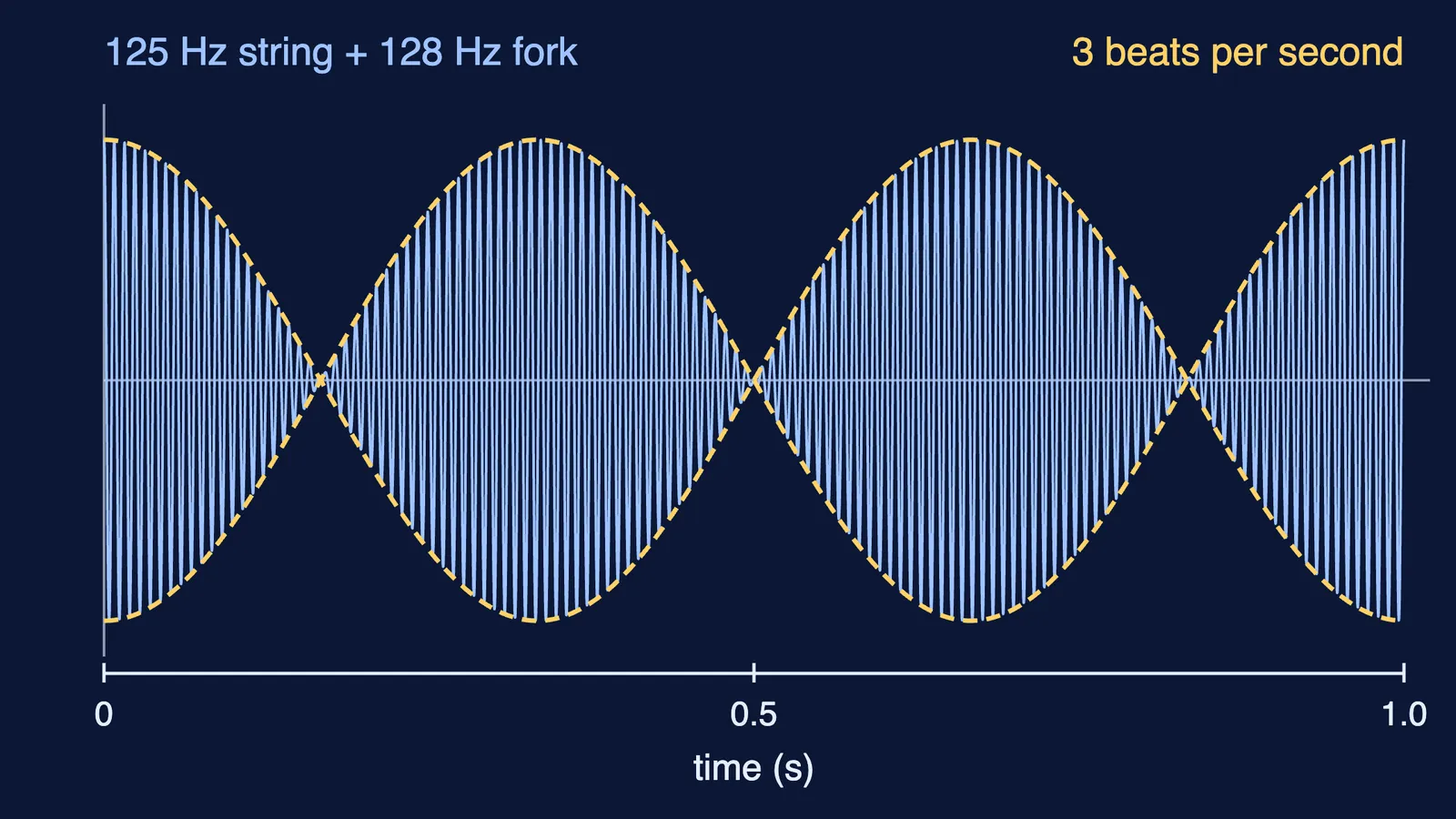
A tanpura maker in Pune is fitting a new steel string. The vibrating length between the bridge and the nut is 0.80 m, and the string has a linear mass density of 5.0 × 10⁻⁴ kg m⁻¹. She first sets the tension to 20 N and plucks the string while a 128 Hz tuning fork sounds next to it. She hears the loudness rise and fall a few times a second. When she tightens the peg slightly, the waxing and waning slows down.
(i) For a string fixed at both ends, the two ends are always (a) nodes (b) antinodes (c) a node and an antinode (d) neither
(ii) What is the speed of transverse waves on the string at 20 N?
(iii) Find the fundamental frequency at 20 N and the number of beats heard per second with the fork.
(iv) What tension makes the beats disappear? Why would the beats speed up again if she kept tightening past it?
Answers.
(i) (a). Fixed ends cannot move, so they are nodes.
(ii) v = √(T/μ) = √(20 ÷ 5.0 × 10⁻⁴) = √40,000 = 200 m s⁻¹.
(iii) ν₁ = v/2L = 200 ÷ 1.6 = 125 Hz. Beat frequency = 128 − 125 = 3 Hz.
(iv) For 128 Hz, v = 2Lν = 1.6 × 128 = 204.8 m s⁻¹, so T = μv² = 5.0 × 10⁻⁴ × (204.8)² = 21.0 N, about 5% more. More tension raises the frequency, so past 21.0 N the string goes above 128 Hz and the difference, the beat frequency, grows again.
How to attack case-study questions
Underline every number with its unit, and convert cm and g to m and kg first.
Identify the oscillator: pendulum (T depends on L and g), spring (T depends on m and k) or wave (v depends on the medium).
For timing data, divide by the number of complete oscillations.
Draw nodes and antinodes before any formula: a string fixed at both ends gives v/2L; a pipe closed at one end gives v/4L, odd harmonics only.
End with one sentence linking your number back to the story.
Our guide to case-based questions covers pacing. If standing waves or beats are hard to picture, the Fermi Simulation Lab has interactive simulations for the ideas that are easier to see than to read.


