On this page
Four of these Wave Optics derivations rest on one figure, and the fifth on one trigonometric identity: learn that and you can rebuild the result. Below are five derivations from the 2026-27 NCERT chapter that the CBSE syllabus covers, with each step in plain words and the place students usually slip.
Which Wave Optics derivations are in the 2026-27 syllabus?
The CBSE Class XII Physics syllabus 2026-27 lists proofs of the laws of reflection and refraction using Huygens' principle, coherent sources and sustained interference, and Young's double-slit experiment. For the fringe width it says "No derivation final expression only", and it treats single-slit diffraction qualitatively. The textbook is NCERT Class 12 Physics, Chapter 10 (Reprint 2026-27). The syllabus does not name polarisation (Section 10.7), so it is left out here.
For Young's experiment, learn the result: bright fringes at x = nλD/d, dark fringes at x = (n + ½)λD/d, so the fringe width is β = λD/d, where d is the slit separation and D the slit-to-screen distance.
Snell's law from Huygens' principle: n₁ sin i = n₂ sin r
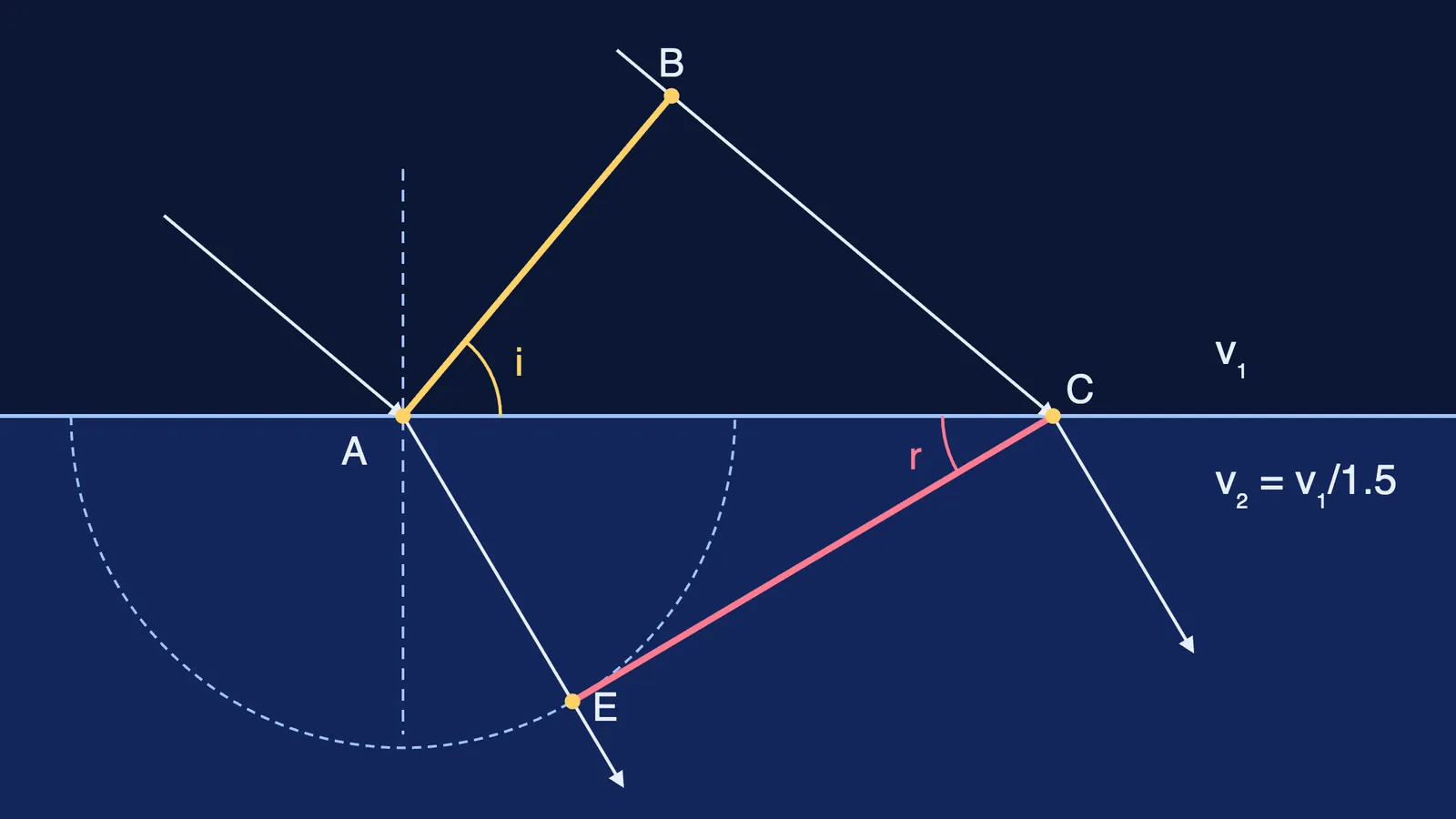
Setup: a plane wavefront AB meets the surface between medium 1 (speed v₁) and a denser medium 2 (speed v₂ < v₁) at angle i, as in the figure above this article (NCERT Fig. 10.4).
Let τ be the time the edge B takes to reach the surface at C, so BC = v₁τ.
In that same time, a secondary wavelet from A spreads into medium 2 with radius AE = v₂τ.
The tangent from C to this wavelet, CE, is the refracted wavefront.
In right triangle ABC (right angle at B), sin i = BC/AC = v₁τ/AC.
In right triangle AEC (right angle at E), sin r = AE/AC = v₂τ/AC.
Divide: sin i/sin r = v₁/v₂.
Put v₁ = c/n₁ and v₂ = c/n₂, where n is the refractive index.
Result: sin i/sin r = v₁/v₂ = n₂/n₁, that is, n₁ sin i = n₂ sin r.
Where students slip: drawing the wavelet from C instead of A. The wavelet starts from the point that hits the surface first.
Wavelength on refraction: v₁/λ₁ = v₂/λ₂
Setup: the same figure, with BC chosen to be exactly one wavelength λ₁ in medium 1.
A crest at B reaches C in time τ, so a crest at A reaches E in the same τ.
That makes AE one wavelength in medium 2: AE = λ₂.
From the Snell construction, BC/AE = v₁τ/v₂τ = v₁/v₂.
So λ₁/λ₂ = v₁/v₂, which rearranges to v₁/λ₁ = v₂/λ₂.
Result: v/λ, the frequency, is the same in both media; only speed and wavelength change.
Where students slip: writing that the frequency drops in glass. Speed and wavelength fall together.
Refraction into a rarer medium: sin ic = n₂/n₁
Setup: the same construction with v₂ > v₁, so the wavelet AE is now longer than BC (NCERT Fig. 10.5).
The Snell proof still gives n₁ sin i = n₂ sin r.
Because n₂ < n₁, r comes out larger than i: the light bends away from the normal.
As i grows, r reaches 90°. Call that angle of incidence ic.
Put r = 90°: n₁ sin ic = n₂ × 1.
Result: sin ic = n₂/n₁; for i > ic there is no refracted wave and the light is totally internally reflected.
Where students slip: writing n₁/n₂. Check that the sine comes out below 1; for glass (n = 1.5) to air, sin ic = 1/1.5 gives ic ≈ 41.8°.
Law of reflection from Huygens' principle: i = r
Setup: a plane wavefront AB meets a reflecting surface MN at angle i; the medium has one speed v throughout (NCERT Fig. 10.6).
Edge B reaches the surface at C in time τ, so BC = vτ.
In the same time, the wavelet from A, staying in the same medium, has radius AE = vτ.
The tangent CE from C to this wavelet is the reflected wavefront.
Triangles ABC and AEC each have a right angle (at B and at E), share the hypotenuse AC, and have BC = AE.
So the triangles are congruent, and the angle the incident wavefront makes with the surface equals the angle the reflected one makes.
Result: angle of incidence i = angle of reflection r.
Where students slip: skipping the congruence reason. Name all three conditions: right angle, common hypotenuse, equal side.
Two coherent waves: I = 4I₀ cos²(φ/2)
Setup: two coherent sources S₁ and S₂ vibrating in phase send waves of equal amplitude a to a point, arriving with a phase difference φ (NCERT Section 10.4).
Write the two displacements: y₁ = a cos ωt and y₂ = a cos(ωt + φ).
Add them: y = a[cos ωt + cos(ωt + φ)].
Use cos A + cos B = 2 cos((A + B)/2) cos((A − B)/2): y = 2a cos(φ/2) cos(ωt + φ/2).
The resultant amplitude is 2a cos(φ/2).
Intensity goes as amplitude squared, and one source alone gives I₀ ∝ a².
Result: I = 4I₀ cos²(φ/2); maximum 4I₀ when φ = 0, ±2π, ±4π…, zero when φ = ±π, ±3π…
Where students slip: answering 2I₀ for the bright fringe. 2I₀ is the time-averaged intensity of incoherent sources, whose phase difference changes rapidly; coherent sources give 4I₀ at a maximum.
How should you practise Wave Optics derivations?
Draw the refraction figure from memory first: wavefront, normal, wavelet arc, tangent. Label A, B, C, E before writing any equation.
Write the Snell and reflection proofs side by side. They differ in one line, AE = v₂τ against AE = vτ, which is why one gives a ratio and the other equality.
For the intensity result, practise the sum-to-product step until you can write it without looking.
Test yourself with the case studies in our Wave Optics case study questions, then plan revision with the Wave Optics Class 12 board exam guide. For the other optics chapter, see the Ray Optics Class 12 board exam guide.
If the wavelet construction is hard to picture, the Fermi Simulation Lab has interactive simulations for the ideas that are easier to see than to read.