On this page
Here are three original Wave Optics case studies, easy to hard, each with four parts and worked answers.
What do these Wave Optics case studies cover?
The CBSE 2026-27 Physics sample paper has two case study-based questions of four marks each in Section D, and calculators are not allowed, so every number here works out by hand.
The cases stay inside the Wave Optics list in the CBSE 2026-27 Class 12 Physics syllabus. Facts were checked against NCERT Class 12 Physics Part II, Chapter 10, Wave Optics (Reprint 2026-27). For the full chapter plan, read our Wave Optics Class 12 board exam guide.
Case 1: Why does a laser beam bend in an aquarium?
Meera keeps an aquarium at home in Pune. She shines a red laser pointer of wavelength 650 nm (in air) into the water, whose refractive index is 4/3. The beam is effectively parallel. She tilts the pointer so that the angle of incidence on the water surface has a sine of 0.80 (about 53°). Her brother says the light's frequency must drop in water because it slows down. Take c = 3 × 10⁸ m/s.
(i) The wavefront of the laser beam is: (a) spherical (b) cylindrical (c) plane (d) elliptical
(ii) Find the speed of the light in water.
(iii) Find the wavelength and frequency of the light in water.
(iv) Find the angle of refraction, and use Huygens' construction to explain why the beam bends towards the normal.
Answers.
(i) (c) plane. Parallel rays are perpendicular to plane wavefronts.
(ii) v = c/n = (3 × 10⁸)/(4/3) = 2.25 × 10⁸ m/s.
(iii) λ = 650/(4/3) = 487.5 nm. The frequency is unchanged: f = c/λ = (3 × 10⁸)/(650 × 10⁻⁹) ≈ 4.6 × 10¹⁴ Hz in both media. The brother is wrong: water's atoms oscillate at the incoming frequency and re-emit at it.
(iv) sin r = 0.80 × 3/4 = 0.60, so r ≈ 37°. In the time τ the wavefront in air moves v₁τ, while the wavelet in water moves only v₂τ. So sin i/sin r = v₁/v₂ > 1, and r < i.
Case 2: Why do two torches never make fringes?
In a Class 12 lab in Kochi, students light two pinholes with two separate torches and see only an even patch of light. Their teacher sends one green laser beam of wavelength 532 nm through a double slit with separation 0.38 mm. Bright and dark bands appear on a wall 1.5 m away. Ravi wants the fringes at least 3.0 mm apart.
(i) The torches give no fringes because the two sources: (a) differ in intensity (b) have no fixed phase difference (c) are too far apart (d) emit white light
(ii) Find the fringe width on the wall.
(iii) How far from the central bright fringe is the third dark fringe?
(iv) With the same laser, give two separate changes that make the fringe width at least 3.0 mm, with the value needed for each.
Answers.
(i) (b). An ordinary source undergoes abrupt phase changes in times of the order of 10⁻¹⁰ s, so two such sources are incoherent and their intensities just add. Two slits lit by one source stay locked in phase.
(ii) β = λD/d = (532 × 10⁻⁹ × 1.5)/(0.38 × 10⁻³) = 2.1 × 10⁻³ m = 2.1 mm.
(iii) Dark fringes sit at x = (n + 1/2)λD/d. The third is n = 2, so x = 2.5 × 2.1 = 5.25 mm.
(iv) Reduce the slit separation to d = λD/β = (532 × 10⁻⁹ × 1.5)/(3.0 × 10⁻³) = 0.266 mm or less; or keep d and move the wall to D = βd/λ ≈ 2.14 m or more.
Case 3: Can diffraction measure a gap?
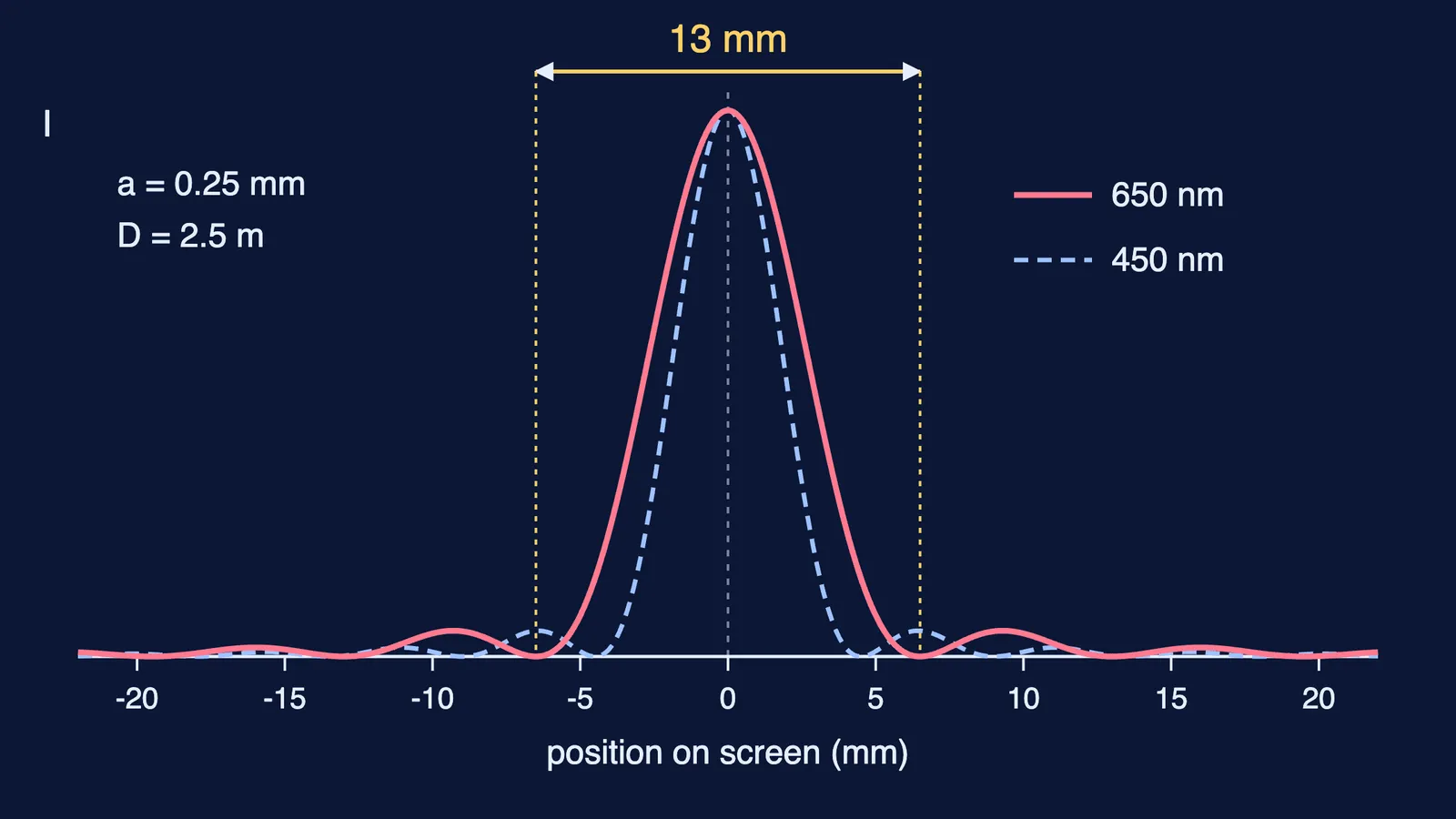
A tool workshop in Coimbatore checks the gap between two straight blade edges by shining a 650 nm red laser through it onto a screen 2.5 m away. The screen shows a central bright band 13 mm wide between the first dark bands, with fainter bands beside it. The workshop also has a 450 nm blue laser. A trainee says the dark bands prove that light energy is destroyed at the gap.
(i) If the gap is made narrower, the central bright band becomes: (a) narrower (b) wider (c) unchanged (d) dark
(ii) Write the angle of the first dark band from the centre in terms of the gap width a and λ. Hence find a.
(iii) With the 450 nm laser and the same gap, how wide is the central band?
(iv) With the red laser, the gap is halved. Find the new width of the central band, and say whether the trainee is right.
Answers.
(i) (b) wider. The first minima are at θ ≈ ±λ/a, so a smaller a spreads the band.
(ii) θ ≈ λ/a. The band runs from −6.5 mm to +6.5 mm, so λ/a = (6.5 × 10⁻³)/2.5 = 2.6 × 10⁻³ rad and a = (650 × 10⁻⁹)/(2.6 × 10⁻³) = 0.25 mm.
(iii) For a fixed gap the width is proportional to λ: 13 × 450/650 = 9.0 mm.
(iv) The width is 2λD/a, so it varies as 1/a: halving a to 0.125 mm doubles it to 26 mm. The trainee is wrong. In diffraction, light energy is redistributed: the dark bands get less, the bright bands get more, and there is no gain or loss.
How to attack case-study questions
List the numbers first. Write λ, d, D, a and n in metres before substituting.
Read the plain-words clue. "Two separate sources" means coherence; "parallel beam" means a plane wavefront; one narrow opening means diffraction.
Use ratios when one thing changes. Case 3 (iii) needs only width ∝ λ.
Watch the half-width trap. Single-slit minima are at ±λ/a, so the central band is twice the distance to one minimum.
Write the formula, then the numbers. The method then shows even if the arithmetic slips.
If a pattern is hard to picture, the Fermi Simulation Lab has interactive simulations for the ideas that are easier to see than to read. For more practice, try our Wave Optics assertion-reason questions and our guide to case-based questions in board exams.