On this page
In Wave Optics, most statements sound familiar. The marks go to whoever can tell a true reason from the right one. These 10 original questions run from easy to hard.
What do these Wave Optics questions cover?
Every item stays inside the wave-optics part of Unit 16, Optics, in the NEET (UG)-2026 syllabus published by the National Medical Commission. Each statement was checked against NCERT Class 12 Physics Part II, Chapter 10, Wave Optics (Reprint 2026-27). New to the chapter? Start with our guide on how to prepare Optics for NEET.
How do you answer assertion-reason questions?
Judge each statement alone. If both are true, say "A, because R" and check that R is the actual cause.
Assertion-reason keys (Q1 to Q6):
(A) Both A and R are true and R is the correct explanation of A.
(B) Both A and R are true but R is NOT the correct explanation of A.
(C) A is true but R is false.
(D) A is false but R is true.
Statement I and II keys (Q7 to Q10):
(A) Both statements are correct.
(B) Both statements are incorrect.
(C) Statement I is correct, Statement II is incorrect.
(D) Statement I is incorrect, Statement II is correct.
Assertion-reason questions on Wave Optics
Q1 (easy). Assertion (A): When light passes from air into glass, its frequency does not change. Reason (R): The atoms of the glass are driven into forced oscillation by the incoming light, and they re-emit light at the frequency at which they are driven.
Answer: (A). Both are true, and R is the reason NCERT gives: the re-emitted light keeps the driving frequency.
Trap: thinking a change of speed must change frequency.
Q2 (easy). Assertion (A): Two separate sodium lamps lighting two pinholes do not give a steady interference pattern on a screen. Reason (R): The two lamps emit light of the same wavelength.
Answer: (B). Both are true. Equal wavelength helps interference, so it cannot explain missing fringes. The real cause is that each lamp's phase jumps abruptly in times of the order of 10⁻¹⁰ s, so the two sources have no fixed phase difference.
Trap: picking (A) because R mentions a condition for interference.
Q3 (medium). Assertion (A): If a Young's double-slit set-up is immersed in water, the fringe width decreases. Reason (R): The frequency of light decreases when it enters water.
Answer: (C). A is true: fringe width is λD/d, and the wavelength in water is λ/n, so β falls to 3/4 of its value for n = 4/3. R is false: frequency stays the same; the wavelength drops.
Trap: blaming frequency for what wavelength does.
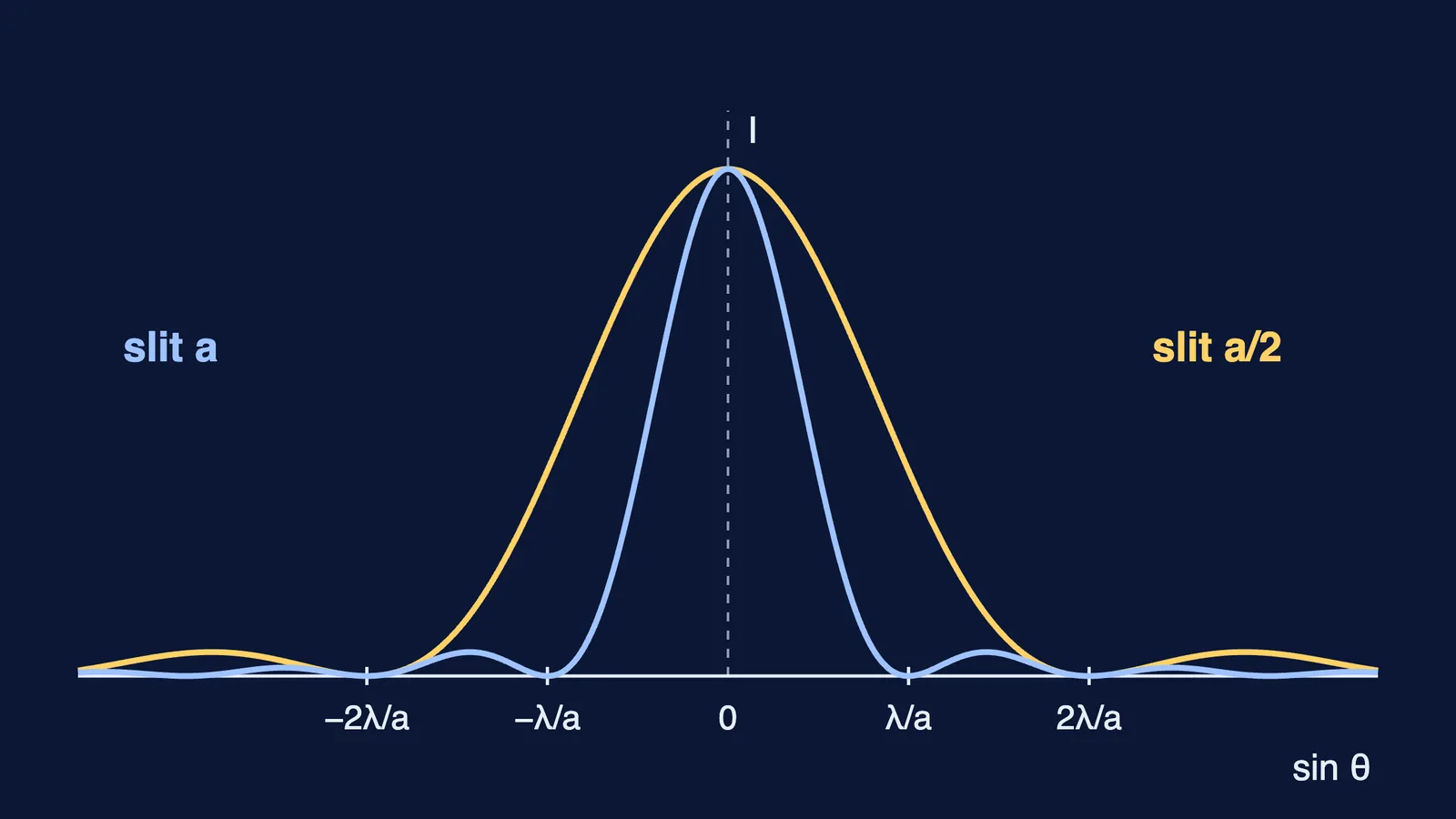
Q4 (medium). Assertion (A): Making a single slit narrower makes the central maximum of its diffraction pattern narrower. Reason (R): The first minima of a single slit of width a lie at angles of about ±λ/a.
Answer: (D). R is true, and it shows A is false: a smaller a makes λ/a larger, so the central maximum spreads out.
Trap: assuming a narrower opening gives a narrower beam, as in ray optics.
Q5 (medium). Assertion (A): The extra brightness of the bright fringes in an interference pattern does not violate conservation of energy. Reason (R): Interference only redistributes light energy; what is missing at the dark fringes appears at the bright ones.
Answer: (A). Both are true, and R is exactly why: there is no gain or loss of energy, only a new distribution across the screen.
Trap: treating a dark fringe as light being destroyed.
Q6 (hard). Assertion (A): Polarisation shows that light waves are transverse. Reason (R): Light shows interference and diffraction.
Answer: (B). Both are true. Interference and diffraction prove light is a wave, but NCERT notes that most interference and diffraction effects occur even for longitudinal waves such as sound in air. Only polarisation needs a transverse wave, so R does not explain A.
Trap: accepting any true wave property as proof of transverse waves.
Statement I and Statement II questions on Wave Optics
Q7 (easy). Statement I: A wavefront is a surface on which every point oscillates in the same phase. Statement II: The energy of a wave travels perpendicular to its wavefront.
Answer: (A). Both are correct, as NCERT defines them.
Trap: calling a wavefront a surface of equal amplitude only.
Q8 (medium). Statement I: Far from a point source, a small part of a spherical wavefront can be treated as a plane wavefront. Statement II: In Young's experiment, the fringe spacing grows steadily as you move away from the central fringe.
Answer: (C). I is correct. II is incorrect: bright fringes sit at x = nλD/d and dark ones halfway between, so both are equally spaced.
Trap: mixing up Young's fringes with the single-slit pattern.
Q9 (hard). Statement I: Unpolarised light of intensity I passes through two Polaroids whose pass axes are 60° apart; the emerging intensity is I/4. Statement II: A third Polaroid placed between two crossed Polaroids, with its axis at 45° to both, lets through I/8 of the unpolarised intensity I falling on the first.
Answer: (D). I is incorrect: the first Polaroid halves the intensity, then Malus' law gives (I/2)cos²60° = I/8. II is correct: (I/2)cos²45°cos²45° = I/8.
Trap: forgetting the first Polaroid halves unpolarised light.
Q10 (hard). Statement I: With two identical slits, at a point where the path difference is λ/3, the intensity is half the maximum. Statement II: If the phase difference between the two slits changes rapidly and randomly, the intensity everywhere on the screen is 4I₀, where I₀ is the intensity from one slit.
Answer: (B). Both are incorrect. I: the phase difference is 2π/3, so I = 4I₀cos²(π/3) = I₀, a quarter of the maximum 4I₀. II: incoherent intensities simply add, giving 2I₀ everywhere.
Trap: guessing "half", and using 4I₀ without a stable phase.
How should you use this set?
Sort every miss: wrong about A, wrong about R, or wrong about the link.
For each link miss, write the real reason in one line.
For each truth miss, reread that NCERT section.
If Q4 or Q9 still feels abstract, the Fermi Simulation Lab has interactive simulations for the ideas that are easier to see than to read.
For board-style answers on the same chapter, see our Wave Optics Class 12 board exam guide. For a method that works in any subject, read our strategy for assertion-reason questions.