On this page
Vector algebra is Chapter 10 of the NCERT Class 12 Mathematics Part II textbook (Reprint 2026-27) and sits in Unit IV of the CBSE Mathematics syllabus for 2026-27. Below are 29 key terms by topic, each with a worked example. For exam answers, see our Vector algebra Class 12 board exam guide.
The scalar triple product is in neither the current chapter nor the 2026-27 syllabus, so it is left out; our vector algebra guide for JEE maths covers it.
What are scalars, vectors and direction cosines?
Scalar: a quantity given by one real number. Example: a mass of 2 kg.
Vector: a quantity with size and direction, drawn as a directed segment AB from initial point A to terminal point B.
Magnitude: the length of a vector, written |a|; never negative. Example: |3î + 4ĵ| = 5.
Position vector: the vector from the origin O to a point P(x, y, z), of magnitude √(x² + y² + z²). Example: P(2, 3, 6) gives |OP| = 7.
Direction cosines (l, m, n): cos α, cos β, cos γ, where α, β, γ are the angles between the vector and the positive x-, y- and z-axes; for OP with P(x, y, z) and r = |OP|, l = x/r, m = y/r, n = z/r, and l² + m² + n² = 1. Example: for 2î + 3ĵ + 6k̂, they are 2/7, 3/7, 6/7.
Direction ratios (a, b, c): any three numbers proportional to the direction cosines, such as lr, mr, nr or the components of the vector. Example: 2, 3, 6 or 4, 6, 12. Don't confuse with: direction cosines; a² + b² + c² need not be 1.
Types of vectors: key terms
Zero (null) vector: initial and terminal points coincide, so its magnitude is 0 and it has no definite direction.
Unit vector: a vector of magnitude 1; â = a/|a| for any non-zero a. Example: (2î + 3ĵ + 6k̂)/7.
Collinear vectors: vectors that lie along one line or along parallel lines, with any lengths and either sense; non-zero a and b are collinear exactly when b = λa for some scalar λ. Example: 2î − ĵ + 3k̂ and −4î + 2ĵ − 6k̂ (λ = −2).
Equal vectors: same length and same direction; the starting point does not matter. Collinear vectors, by contrast, may differ in length or sense.
Negative of a vector: same magnitude, opposite direction. Example: BA = −AB.
How do you add vectors and use the section formula?
Triangle law: put b's tail at a's head; the closing side is a + b. Example: AB + BC = AC.
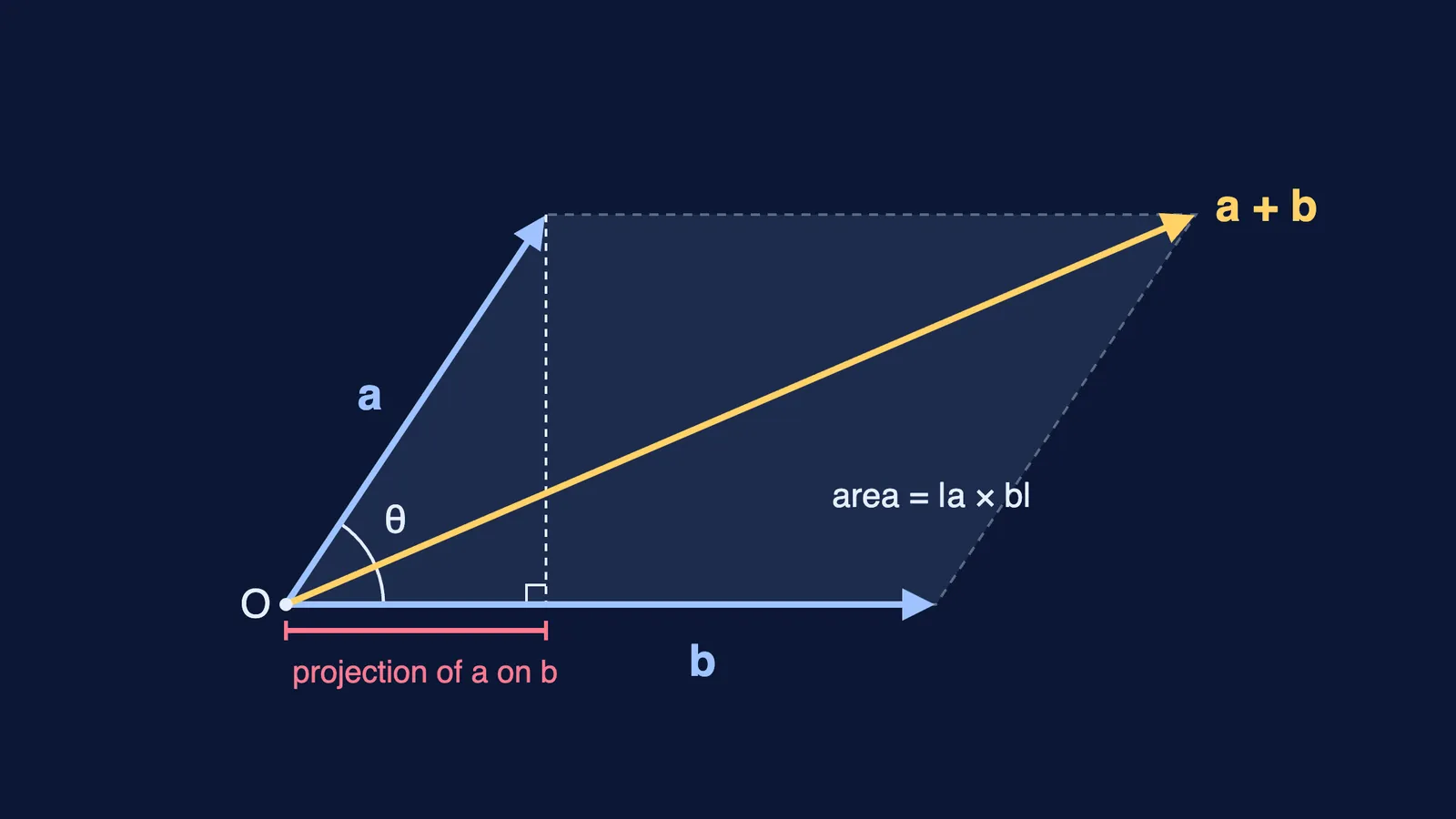
Parallelogram law: for coinitial a and b as adjacent sides, a + b is the diagonal from their common point.
Scalar multiple (λa): collinear with a, |λ| times as long, same direction if λ > 0, opposite if λ < 0.
Component form: r = xî + yĵ + zk̂, with î, ĵ, k̂ the unit vectors along the axes. Here x, y, z are scalar components; xî, yĵ, zk̂ are vector components.
Vector joining two points: P₁P₂ = (x₂ − x₁)î + (y₂ − y₁)ĵ + (z₂ − z₁)k̂, end minus start. Example: P(1, 2, 3) to Q(4, 6, 3): 3î + 4ĵ.
Section formula (internal): R dividing PQ internally in m : n has position vector (mb + na)/(m + n), where a and b are those of P and Q; m = n gives the midpoint (a + b)/2. Example: P(1, −2, 3), Q(4, 1, 0), 2 : 1 gives R(3, 0, 1).
Section formula (external): (mb − na)/(m − n), with m ≠ n. Example: same points, 2 : 1, give (7, 4, −3).
What do the dot product and projection mean?
Take a = î + 2ĵ + 2k̂ and b = 2î − ĵ + 2k̂, so |a| = |b| = 3.
Scalar (dot) product: a·b = |a||b| cos θ, a number, with 0 ≤ θ ≤ π; in components, a₁b₁ + a₂b₂ + a₃b₃. Example: a·b = 2 − 2 + 4 = 4.
Angle between two vectors: cos θ = a·b/(|a||b|). Example: cos θ = 4/9.
Perpendicular vectors: non-zero a and b are perpendicular exactly when a·b = 0. Example: a·(2î − ĵ) = 0.
Projection of a on b: a·b/|b| (that is, a·b̂), a signed number: negative when θ is obtuse; the projection vector is (a·b/|b|) b̂. Example: 4/3.
Triangle inequality: |a + b| ≤ |a| + |b|. Example: |a + b| = √26 ≤ 6.
Cross product: key terms
Same a and b:
Right-handed system: axes set up so that turning from the positive x-axis to the positive y-axis drives a standard screw, or points the right thumb, along the positive z-axis.
Vector (cross) product: a × b = |a||b| sin θ n̂, with 0 ≤ θ ≤ π, where n̂ is the unit vector perpendicular to both and a, b, n̂ form a right-handed system. Example: the î ĵ k̂ determinant gives 6î + 2ĵ − 5k̂.
Not commutative: b × a = −(a × b). Example: î × ĵ = k̂ but ĵ × î = −k̂. Don't confuse with: the dot product, where a·b = b·a.
Parallel test: non-zero a and b are parallel exactly when a × b = 0. Example: (2î − ĵ + 3k̂) × (−4î + 2ĵ − 6k̂) = 0.
Area of a parallelogram: |a × b| for adjacent sides a and b. Example: √65, so the triangle on a and b has area √65/2.
Unit vectors perpendicular to a and b: there are two, ±(a × b)/|a × b|. Example: ±(6î + 2ĵ − 5k̂)/√65.
Lines in space reuse these tools: Three Dimensional Geometry Class 12 board exam guide.
How to learn these terms
Learn the pairs together: cosines and ratios, equal and collinear, dot and cross.
Draw one parallelogram on a and b; mark a + b, the projection and |a × b|.
Check a cross product by dotting it with a and b: both give 0.
If a term stays fuzzy, open it in the Fermi Concept Library, where each concept has its own lesson and its place in the map.