On this page
This sheet collects the main formulas in Chapter 10 of the NCERT Class 12 Mathematics Part II textbook (Reprint 2026-27), which matches the vectors unit of the CBSE Class XII Mathematics syllabus for 2026-27. For marks and answers, see our Vector algebra Class 12 board exam guide.
Notation: a = a₁î + a₂ĵ + a₃k̂ and b = b₁î + b₂ĵ + b₃k̂ are vectors, |a| is the magnitude of a, θ is the angle between a and b (0 ≤ θ ≤ π) and λ is a real number. The scalar triple product is not in the 2026-27 NCERT chapter, so it is excluded.
What are the basic vector formulas for magnitude and direction?
Position vector of P(x, y, z): OP = xî + yĵ + zk̂, with |OP| = √(x² + y² + z²).
Vector from A(x₁, y₁, z₁) to B(x₂, y₂, z₂): AB = (x₂ − x₁)î + (y₂ − y₁)ĵ + (z₂ − z₁)k̂.
Direction cosines of r = xî + yĵ + zk̂ (direction ratios x, y, z) with r = |r| ≠ 0: l = x/r, m = y/r, n = z/r.
l² + m² + n² = 1 (true for direction cosines only).
Unit vector along a: â = a/|a|, defined only when a ≠ 0.
Sum and scalar multiple: a + b = (a₁ + b₁)î + (a₂ + b₂)ĵ + (a₃ + b₃)k̂ and λa = (λa₁)î + (λa₂)ĵ + (λa₃)k̂.
Collinear vectors: b = λa for some scalar λ (a ≠ 0), so b₁/a₁ = b₂/a₂ = b₃/a₃ when the components are non-zero.
Worked example: a = 2î − 3ĵ + 6k̂. Then |a| = √(4 + 9 + 36) = 7, the direction cosines are 2/7, −3/7, 6/7, and â = (2î − 3ĵ + 6k̂)/7.
Watch for: l² + m² + n² = 1 holds for direction cosines, not for direction ratios.
What is the section formula for vectors?
P and Q have position vectors a and b; R divides PQ so that PR : RQ = m : n.
Internal division: r = (mb + na)/(m + n).
External division: r = (mb − na)/(m − n), with m ≠ n.
Midpoint (m = n = 1): r = (a + b)/2.
Worked example: P(1, −2, 3), Q(4, 1, −3), ratio 2 : 1. Internally, r = (2Q + P)/3 = (9, 0, −3)/3, so R is (3, 0, −1). Externally, r = (2Q − P)/1, so R is (7, 4, −9).
Watch for: m pairs with Q, not P. The external formula has a minus sign top and bottom.
How do you find the angle between two vectors?
Definition: a · b = |a||b| cos θ, a real number (0 if either vector is zero).
Component form: a · b = a₁b₁ + a₂b₂ + a₃b₃.
Angle: cos θ = (a · b)/(|a||b|), for non-zero a and b.
Perpendicular: a · b = 0 if and only if a ⊥ b (non-zero a and b).
Unit vectors: î · î = ĵ · ĵ = k̂ · k̂ = 1 and î · ĵ = ĵ · k̂ = k̂ · î = 0.
a · a = |a|², and a · b = b · a.
Projection of a on b: (a · b)/|b|, for b ≠ 0. Projection vector: ((a · b)/|b|²) b.
Expansion: |a + b|² = |a|² + 2a · b + |b|².
Inequalities: |a · b| ≤ |a||b| (Cauchy-Schwarz) and |a + b| ≤ |a| + |b| (triangle).
Worked example: a = î + 2ĵ + 2k̂ and b = 2î − ĵ + 2k̂. Then a · b = 2 − 2 + 4 = 4, |a| = |b| = 3, so cos θ = 4/9 (θ ≈ 63.6°). The projection of a on b is 4/3.
Watch for: the projection of a on b divides by |b|, not |a|. A negative dot product means θ is obtuse.
How do you find area using the cross product?
Definition: a × b = |a||b| sin θ n̂, where n̂ is the unit vector perpendicular to a and b making a, b, n̂ right-handed.
Determinant form: a × b = (a₂b₃ − a₃b₂)î − (a₁b₃ − a₃b₁)ĵ + (a₁b₂ − a₂b₁)k̂.
Order matters: b × a = −(a × b).
Unit vectors: î × î = ĵ × ĵ = k̂ × k̂ = 0; î × ĵ = k̂, ĵ × k̂ = î, k̂ × î = ĵ; ĵ × î = −k̂.
Parallel: a × b = 0 if and only if a ∥ b (non-zero a and b).
Angle: sin θ = |a × b|/(|a||b|).
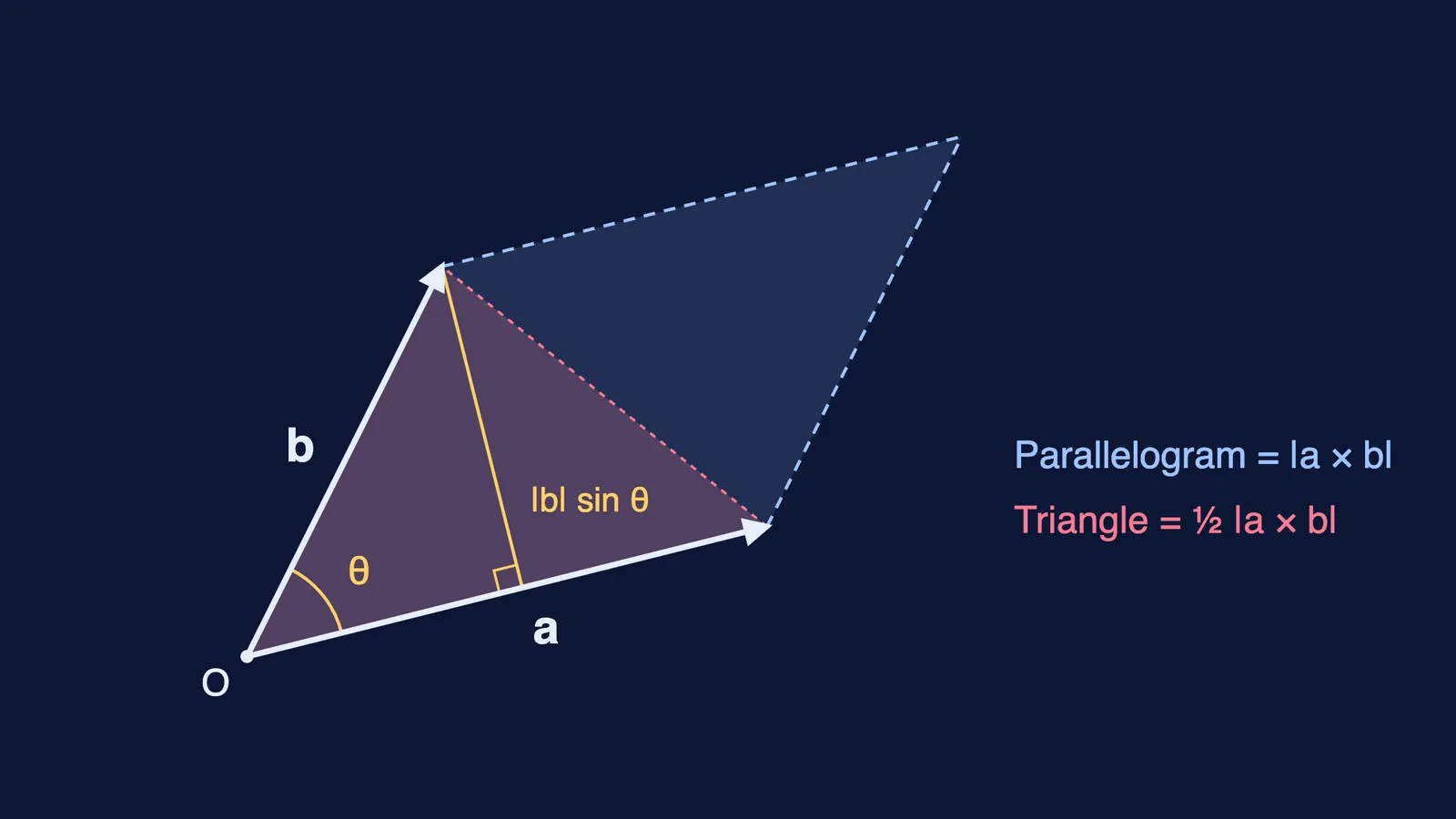
Area of a parallelogram with adjacent sides a and b: |a × b|.
Area of a triangle with adjacent sides a and b: ½|a × b|.
Unit vectors perpendicular to both a and b: ±(a × b)/|a × b|, when a × b ≠ 0.
Worked example: triangle A(1, 1, 0), B(3, 2, 2), C(2, 4, 1). AB = 2î + ĵ + 2k̂ and AC = î + 3ĵ + k̂. AB × AC = −5î + 0ĵ + 5k̂, with magnitude 5√2. Area = 5√2/2 square units, and a unit vector perpendicular to the triangle is (−î + k̂)/√2.
Watch for: the ĵ term carries a minus sign. A triangle needs the ½.
If determinant signs keep slipping, the Fermi Problem Library has worked problems with a step-by-step solver that explains the reasoning rather than printing an answer.
How to revise this formula sheet
Write î × ĵ = k̂, ĵ × k̂ = î, k̂ × î = ĵ from memory first; most cross-product signs follow.
Before writing an answer, check its type: a dot product is a number, a cross product is a vector.
Pair this chapter with lines in 3D: the next chapter leans on direction ratios and the cross product; see our Three Dimensional Geometry Class 12 guide.
If you are also preparing for JEE, the triple product left out here is covered in vector algebra for JEE maths.