On this page
This glossary follows NCERT Chapter 1, Units and Measurement (Reprint 2026-27), and the chapter list in the CBSE Physics curriculum for 2026-27. For worked examples, use it with our Units and Measurements Class 11 chapter guide.
The rationalised chapter has no sections on types of error, parallax or measuring large distances, so those terms are left out.
What are base and derived units?
Physical quantity: anything in physics that can be measured and written as a number with a unit.
Unit: the agreed reference a quantity is compared with. Example: "3 m" means three times the metre.
Base (fundamental) quantity: one of the seven quantities chosen as the starting set: length, mass, time, electric current, thermodynamic temperature, amount of substance and luminous intensity. Don't confuse with: derived quantity.
Base unit: the unit of a base quantity. The seven SI base units are metre (m), kilogram (kg), second (s), ampere (A), kelvin (K), mole (mol) and candela (cd).
Derived unit: a unit made by combining base units. Example: the newton, 1 N = 1 kg m s⁻², and the joule, 1 J = 1 kg m² s⁻².
System of units: a full set of base and derived units used together. Example: CGS (centimetre, gram, second), FPS (foot, pound, second) and MKS (metre, kilogram, second).
SI: the International System of Units, the system accepted worldwide today, with seven base units. Don't confuse with: MKS, an older system whose base units for length, mass and time were the metre, kilogram and second.
Mole: the SI unit of amount of substance; one mole holds exactly 6.02214076 × 10²³ specified entities. Don't confuse with: mass, since a mole of different substances has different masses.
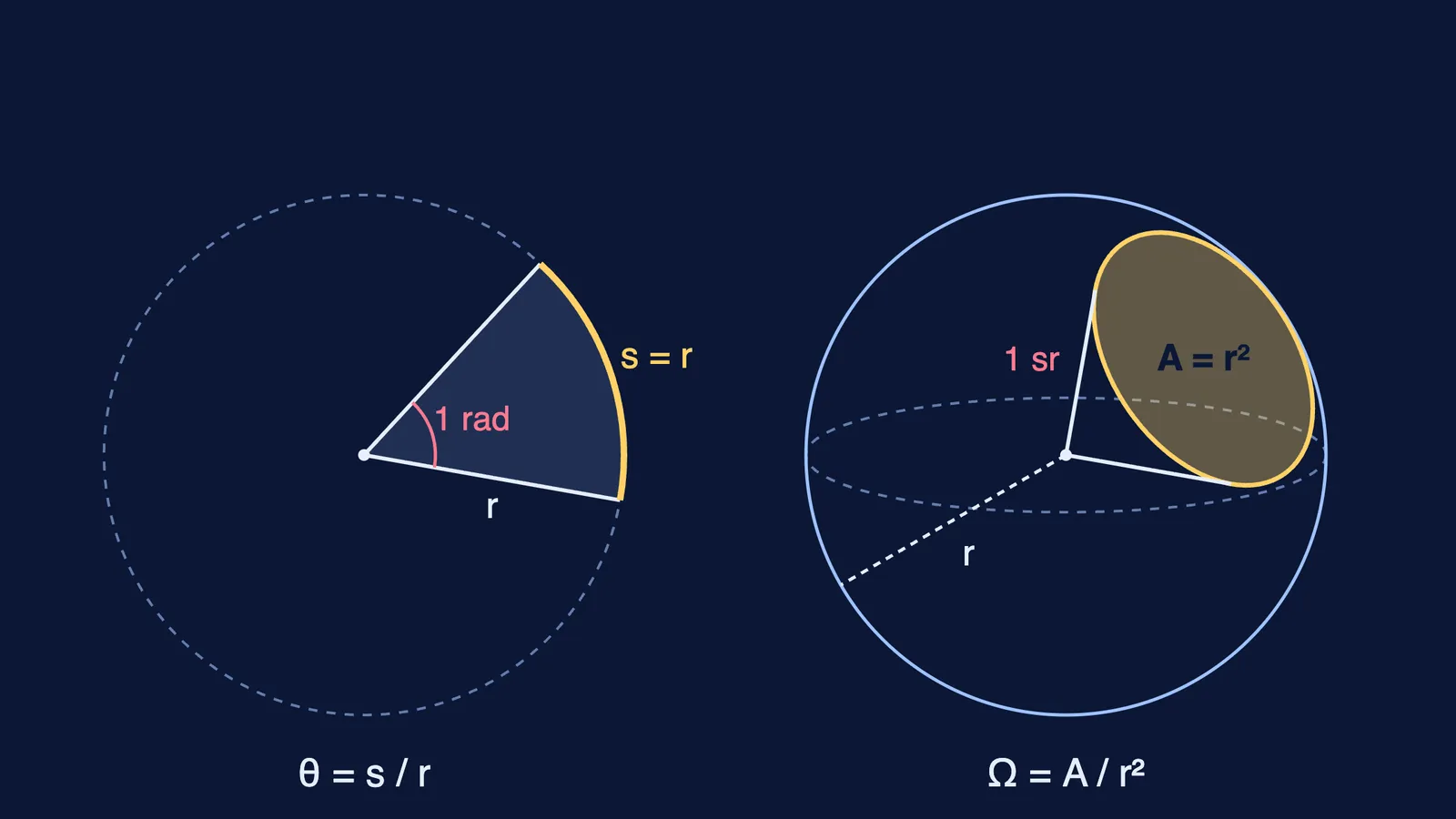
Radian (rad): the unit of plane angle, defined as arc length divided by radius. Example: one radian is the angle where the arc equals the radius.
Steradian (sr): the unit of solid angle, defined as the area cut on a sphere divided by the radius squared. Example: a whole sphere is 4πr²/r² = 4π sr. Both radian and steradian are dimensionless.
Significant figures, precision and rounding
Least count: the smallest change in a quantity that an instrument can read. Example: a metre scale reads to 1 mm, so NCERT writes a length measured with it as 16.2 ± 0.1 cm.
Precision: how finely a measured value is resolved, which depends on the least count.
Significant figures: the digits known reliably plus the first uncertain one. Example: a pendulum period of 1.62 s has three; the 2 is the uncertain digit.
Trailing zero: a zero at the end of a number; it counts only if there is a decimal point. Example: 3.500 has four significant figures; 12300 cm, written without a decimal point, has three.
Scientific notation: writing a number as a × 10ᵇ with a between 1 and 10. Every digit in a counts, so 4.700 × 10³ mm has four.
Order of magnitude: the power b after rounding a number to 10ᵇ. Example: Earth's diameter, 1.28 × 10⁷ m, is of the order of 10⁷ m. Don't confuse with: significant figures, which describe precision, not size.
Exact number: a factor in a formula that is neither measured nor rounded, like the 2 in 2πr. It never limits the answer.
Rounding off: dropping uncertain digits. When the dropped digit is exactly 5, NCERT keeps an even preceding digit and raises an odd one: 2.745 becomes 2.74, and 2.735 also becomes 2.74.
How is uncertainty carried through a calculation?
Multiplication and division rule: keep as many significant figures as the least precise input. Example: 4.237 g ÷ 2.51 cm³ gives 1.69 g cm⁻³.
Addition and subtraction rule: keep as many decimal places as the input with the fewest. Example: 436.32 g + 227.2 g + 0.301 g gives 663.8 g. Don't confuse with: the multiplication rule, which counts significant figures, not decimal places.
Uncertainty (error): the ± range on a measured value, in the same unit. Example: 10.1 ± 0.1 cm.
Relative error: the uncertainty divided by the value, often written as a percentage. Example: ±0.01 g is ±1% of 1.02 g but only ±0.1% of 9.89 g. For a product, NCERT adds the percentage errors: about 0.6% and 1% give about 1.6%.
Extra digit: in multi-step work, carry one more digit than the least precise input and round at the end. Example: inverting a rounded 0.104 gives 9.62, but 0.1044 gives back 9.58.
What are dimensions and dimensional formulae?
Dimensions: the powers to which base quantities are raised to describe a quantity, written in square brackets. Example: volume is [L³]; force is [M L T⁻²].
Dimensional formula: the expression showing those base quantities and powers. Example: speed is [M⁰ L T⁻¹] (SI unit m s⁻¹); density is [M L⁻³ T⁰] (SI unit kg m⁻³).
Dimensional equation: a quantity set equal to its dimensional formula, such as [F] = [M L T⁻²].
Dimensionless quantity: a pure number or a ratio of like quantities, such as angle or refractive index. Arguments of sin, log and exp must be dimensionless.
Principle of homogeneity: you can add, subtract or equate only quantities with the same dimensions. Example: in x = x₀ + v₀t + ½at², every term has dimension [L].
Dimensional analysis (method of dimensions): using dimensions to check an equation or find how quantities relate. Example: a pendulum's period from l, g and m comes out as T = k√(l/g).
Limits of the method: it cannot find the number k. A formula that fails the check is wrong; one that passes may still be wrong, as ½mv² and (3/16)mv² both pass for kinetic energy.
How to learn these terms
Keep a unit-and-dimension card for the year: SI unit beside dimensional formula, as in N and [M L T⁻²].
Rederive the pendulum result from a blank page.
Practise rounding numbers that end in 5.
Draw the radian and steradian, as in the diagram above, and write the ratio under each.
If a term still feels abstract, the Fermi Concept Library gives each physics concept its own lesson and shows its place in the map. Preparing for entrance exams too? See our Units and Measurements for JEE Main guide and the Physics and Measurement for NEET guide.