On this page
Units and Measurement is Chapter 1 of NCERT Physics Part I (Reprint 2026-27). The CBSE Physics curriculum 2026-27 covers SI units, significant figures, the uncertainty in a result and dimensional analysis. The rationalised chapter has no section on measuring instruments or types of error, so those are left out. Formulas were checked in SymPy and examples computed in Python; for the concepts, see our Units and Measurements Class 11 guide.
What are the SI base units in Class 11 physics?
Seven SI base units: metre (m, length), kilogram (kg, mass), second (s, time), ampere (A, current), kelvin (K, temperature), mole (mol, amount of substance), candela (cd, luminous intensity).
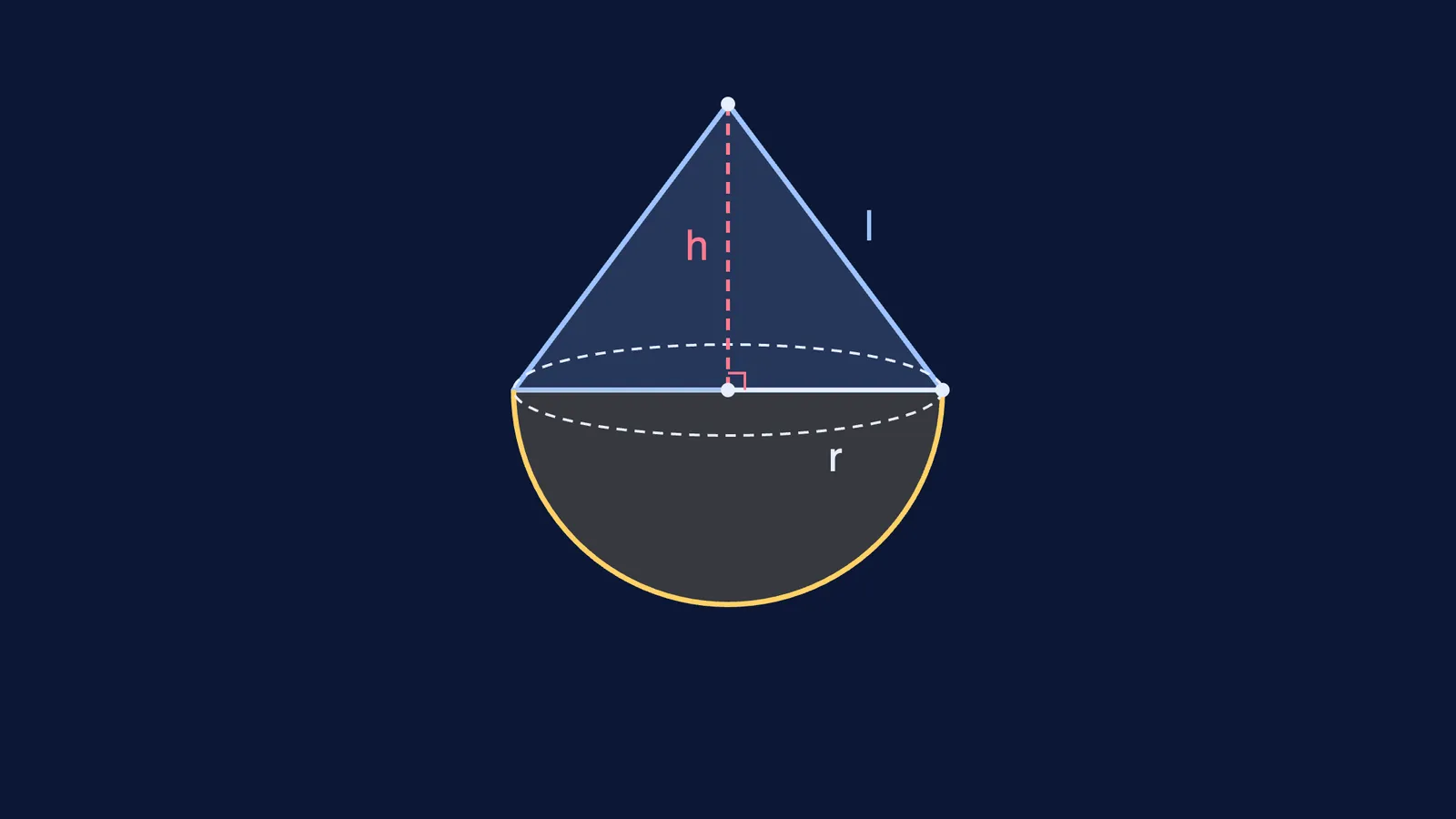
Plane angle dθ = ds/r (rad): arc length ds (m) over radius r (m).
Solid angle dΩ = dA/r² (sr): intercepted sphere area dA (m²) over r² (m²). Both are dimensionless.
Light year: 1 ly = c × 1 year ≈ 9.47 × 10¹⁵ m, with c = 3.00 × 10⁸ m s⁻¹ and 1 year = 3.1557 × 10⁷ s.
Order of magnitude: write the quantity as a × 10ᵇ in its unit. If a ≤ 5 the order is b; if 5 < a ≤ 10 it is b + 1.
Example: a 0.20 m² patch on a sphere of radius 2.0 m subtends 0.20/2.0² = 0.050 sr. And 3.6 × 10⁵ m is of the order of 10⁵ m.
Watch for: 7.2 × 10⁻³ m has order of magnitude −2, not −3, because 7.2 rounds up to 10.
Significant figures and rounding rules
Non-zero digits, and zeros between them, are significant. Leading zeros are not (0.002308 m has four).
Trailing zeros count only with a decimal point: 3.500 kg has four, 123 m written as 12300 cm has three.
In a × 10ᵇ every digit of a counts; changing units never changes the count.
Multiplying or dividing: keep the fewest significant figures of any input.
Adding or subtracting: keep the fewest decimal places of any input.
Rounding a dropped 5: leave an even preceding digit, raise an odd one (3.465 → 3.46, 3.475 → 3.48).
Exact numbers, like the 2π in T = 2π√(l/g), have unlimited significant figures.
Example: a stone of 12.46 g displaces 3.2 cm³ of water. Density = 12.46/3.2 = 3.89375, reported as 3.9 g cm⁻³. Masses of 25.4 g, 1.236 g and 0.85 g add to 27.486 g, reported as 27.5 g.
Watch for: carry one extra digit through multi-step working and round only at the end.
How do you find the uncertainty in a result?
A result is written a ± Δa, with Δa in the unit of a. Relative error = Δa/a (no unit); percentage error = (Δa/a) × 100%.
Product of two or more measured values, Z = A × B: ΔZ/Z = ΔA/A + ΔB/B, so the relative errors add; ΔZ is in the unit of Z.
A value given to n significant figures keeps n figures after multiplying; in subtraction the count can fall (12.9 g − 7.06 g gives 5.8 g, not 5.84 g).
The rationalised chapter (section 1.3.3) states the product rule only; separate rules for sums, quotients and powers are not in the current chapter.
Example: a sheet of l = 25.0 ± 0.1 cm and b = 8.0 ± 0.1 cm has area 200 cm² with error 0.4% + 1.25% = 1.65%, so ΔA = 3.3 cm² and area = 200 ± 3 cm².
Watch for: the same ±0.1 cm is a bigger relative error on the shorter side, so it dominates.
Dimensional formulas of common quantities
Dimensions are the powers of the base quantities [M], [L], [T], [A], [K], [cd], [mol] in a quantity.
Volume [M⁰ L³ T⁰] (m³); speed [L T⁻¹] (m s⁻¹); acceleration [L T⁻²] (m s⁻²); mass density [M L⁻³] (kg m⁻³).
Force [M L T⁻²] (N = kg m s⁻²); momentum [M L T⁻¹] (kg m s⁻¹).
Work and energy [M L² T⁻²] (J = kg m² s⁻²); power [M L² T⁻³] (W = J s⁻¹); pressure [M L⁻¹ T⁻²] (Pa = N m⁻²).
Gravitational constant G, from F = Gm₁m₂/r²: [M⁻¹ L³ T⁻²] (N m² kg⁻²).
Angle, refractive index and ratios of like quantities are dimensionless, as must be the arguments of sin, log and exp.
Example: pressure = force/area = [M L T⁻²]/[L²] = [M L⁻¹ T⁻²], so 1 Pa = 1 kg m⁻¹ s⁻².
Watch for: work and torque share [M L² T⁻²]; dimensions cannot tell them apart.
How is dimensional analysis used?
Homogeneity: only terms of the same dimensions can be added or equated. In x = x₀ + v₀t + ½at² (x in m, t in s), every term is [L]. A dimensionally wrong equation must be wrong; a correct one need not be right.
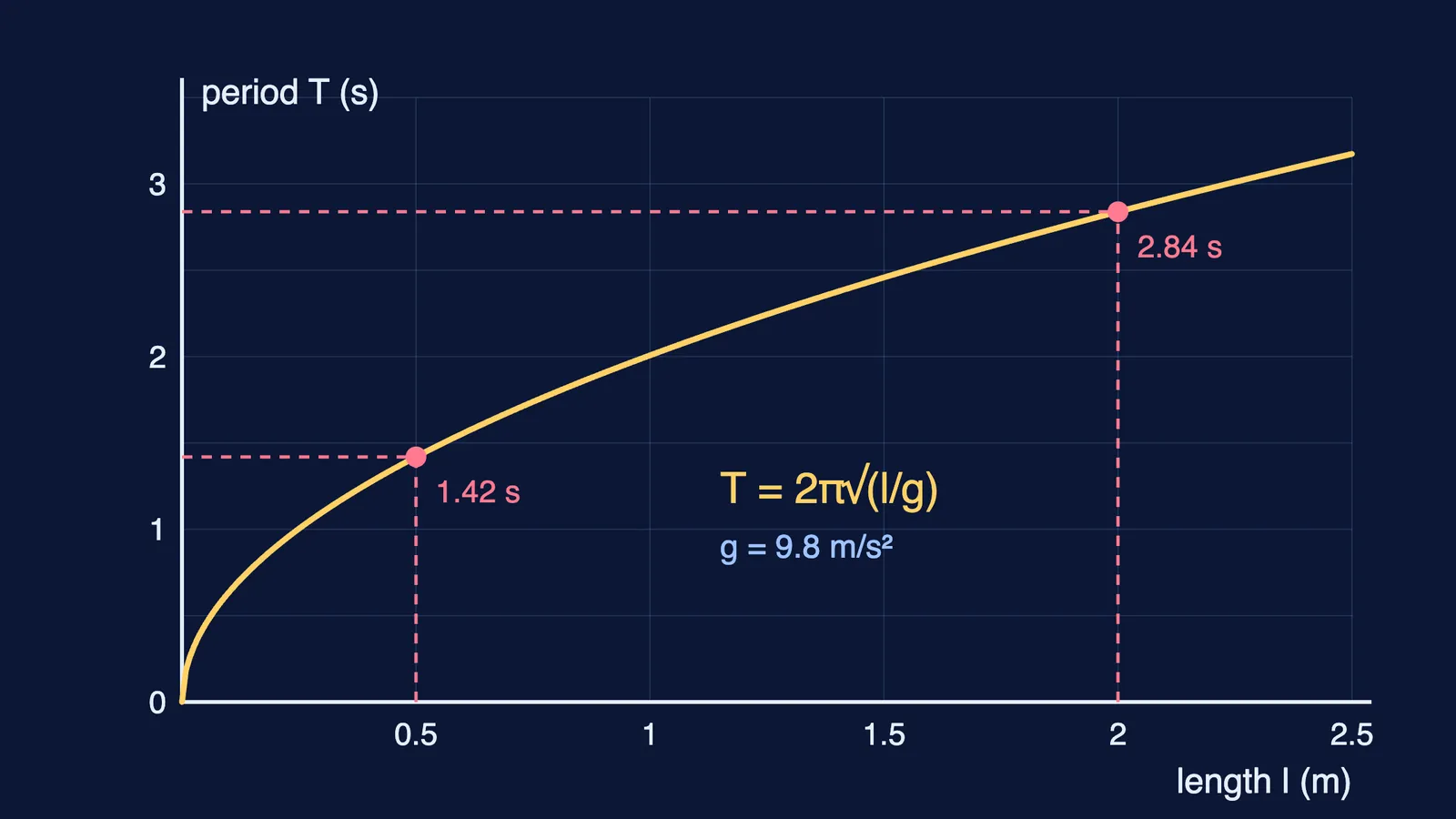
Deducing a relation: for a pendulum, T = k lˣ gʸ mᶻ (T in s, l in m, g in m s⁻², m in kg); equating powers of M, L, T gives T = k√(l/g). NCERT notes k = 2π, which dimensions cannot supply.
Example: let wave speed v (m s⁻¹) on a string depend on tension F (N) and mass per unit length μ (kg m⁻¹). Writing v = k Fˣ μʸ and matching [L T⁻¹] = [M L T⁻²]ˣ [M L⁻¹]ʸ gives x = ½, y = −½, so v = k√(F/μ). With F = 90 N and μ = 0.010 kg m⁻¹, √(F/μ) ≈ 94.9 m s⁻¹.
Watch for: the method handles at most three variables and gives no dimensionless constant.
How to revise this formula sheet
Write the seven base units from memory, then derive the dimensions of force, energy, power and pressure.
State the significant figures in 0.004700 m, 0.0470 kg, 4.700 × 10³ s and 470.0 cm.
In uncertainty questions, first decide sum or product, then add absolute or relative errors.
Redo the pendulum derivation, then the string wave, without looking.
Practise with our Units and measurements case study questions for Class 11 and the units and measurement assertion-reason set.
For ideas easier to see than to read, the Fermi Simulation Lab has interactive simulations.