On this page
Chapter 5 of *Khel Praveen*, the new NCERT Physical Education and Well-being book for Class 9 (First Edition, April 2026; Unit 2 PDF), opens the Science and Sports unit. It asks why muscles tighten and breath quickens when you play, and builds the vocabulary of bones, joints and muscles the rest of the unit uses.
What does Understanding Our Body cover in Class 9 PE?
Anatomy is the study of the body's structure: what each part is and where it sits. Physiology is the study of how organs and systems work to keep us alive. The chapter also introduces Maharshi Sushruta, whom the book calls the "Father of Surgery", then moves through five blocks:
Bones, cartilage, tendons and ligaments
Joints by structure and function, and six synovial types
Skeletal, smooth and cardiac muscle, and how muscles are named
Factors influencing movement, such as degrees of freedom
Force, strength, power and five muscle actions
It ends by splitting a kicked football's displacement into a forward part (x) and an upward part (y).
How many marks is this chapter worth?
Physical Education and Well-being is assessed by the school in Class 9, through internal assessment and an annual examination, not a Board exam (CBSE Secondary Curriculum 2026-27, Table 2).
The PEWB syllabus for 2026-27 gives 100 marks: theory 20, practical 80. Theory is 2 marks for each of 8 units (16 marks) plus a 4-mark viva (MCQs, objective or short answer).
Those 2 marks cover the whole unit, not this chapter alone. The syllabus calls it "Unit 3 Sciences and Sports" (10 hours); the book prints it as Unit 2. Its outline covers body systems, bones, major joints, voluntary and involuntary muscles, circulation and breathing in exercise, and growth. Nothing in Chapter 5 is marked as dropped.
What are the types of bones and joints?
The book sorts bones by shape:
Long: tube-shaped, such as the humerus and femur
Short: cube-like, such as the carpals
Flat: thin and protective, such as the scapula
Irregular: complex shapes, such as the vertebrae
Sesamoid: sitting inside tendons, such as the patella
Cartilage cushions bone ends; a tendon joins muscle to bone; a ligament joins bone to bone.
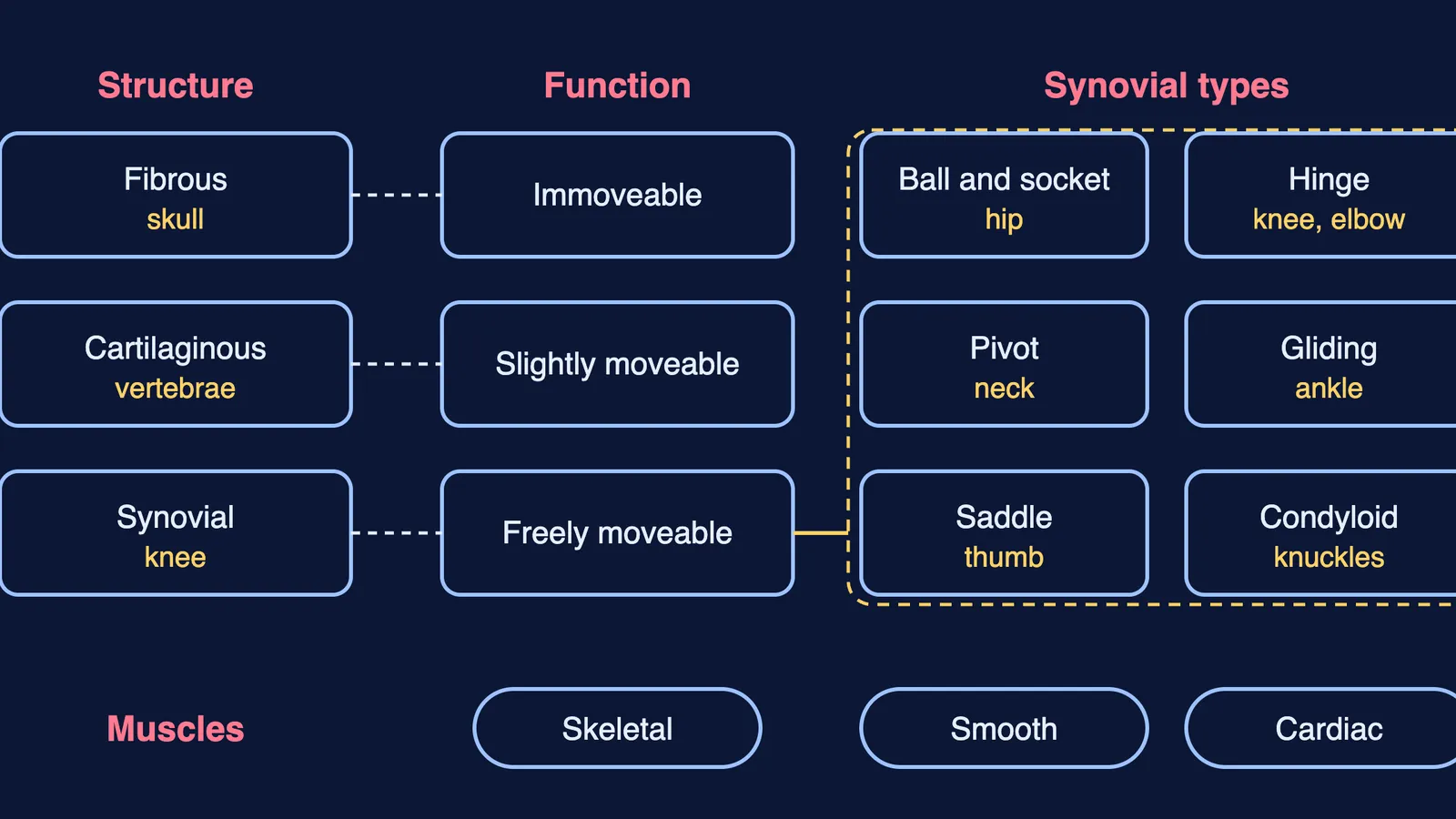
A joint is where two or more bones meet. The book classifies joints by structure and by function; its figures pair them like this:
Fibrous joints are immoveable (skull)
Cartilaginous joints are slightly moveable (vertebrae)
Synovial joints are freely moveable (knee, shoulder)
Synovial types: ball and socket (hip, shoulder), hinge (knee, elbow), pivot (the joint between the first two neck vertebrae), gliding (wrist, ankle), saddle (thumb) and condyloid (knuckles).
Note: the text calls the wrist a gliding joint, but Fig. 5.13 labels the radius-carpal wrist joint condyloid and places gliding between the tarsal bones. Ask your teacher which to use.
How do muscles work in movement?
There are three muscle types. Skeletal muscle is attached to bone, striated and voluntary. Smooth muscle lines hollow organs such as the stomach and is mainly controlled by the autonomic nervous system. Cardiac muscle is found only in the heart wall and stimulates itself. A "Let us recall" box puts the body at 206 bones and nearly 639 muscles (the box prints the word as "muslces"; it means muscles).
Force is the push or pull a muscle makes; strength is how much force it can produce against resistance; power is strength combined with speed. Muscles act in five ways:
Isometric: tension, no change in length
Isotonic: length changes while moving a load
Concentric: the muscle shortens
Eccentric: the muscle lengthens under control
Isokinetic: length changes at a constant speed, usually on a machine
This is a study summary, not medical advice.
Worked example: naming every part of a biceps curl
Label a curl with a water bottle using the chapter's terms:
Joint: the elbow, a hinge joint: flexion and extension only.
Lifting phase: the elbow angle closes, which is flexion. The biceps shortens: a concentric action.
Lowering phase: the biceps lengthens in control: an eccentric action.
Both phases: length changes against a load, so isotonic.
Holding the bottle still halfway: isometric.
Muscle type: skeletal and voluntary; "biceps" means two heads.
Repeat this audit for a plank, a squat and a kick.
Practice questions for Chapter 5
Mark values are our suggestion.
Which joint type allows movement in all directions? (a) hinge (b) pivot (c) ball and socket (d) saddle. *(1 mark)*
State one difference between a tendon and a ligament. *(1 mark)*
Name the structural and functional class of the joints between vertebrae. *(1 mark)*
During a push-up, name the joint movement at the elbow on the way down and the action of the triceps. *(2 marks)*
Answers: 1 (c); 2 tendon joins muscle to bone, ligament joins bone to bone; 3 cartilaginous, slightly moveable; 4 flexion, eccentric.
Going further? See the Class 11 guides on anatomy and physiology in sports and kinesiology and biomechanics, or Locomotion and Movement Class 11.
Not sure where to start revising? Fermi's AI tutor works out what you already know and builds a plan for the session.