On this page
This unit is the biology of sport: bones, joints, muscles, heart and lungs. Learn each classification with a sports movement and most questions follow.
What is in Unit 7 for Class 11 in 2026-27?
In the CBSE Physical Education curriculum for 2026-27 (code 048), Unit 7 is allotted 08 of the 70 theory marks, with no b* (concept-based) share. Its five topics:
Definition and importance of anatomy and physiology in sport
Functions of the skeletal system, classification of bones and types of joints
Properties and functions of muscles
Structure and functions of the circulatory system and heart
Structure and functions of the respiratory system
The prescribed book is the CBSE Physical Education Class XI textbook (second edition, January 2023), where this is Unit 7. Anatomy is the study of the body's structure; physiology, of how it works. Effects of exercise and sports injuries come in Class 12: see our guide to physiology and injuries in sports for Class 12.
What are the functions of the skeleton, bone types and joints?
The CBSE textbook says a baby has around 300 bones, and fusion leaves 206 in an adult. The skeleton gives shape and support, anchors muscles for movement, protects organs (skull, rib cage), stores minerals and makes blood cells (haemopoiesis).
Bones come in five types: long (femur, humerus), short (carpals, tarsals), flat (skull, ribs, sternum, scapula), irregular (vertebrae) and sesamoid (the patella).
By function, joints are immovable (synarthroses), slightly movable (amphiarthroses) or freely movable (diarthroses). By structure, they are fibrous (skull sutures), cartilaginous (ribs to sternum) or synovial. The six synovial types, each with a movement:
Ball and socket (shoulder, hip): bowling in cricket, an overhead clear in badminton
Hinge (elbow, knee): a squat or a biceps curl
Pivot (first two neck vertebrae): turning your head
Gliding (between the carpals): small wrist adjustments
Saddle (thumb): gripping a bat or racquet
Condyloid (wrist): dribbling a basketball
What are the properties and functions of muscles?
There are three muscle types. Skeletal muscle is striated and voluntary; the textbook puts it at 40% of body weight. Smooth muscle is involuntary and lines hollow organs. Cardiac muscle is found only in the heart and is involuntary.
Skeletal muscle shows excitability (responds to a stimulus), contractility (shortens with force), extensibility (stretches) and elasticity (recoils). Muscles move the body, hold posture, make heat (shivering), drive breathing, squeeze organs and vessels, and pump blood.
How do the heart and circulation work?
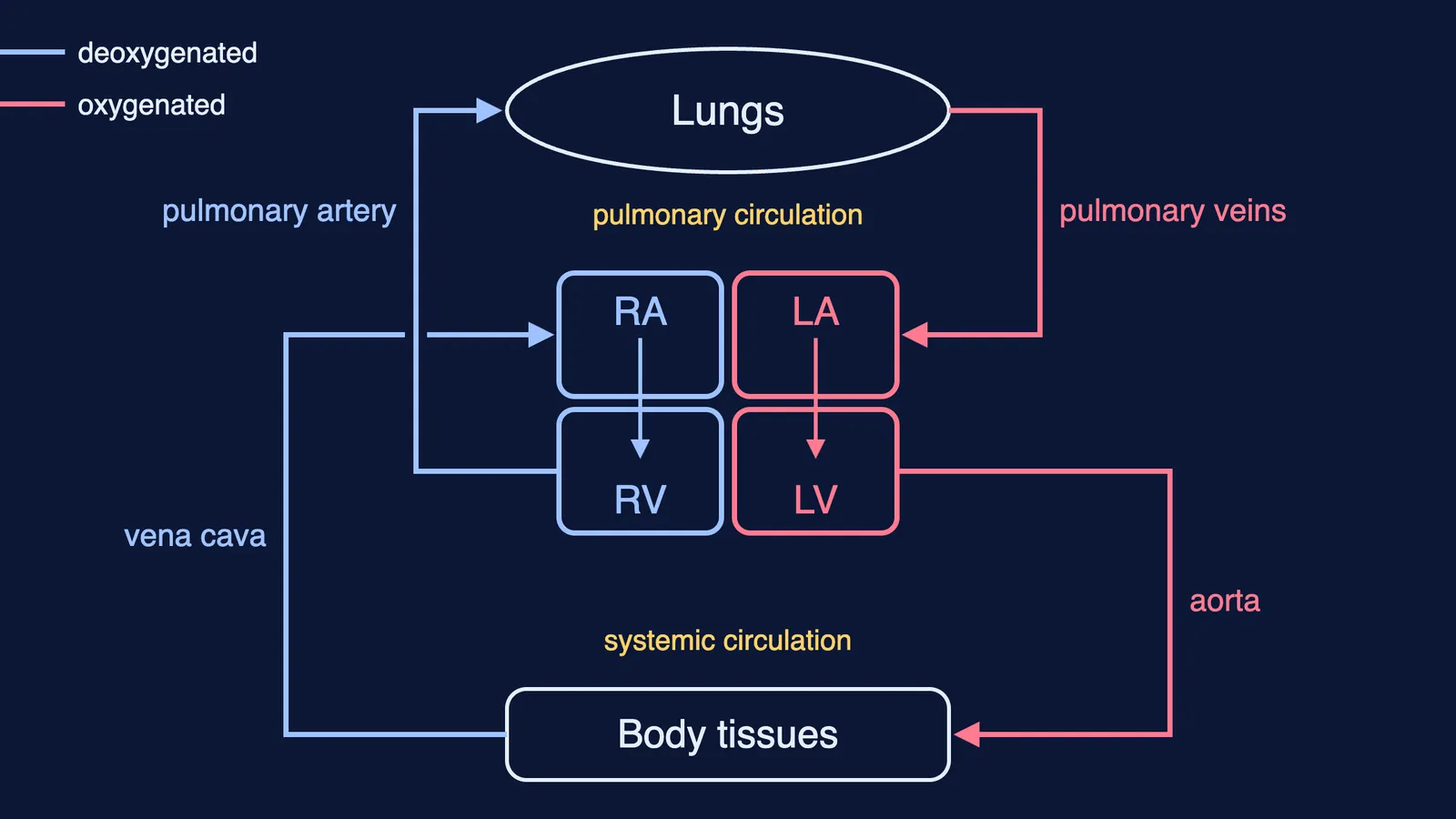
The heart has two receiving atria and two pumping ventricles, divided by the septum. Arteries carry blood from the heart, veins return it, and capillaries handle exchange.
NCERT Biology Class 11, Chapter 15 gives the route. The right ventricle pumps deoxygenated blood through the pulmonary artery to the lungs, and the pulmonary veins return oxygenated blood to the left atrium: that is pulmonary circulation. The left ventricle pumps it into the aorta, out to the tissues, and the vena cava brings it back to the right atrium: that is systemic circulation.
Stroke volume is blood pumped per beat; cardiac output, per minute. NCERT Biology gives about 70 mL per beat at 72 beats per minute.
Worked example. Cardiac output = stroke volume × heart rate.
At rest: 70 mL × 72 beats/min = 5,040 mL/min, about 5.0 L/min, matching NCERT's average of 5,000 mL.
A runner mid-race (our own illustrative figures): 110 mL × 150 beats/min = 16,500 mL/min = 16.5 L/min.
16,500 ÷ 5,040 = 3.3, so about 3.3 times the resting flow.
What is the structure of the respiratory system?
Air passes through the nose, pharynx, larynx (voice box), trachea (windpipe), bronchi, bronchioles and alveoli, the site of gas exchange. The textbook gives bronchioles a diameter of about 1 mm, with more than 1,000 terminal bronchioles in each lung. The right lung has three lobes and the left has two, leaving room for the heart.
The diaphragm contracts and flattens to draw air in, and relaxes to push it out. Ventilation moves air; external respiration is exchange between lungs and blood; internal respiration, between blood and tissues.
Practice questions for Unit 7
Our own questions; mark labels are suggestions.
Which bone type is the patella? (1 mark)
Name the joint type in a bowling action and one other example. (2 marks)
Distinguish contractility from elasticity, with a sports example of each. (3 marks)
A swimmer's stroke volume is 90 mL at 80 beats/min. Find the cardiac output in L/min. (3 marks; answer: 7.2 L/min)
Trace blood from the right atrium round to the right atrium again, naming each chamber and vessel. (5 marks)
Not sure where to start revising Unit 7? Fermi's AI tutor can work out what you already know and build a plan for the session, so you sit down to a clear next step.
Next, read our guides to doping in sports for Class 11 and changing trends and careers in physical education.