On this page
Chapter 12 asks how goods reach you, how prices settle and why the government steps in. It closes Exploring Society: India and Beyond, Part I (book code gees1, first edition April 2025, reprint 2026-27), on pages 247 to 272 under Theme E, Economic Life Around Us.
Classes 6 to 8 follow the NCERT book; CBSE's 2026-27 curriculum page covers Classes 9 to 12 only, so this chapter has no separate syllabus or marks split. It is assessed by the school.
What is a market in Class 7 Social Science?
The chapter defines a market as a place, physical or online, where people buy and sell goods. It needs a buyer, a seller and a price both accept, often reached by bargaining; without that agreement, the sale may not take place.
It separates needs (food, water, clothing, shelter) from wants (things you desire but could live without), and opens with the 16th-century Hampi Bazaar of the Vijayanagara Empire.
It then sorts markets into pairs:
Physical and online: a haat, local market or mall, or apps and websites that deliver home.
Domestic and international: trade inside the country, or exports and imports across borders.
Wholesale and retail: wholesalers buy in bulk and store goods in godowns or cold storage; retailers sell small amounts to final consumers.
Where distance or terrain makes it hard for wholesalers to reach many retailers, distributors bridge the gap. Online, an aggregator gathers many sellers' offers in one app and delivers. Markets matter beyond money too: every shop at Ima Keithal in Imphal is owned and run by women, about 3000 of them.
The case study is Surat's textile trade, where raw cotton arrives through cotton mandīs and moves through markets for woven fabric, dyed fabric and finished sarees or garments.
How do demand and supply set a price?
In the chapter, demand is how much buyers are willing and able to purchase at a given price and time; supply is how much sellers are willing and able to sell. Too high a price and buyers hold back; too low and the seller loses. Over time the price settles where both sides are satisfied.
Worked example: where does the papaya price settle?
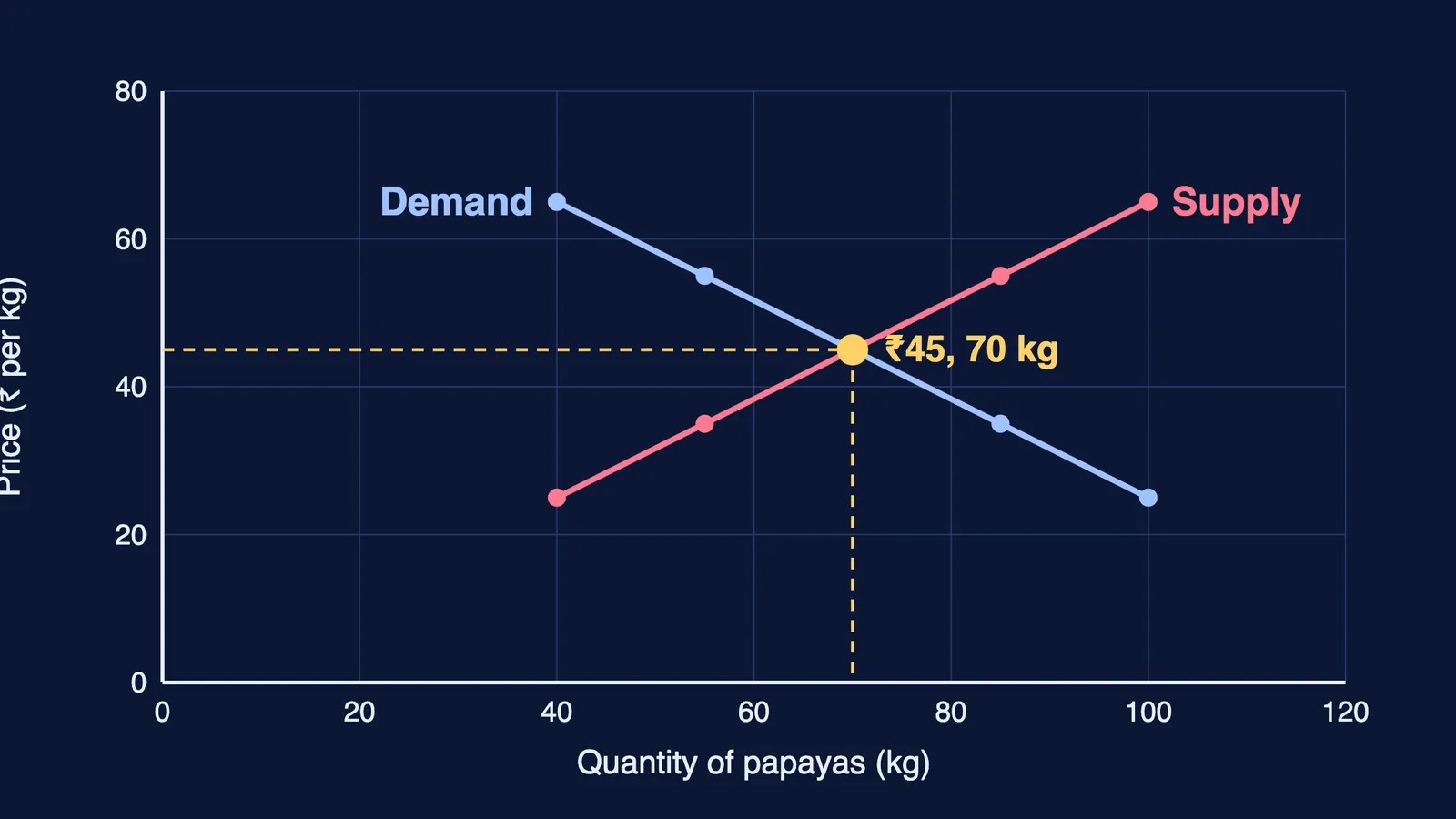
Our own numbers: at a fictional weekly market, papaya buyers and sellers behave like this:
At ₹25 per kg, buyers want 100 kg but sellers bring only 40 kg: 60 kg short.
At ₹35, buyers want 85 kg and sellers bring 55 kg: 30 kg short.
At ₹45, buyers want 70 kg and sellers bring 70 kg: they match.
At ₹55, buyers want 55 kg and sellers bring 85 kg: 30 kg unsold.
At ₹65, buyers want 40 kg and sellers bring 100 kg: 60 kg unsold.
Shortages let sellers ask more; unsold papayas push the price down. It settles at ₹45, where 70 kg change hands and sellers take in 70 × ₹45 = ₹3,150 (graph above).
Why does the government step into markets?
The chapter gives five roles:
Price limits: a maximum price on essentials such as lifesaving drugs, a minimum price for wheat, paddy and maize, and minimum wages. Set too low, producers lose the motivation to produce; too high, consumers are disadvantaged.
Quality and safety: approving medicines and testing samples.
External effects: strict rules where production pollutes, such as single-use plastics.
Weights and measures: checking net quantity in packages. The book links this to Kauṭilya's Arthaśhāstra: ghee buyers got 1/50 part extra for ghee sticking to the measuring can. On 5 kg, that is 5 ÷ 50 = 0.1 kg.
Public goods: parks, roads and policing.
It adds that too many rules can make it hard for markets to work properly.
How can you check the quality of what you buy?
Read the label (net quantity, MRP, batch number, dates, ingredients, allergens) and look for government marks:
FSSAI: food tested and safe to eat.
ISI mark: from BIS, on appliances, building materials, tyres and paper.
AGMARK: farm products such as pulses, spices and honey.
BEE star rating: more stars mean less electricity used.
Word of mouth and online reviews also guide buyers. (Page 269 prints "Bureau of India Standards"; the correct name of the body that issues the ISI mark is the Bureau of Indian Standards.)
Practice questions and where this chapter fits
Marks are our suggestion; your school sets the paper.
Name the three features every market needs. (2)
Give one difference between a wholesaler and a retailer, with an example of each. (3)
Using the papaya table, explain what happens to the price at ₹55 per kg and why. (3)
If a maximum price of ₹35 per kg were fixed for these papayas, how many kg short would buyers be? (2)
Under the Arthaśhāstra rule, how much extra ghee should a buyer of 8 kg receive? (2)
Answers: question 3, 85 − 55 = 30 kg unsold, so the price falls; question 4, 30 kg short; question 5, 8 ÷ 50 = 0.16 kg.
Part II continues with Banks and the Magic of Finance. Compare the older book's Markets Around Us and Class 8's Factors of Production.
Stuck on demand and supply? Fermi's AI tutor works out what you already know and builds a plan for the session.