

On this page
Every packet of biscuits you buy has passed through several hands before it reaches you. The Class 7 NCERT chapter Markets Around Us follows that journey: who sells, who buys, why a dress costs more in a mall, and how onions get from a farm to your kitchen. Here it is in plain words, with exam answers and a market walk.
Which book is “Markets around us” in?
“Markets Around Us” is Chapter 7 of NCERT's Class 7 civics book, Social and Political Life II (NCERT chapter PDF). NCERT's newer Class 7 book, Exploring Society: India and Beyond, has a chapter called Understanding Markets (Chapter 12), whose Big Questions ask what markets are and how they work, what role they play in people's lives, what role the government plays and how consumers can judge the quality of what they buy. Ask your teacher which one your school follows; both ask how goods reach us.
What are the different types of markets in Class 7?
The older NCERT chapter looks at these marketplaces:
Weekly market: held on a specific day of the week, with no permanent shops. Traders set up for the day and may move elsewhere the next day.
Neighbourhood shops: permanent shops and roadside stalls near home, open on any day. Buyer and seller usually know each other, and these shops also sell on credit.
Shopping complexes and malls: urban markets with many shops, and large multi-storeyed, air-conditioned malls, selling branded and non-branded goods. Branded goods are expensive, so fewer people can afford them.
Markets everywhere: orders by phone or internet delivered home, sales representatives at clinics, and trade we never see, like a car factory buying parts from other factories.
Why are things cheaper in a weekly market?
NCERT gives three reasons in the same chapter:
No permanent building, so no rent, electricity bill or fees to the government.
Family members help, so there are no wages to pay hired workers.
Many shops sell the same goods, so competition and bargaining push prices down.
In the chapter's mall story, no dress in a branded shop cost less than ₹3,000, which the book calls almost five times the weekly market price (NCERT).
How does a chain of markets work?
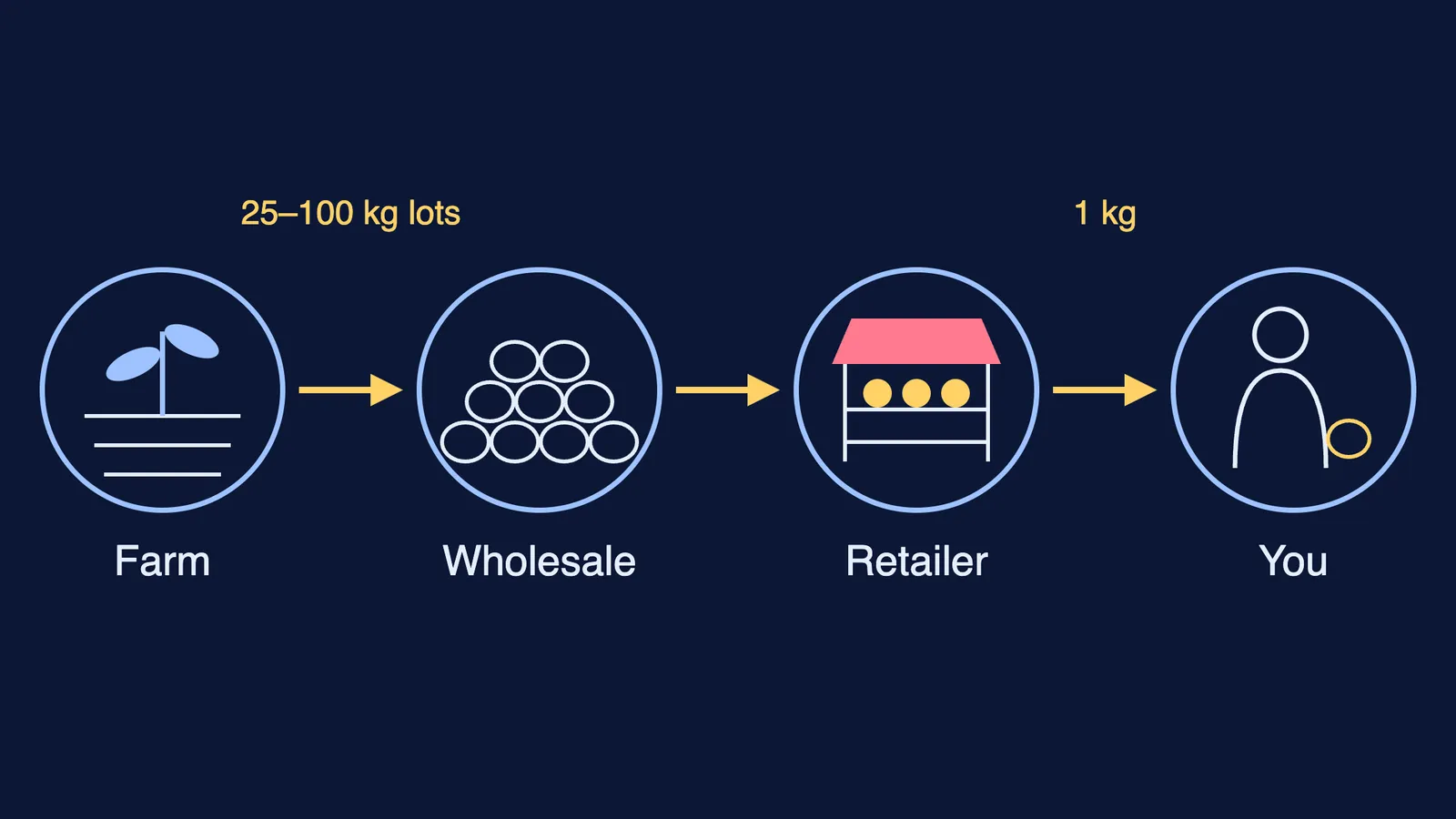
A chain of markets is “a series of markets that are connected like links in a chain because products pass from one market to another”, in the words of the NCERT glossary. The people between the producer and you are traders. A wholesale trader buys in bulk: a vegetable wholesaler buys lots of 25 to 100 kilos, not a few kilos (NCERT). The retailer is the trader who finally sells to you, at a weekly market, as a neighbourhood hawker or in a shopping complex.
Worked example: follow the onions, using the chapter's story of Aftab, a wholesaler in a city mandi (NCERT).
Farm: vegetables leave farms near and far in trucks, matadors and tractor trolleys.
Wholesale mandi, about 2 am: the vegetables arrive and auctions soon begin. On the day in the story, Aftab buys 10 quintals of onions and 5 quintals of cauliflower and stores them in his shop in the market.
Retailers, from about 6 am: hawkers and shopkeepers buy from him, then open their own shops around 10 am.
You: you buy, say, one kilo from the hawker at your corner.
The same producer-to-trader chain returns in sectors of the Indian economy in Class 10, where farming is primary and trade is tertiary.
What does the chapter say about markets and equality?
The weekly market trader has little money to run the shop and earns little compared with the profit of a shop owner in a shopping complex (NCERT). Buyers differ too: some cannot afford the cheapest goods while others shop in malls. So whether you can buy or sell in a market depends, among other things, on the money you have.
A 30-minute market walk for your project
Answers to “compare a weekly market and a shopping complex” are stronger with your own observations. Try this with a parent:
Pick three items sold almost everywhere: a kilo of onions, a bar of soap, a notebook.
Note each price at a weekly market or hawker, a neighbourhood shop and a supermarket or mall.
Ask one seller, politely, where they buy their stock and how often.
For each place, write the kind of goods, prices, sellers and buyers: the chapter's comparison headings.
For each item, find the range: highest price minus lowest. Our guide to range of data for Class 7 shows how.
If working out how many times costlier one price is than another trips you up, the Fermi Problem Library has worked problems with a step-by-step solver that explains the reasoning rather than printing an answer.
Next time you buy something, count the hands it passed through. In Class 10, the buyer's side of the story continues with consumer rights.


