On this page
Chapter 8 of the new Class 7 Social Science book follows money: who keeps it, who borrows it and how it moves. It closes Exploring Society: India and Beyond, Part II (book code gees2, first edition November 2025, reprint 2026-27), on pages 193 to 212 under Theme E, Economic Life Around Us.
Classes 6 to 8 follow the NCERT book: CBSE's 2026-27 curriculum page covers Classes 9 to 12 only, so there is no separate syllabus or marks split. The chapter is assessed by the school.
What is financial infrastructure in Class 7?
Chapter 7 covered physical infrastructure such as roads, railways and telecom. The chapter adds a second layer: financial infrastructure, the network of banks, stock markets, payment systems and other financial institutions through which people, businesses and the government carry out transactions and manage money.
What do banks do with your money?
The book defines a bank as an institution that takes in deposits and lends money out as loans. In its story, Navdeep saves at a bank and Rima borrows for her bamboo business.
The chapter lists three account types:
Savings account: for individuals; earns interest, with limits on withdrawals each month.
Current account: for businesses and traders; no interest, but generally no limit on how often money goes in or out.
Fixed deposit: one amount kept for a set period, such as 3 or 5 years, usually at a higher rate than a savings account.
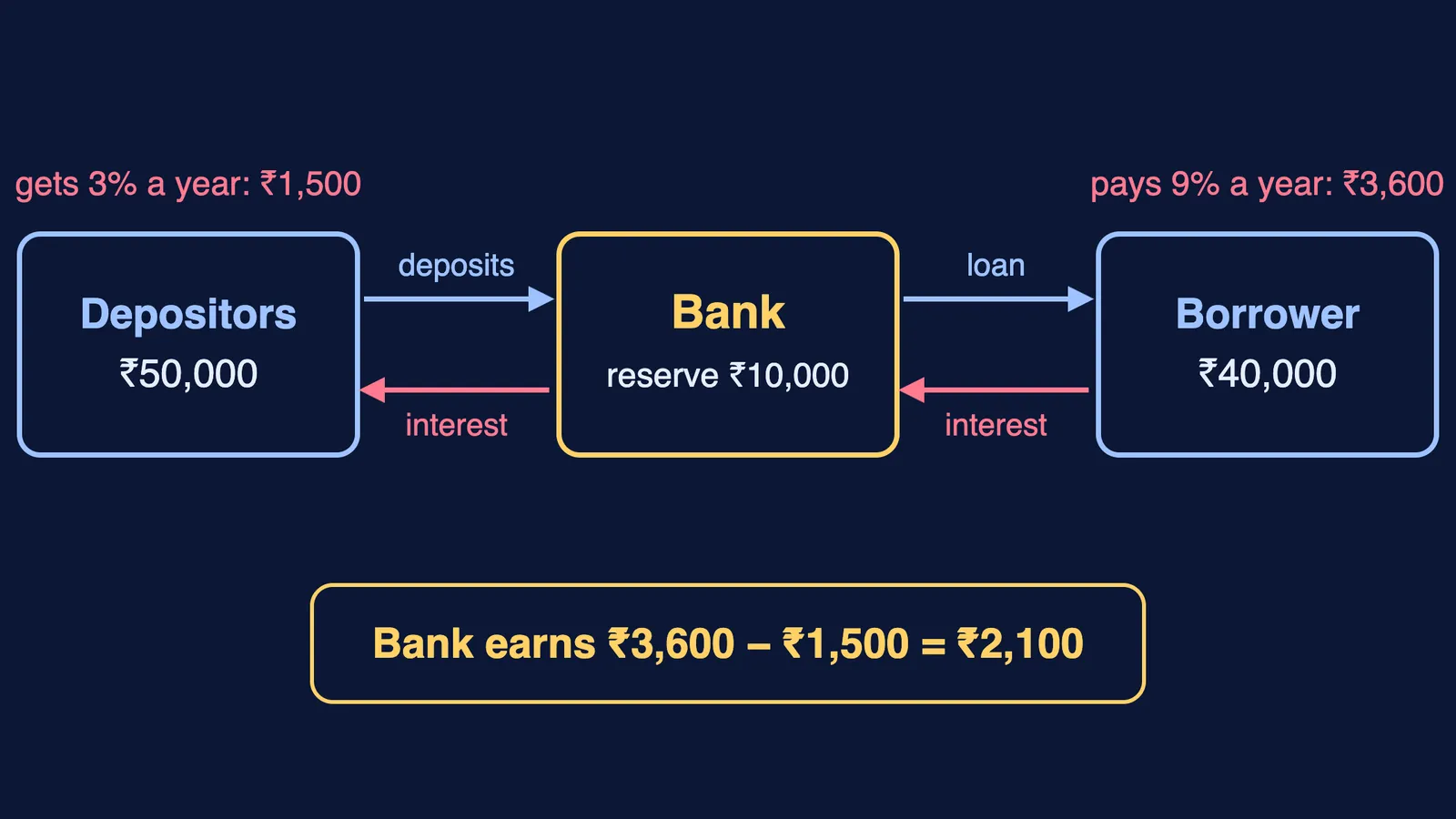
Banks pay depositors a lower rate and charge borrowers a higher one; the book calls this difference a source of income for banks. They also hold back some money as reserves instead of lending every rupee. A passbook records each debit (money out) and credit (money in).
Worked example: how does compounding make money grow?
These numbers are ours, not the book's. Kavya deposits ₹2,500 in her bank account, and the bank pays 8% interest each year as long as she does not withdraw it.
Year 1: 8/100 × 2,500 = ₹200, so she has ₹2,500 + ₹200 = ₹2,700.
Year 2: 8/100 × 2,700 = ₹216, so she has ₹2,700 + ₹216 = ₹2,916.
Year 3: 8/100 × 2,916 = ₹233.28, so she has ₹2,916 + ₹233.28 = ₹3,149.28.
If interest were paid on the original amount of ₹2,500 only, she would have ₹2,500 + 3 × ₹200 = ₹3,100. Compounding, earning interest on earlier interest, adds ₹49.28 more. The book tells the same idea through a sage, a king of Ambalappuzha and rice grains doubling across a chessboard.
On the bank's side (see the diagram), a fictional bank holds ₹50,000 in deposits at 3% a year and lends ₹40,000 at 9%, keeping ₹10,000 as reserve. It pays depositors ₹1,500 and collects ₹3,600 from the borrower, so it earns ₹2,100 in the year.
Who regulates banks, and how does money move today?
The chapter calls the Reserve Bank of India (RBI) the banker to banks. Set up in 1935, it has worked as India's central bank since 1949. It issues currency and fixes the benchmark interest rate. Post offices offer savings schemes such as National Savings Certificates, and NABARD funds banks that lend for rural development.
According to the book, only 15 crore Indians had bank accounts before the Pradhan Mantri Jan Dhan Yojana began in 2014, and over 50 crore accounts have been opened since. For payments, it moves from withdrawal slips and cheques to debit cards at ATMs and POS machines, net banking, and UPI, launched by NPCI in 2016. Nepal became the first country to adopt UPI, in 2022.
The stock market is where people buy and sell shares, small parts of a company's ownership. The Bombay Stock Exchange dates from 1875. Share prices rise and fall with a company's results, government policy and economic shocks, so trading can bring gains or losses.
The chapter ends on safety. Never share personal details such as your phone number, account number, home address, passwords or OTPs with strangers. Do not click unknown links or videos that arrive in messages. Do not store account passwords or debit card PINs on devices. If fraud happens, the book says to report it by calling helpline 1930 or through the National Cybercrime Reporting Portal.
Spelling note: page 203 prints "acoount" in the debit-card line; the correct word is "account".
Practice questions and where this chapter fits
Marks are our suggestion.
Name the three types of bank account and say who each one suits. (3)
Why does a bank charge borrowers more interest than it pays depositors? (2)
Arjun deposits ₹4,000 at 5% a year, compounded yearly. Find his balance after 2 years, showing each year. (3)
Trace a UPI payment from a buyer's phone to a shopkeeper's bank account. (3)
Give two reasons a share price might fall, and explain what a stock market crash is. (3)
Answer to question 3: ₹4,410. Compare this chapter with the older Class 10 chapter on money and credit and the Class 9 guide to budgets and interest in Managing Your Personal Finances.
Not sure where to start revising? Fermi's AI tutor works out what you already know and builds a plan for the session.