On this page
Money and Credit is Chapter 3 of the NCERT Class 10 economics book, Understanding Economic Development. Here is each idea in plain words, with the textbook's current numbers, a worked example and a checklist to revise from.
What is double coincidence of wants?
Double coincidence of wants means that what one person wants to sell is exactly what the other person wants to buy (NCERT, Chapter 3). Barter depends on it: the textbook's shoe maker who wants wheat must find a wheat farmer who also wants shoes.
Money removes that search: sell shoes to anyone for money, then buy wheat from anyone. Because it sits in the middle of every exchange, money is a medium of exchange. Its modern forms are currency, whose notes the Reserve Bank of India issues on behalf of the central government, and demand deposits, which you can withdraw on demand or pay by cheque.
How do banks use your deposits to give loans?
According to the current NCERT textbook, banks in India hold about 5 per cent of their deposits as cash to pay depositors who withdraw on any given day (NCERT, Chapter 3). They lend out the major portion, charging borrowers more interest than they pay depositors; that gap is their main income.
Say 100 people deposit Rs 1,000 each, so the bank holds Rs 1,00,000. It keeps Rs 5,000 as cash and lends Rs 95,000. The depositors still own their Rs 1,00,000, and the borrowers now have Rs 95,000 to spend. This works because few depositors withdraw on the same day. The RBI checks that banks keep this cash balance.
What is the difference between formal and informal credit?
Credit (a loan) is an agreement in which the lender supplies money, goods or services in return for a promise of future payment (NCERT, Chapter 3). Interest rate, collateral, documentation and mode of repayment make up the terms of credit. Collateral is an asset, such as land or livestock, that the lender can sell if the loan is not repaid.
Formal lenders are banks and cooperatives. The RBI supervises them.
Informal lenders are moneylenders, traders, employers, relatives and friends. No one supervises them, so they can charge any interest and use unfair means to recover money.
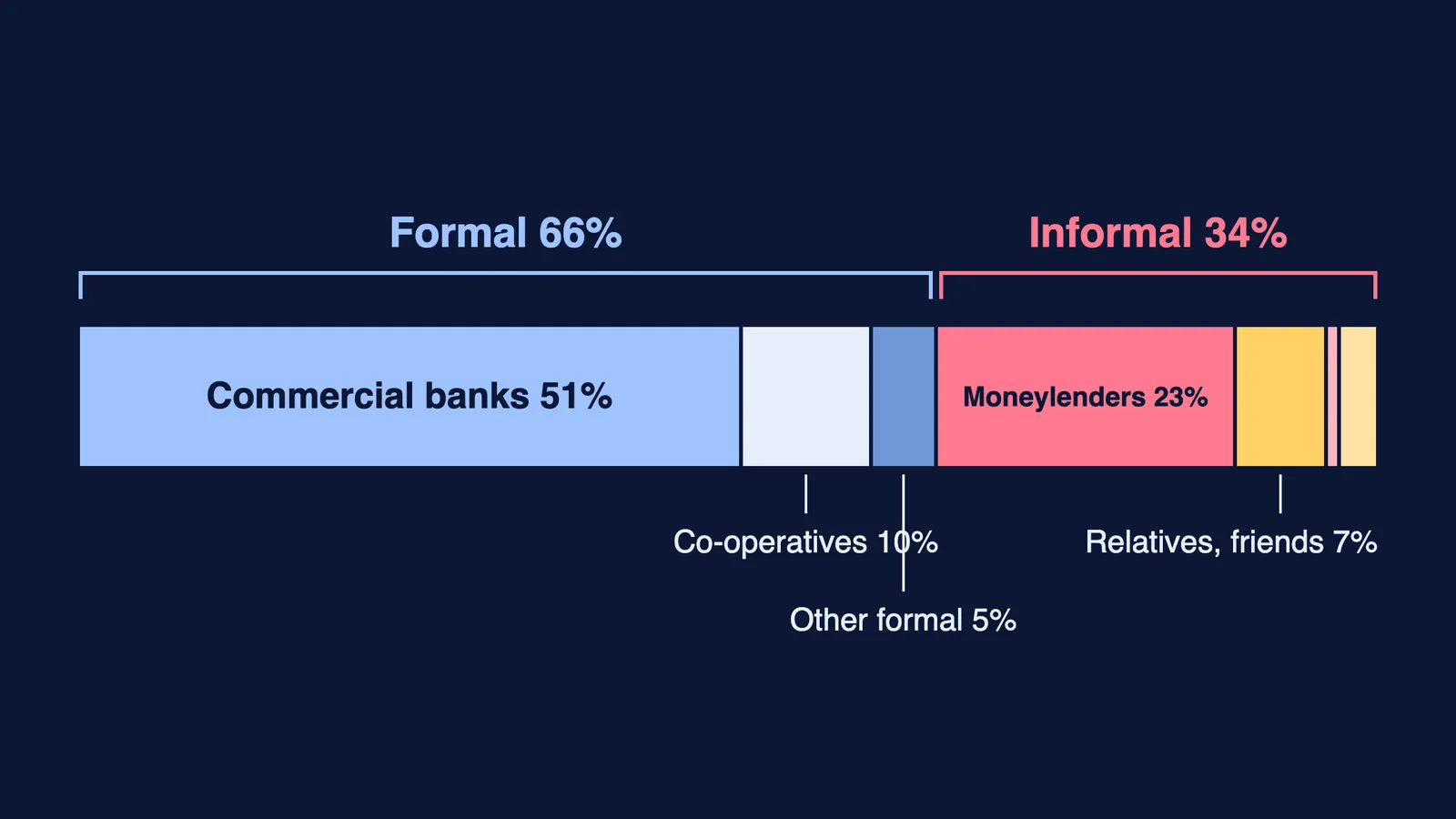
In 2019, commercial banks supplied 51 per cent of rural households' credit, cooperatives 10 per cent and other formal agencies 5 per cent, while moneylenders supplied 23 per cent (the textbook's Graph 1, from the All India Debt and Investment Survey). In its Graph 2, 54 per cent of poor urban households' loans came from informal sources, against 17 per cent for rich households.
How much more does a moneylender's loan cost?
In the textbook's village of Sonpur, Shyamal used to pay a moneylender 5 per cent a month, or 60 per cent a year, while Arun's bank crop loan costs 8.5 per cent a year (NCERT, Chapter 3). Take Rs 10,000 for one year at simple interest:
Moneylender: 10,000 x 60/100 = Rs 6,000 interest, so Rs 16,000 to repay.
Bank: 10,000 x 8.5/100 = Rs 850 interest, so Rs 10,850 to repay.
Difference: Rs 5,150 more interest, paid out of the farmer's earnings.
If the arithmetic feels rusty, our guide on how many years money takes to double at simple interest uses the same formula. If you keep choosing the wrong method, the Fermi Problem Library has worked problems with a step-by-step solver that explains the reasoning rather than printing an answer.
What are self-help groups and why do banks lend to them?
A typical self-help group (SHG) has 15-20 members, usually from one neighbourhood, who meet and save regularly, from Rs 25 to Rs 100 or more each (NCERT, Chapter 3). Members borrow small sums from the group at less interest than a moneylender charges. After a year or two of regular saving, the group becomes eligible for a bank loan, sanctioned in the group's name.
The group sets the loan terms and is responsible for repayment, so banks lend to poor women in SHGs even without collateral. The textbook's success story is Grameen Bank of Bangladesh, which by 2018 had over 9 million members in about 81,600 villages.
A revision checklist for Money and Credit
Every number here is from the NCERT chapter. Tick a line only when you can say it aloud without notes:
Define double coincidence of wants, with your own example.
Describe banks as go-betweens: deposits in, loans out, about 5 per cent kept as cash.
Name the four terms of credit and define collateral.
Compare formal and informal credit on supervision, interest and who gets it.
Quote one figure: in 2019, 51 per cent of rural credit came from commercial banks and 23 per cent from moneylenders.
Explain why banks trust SHGs.
For long answers, use four parts: the point, a textbook example, one number, the effect on the borrower. Then try Exercises 2 and 10 in your own words, and revise the geography chapter with our Resources and development Class 10 notes.