On this page
Two Variables, One Line is Chapter 13 of Ganita Manjari Part II, the new NCERT Class 9 mathematics textbook; the CBSE Class IX Mathematics curriculum for 2026-27 calls it Linear Equations in Two Variables. Here are 31 of its key terms in five groups, with our own examples. For a study plan, read our Two Variables, One Line chapter guide.
What is a linear equation in two variables?
If y = mx + d feels new, revise our linear polynomials Class 9 guide.
Linear equation in two variables: any equation you can rearrange into ax + by + c = 0, with real numbers a, b, c and at least one of a, b non-zero. Example: 2x + 3y = 14. Counter-example: x² + y = 5, because x is squared.
Standard form: ax + by + c = 0, all terms on the left. Example: 2x = 14 − 3y becomes 2x + 3y − 14 = 0.
Coefficient: the number multiplying a variable: a for x, b for y. Example: a = 2, b = 3 above.
Constant term: c, the number with no variable. Example: c = −14 above, not 14. Don't confuse with: a coefficient.
Special case (one coefficient zero): an equation with only x, or only y, still counts as a linear equation in two variables. Example: x = 4 is x + 0×y − 4 = 0.
What counts as a solution, and why do they form a line?
Solution: values of x and y that together make the equation true. Example: x = 1, y = 4 solves 2x + 3y = 14.
Ordered pair: a solution written (x, y), x first. Example: (1, 4) works; (4, 1) gives 11. Don't confuse with: the swapped pair.
Infinitely many solutions: any x gives a matching y, so solutions never run out. Example: x = 7 gives (7, 0). More in why a linear equation in two variables has infinite solutions.
Graph of a linear equation: the straight line of all its solutions; every point on it is a solution, and every solution is on it. Counter-example: (2, 2) gives 10, so it is off the line.
Where the line meets the axes: put x = 0 to find where the line cuts the y-axis, y = 0 for the x-axis. Example: (0, 14/3) and (7, 0).
Line through the origin: if c = 0, (0, 0) is a solution. Example: 3x − 2y = 0.
What is the slope of a line?
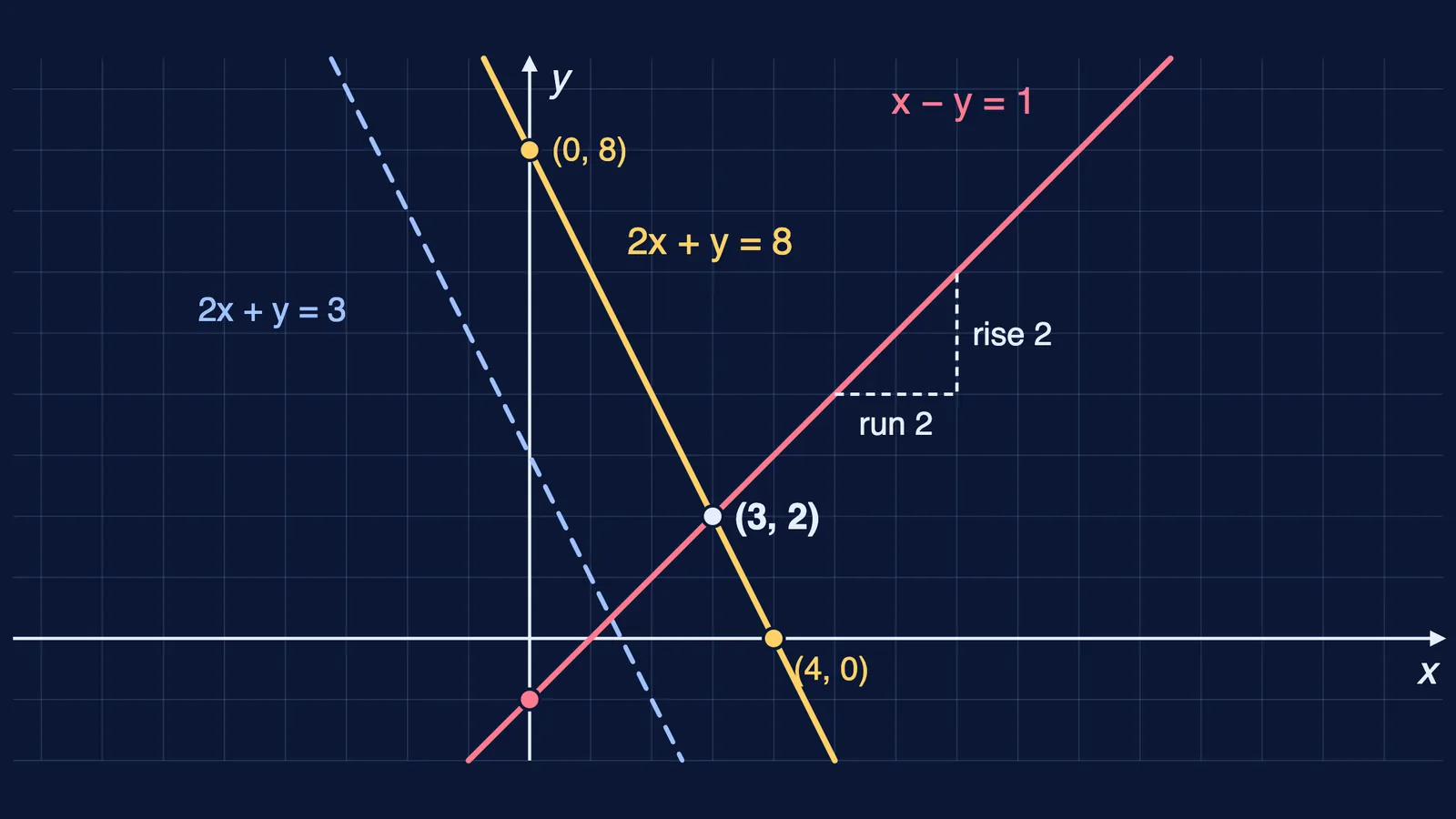
Slope (gradient): steepness, rise ÷ run, (y₂ − y₁)/(x₂ − x₁), the same for any two points on the line. Example: (1, 2) to (4, 8) gives 6/3 = 2.
Rise: vertical change y₂ − y₁; negative if the line goes down.
Run: horizontal change x₂ − x₁; negative if you move left. Don't confuse with: rise, the top of the fraction.
Positive slope: the line climbs left to right. Example: y = 2x + 1.
Negative slope: the line falls left to right. Example: y = −3x + 5.
Zero slope: a horizontal line, parallel to the x-axis; y stays fixed. Example: y = 4.
Undefined slope: a vertical line, parallel to the y-axis; x stays fixed, the run is 0 and division by 0 is undefined. Example: x = −2.
Slope-intercept form: y = mx + d, with slope m and y-intercept d. Example: y = 2x + 1 has m = 2, d = 1.
y-intercept: d; the line cuts the y-axis at (0, d). Example: y = 2x − 3 cuts it at (0, −3).
Slope from standard form: if b ≠ 0, m = −a/b and d = −c/b. Example: 4x + 2y − 6 = 0 is y = −2x + 3.
How do you solve a pair of linear equations?
Pair of linear equations: two linear equations in the same x and y, a₁x + b₁y + c₁ = 0 and a₂x + b₂y + c₂ = 0. Example: x + y = 10 and x − y = 4.
Solution of a pair: an ordered pair satisfying both at once. Example: (7, 3). Don't confuse with: (5, 5), which fits only the first.
Substitution method: express one variable through the other, then put it into the second equation. Example: y = 10 − x turns x − y = 4 into 2x − 10 = 4, so x = 7.
Elimination method: make one variable's coefficients equal, then add or subtract to remove it. Example: adding the pair gives 2x = 14.
When does a pair have one, no or infinitely many solutions?
These ratio tests assume a₂, b₂, c₂ are non-zero.
Unique solution: exactly one, when a₁/a₂ ≠ b₁/b₂. Example: x + y = 10, x − y = 4.
No solution: when a₁/a₂ = b₁/b₂ ≠ c₁/c₂. Example: x + y = 10, 2x + 2y = 15.
Infinitely many solutions (pair): when all three ratios are equal; one equation is a multiple of the other. Example: x + y = 10, 3x + 3y = 30.
Intersecting lines: graphs crossing at one point, the unique solution.
Parallel lines: graphs that never meet, so no solution; equal slopes, different y-intercepts. Example: y = 2x + 1 and y = 2x + 5.
Coincident lines: graphs lying on top of each other, so infinitely many solutions. Don't confuse with: parallel lines, which share only the slope.
How to learn these terms
Learn look-alike pairs together: rise and run, zero and undefined slope, parallel and coincident lines.
On one graph sheet, draw an intersecting, a parallel and a coincident pair, with the ratio test beside each.
Solve each pair by both methods, then substitute the answer into both equations.
Rewrite each equation as y = mx + d and read off m and d before plotting.
If the ratio test still feels like a rule without a reason, the Fermi Concept Library gives each concept its own lesson and its place in the map.