On this page
Chapter 4 of NCERT's Exploring Society: India and Beyond, Part 2 (book code gees2, First Edition November 2025, Reprint 2026-27) is "Turning Tides: 11th and 12th Centuries", in the theme Tapestry of the Past.
CBSE publishes no separate 2026-27 curriculum for Classes 6 to 8; these classes follow the NCERT book, and this chapter is assessed by the school.
What is Turning Tides about?
The chapter asks why these two centuries count as a transition. Between an opening and a closing invasion, it visits kingdoms that fought invaders and one another, sent fleets overseas, built temples and supported scholars.
The book adds a word of caution: darker periods are better faced than avoided, and nobody today should be held responsible for past events. Its closing lesson is resilience, as learning, trade and art carried on.
What happened in the north under Mahmud of Ghazni and Muhammad Ghuri?
The book describes two phases.
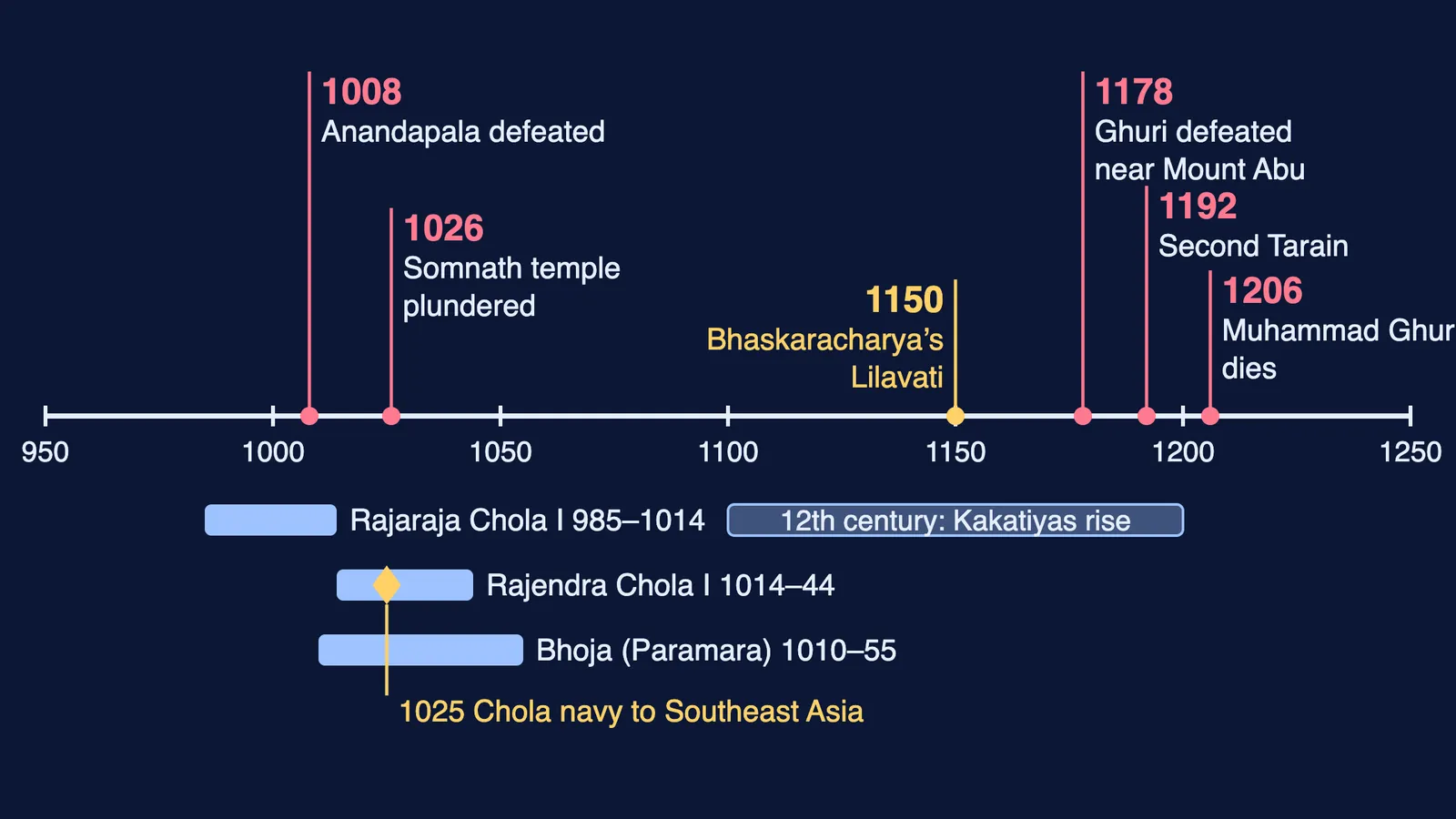
The Ghaznavids, 11th century. The Hindu Shahis held the Khyber Pass, a trade route for at least 2,500 years. Mahmud, ruler of the Turkic Ghaznavids, defeated Jayapala and, in 1008, his son Anandapala. Mahmud led 17 campaigns into India; the book records plunder and destruction of temples at Mathura (1018), Kannauj and Somnath, with killings and captives. Historians often name plunder as the main reason; the book adds, from evidence of his time, that he also sought to spread his version of Islam.
The Ghurids, 12th century. Muhammad of Ghur wanted lasting territory. Mularaja II defeated him near Mount Abu in 1178, and Prithviraja III at Tarain in 1191. In 1192 he won the Second Battle of Tarain and then took Delhi. His general Qutb-ud-din Aibak later founded the Delhi Sultanate. Aibak's commander Bakhtiyar Khilji took Bihar and Bengal, destroyed Nalanda and Vikramashila, and suffered severe losses in Kamarupa in 1205.
Resistance runs through both phases: the Chandellas against Mahmud; Suheldev of Bahraich, who, by oral history and a later chronicle, defeated Mahmud's nephew Salar Masud; and Kamarupa, where, the book says, invaders were left without supplies.
Which kingdoms grew in the rest of India?
Much of the north and all of the south stayed outside Turkic control:
East: the Senas of Bengal, patrons of the poet Jayadeva; the Eastern Gangas, who began the Jagannatha temple at Puri.
Deccan: the Kakatiyas at Orugallu (Warangal), with village self-governance and irrigation; the Hoysalas of Belur and Halebidu, known for carved temples.
Far south: the Cholas. Rajaraja I (from 985) built the Brihadishvara temple at Thanjavur. Rajendra I sent a navy against the Shrivijaya king in 1025, a rivalry over sea trade with China.
Malwa: Bhoja of Dhara, a Paramara scholar-king who ruled from 1010.
Ideas: Bhaskaracharya (born 1114) wrote Lilavati; Ramanujacharya and Basavanna shaped religious thought in the south.
How do you judge a source from this chapter? A worked example
The chapter quotes writers at different distances from events. For each, note what the book says: who wrote, when, and how close they were.
Al-Utbi was Mahmud's court historian and chronicled his campaigns. The book cites him as evidence from Mahmud's time.
Al-Biruni went with Mahmud into India around 1017. He praised the Hindu Shahis and recorded the harm the campaigns did to Indian learning. The book asks what such a remark from Mahmud's entourage tells us.
Juzjani wrote his account of Bakhtiyar Khilji's campaign through Bihar some 60 years after it.
Merutunga, a Jain scholar from Gujarat, wrote a semi-historical chronicle of the 1178 battle over a century later. The book says this is why historians are divided on whether Queen Naikidevi or her son Mularaja II should be credited with the victory, while sources do record Muhammad's defeat.
Copy the book's method from Merutunga: accept what several sources record, and treat a detail that rests on one much later source as uncertain.
How does Chapter 4 connect to the rest of the book?
It follows Chapter 3, Empires and Kingdoms: 6th to 10th Centuries, which the book refers back to for the Cholas, the Western Chalukyas and a different King Bhoja, of the Gurjara-Pratiharas. It points to Grade 8 for the Delhi Sultanate, and to Grade 7 Mathematics for riddles in Bhaskaracharya's style.
From the older books, our guides to the Delhi Sultans in Class 7 and Bhakti and Sufi traditions cover nearby ground; the Class 9 chapter Resistance and Resilience, 1000–1700 CE carries the story on.
Practice questions
Marks are our suggestion; your school sets its own pattern.
Why did control of the Khyber Pass matter in this period? (2 marks)
Name one capital each of the Kakatiyas and the Hoysalas. (2 marks)
What rivalry lay behind Rajendra I's naval expedition of 1025? (3 marks)
Give two pieces of evidence that trade kept growing despite the wars. (3 marks)
A classmate says all of India came under Turkic rule by 1206. Correct this using three kingdoms from the chapter. (5 marks)
Not sure which kingdom to revise first? Fermi's AI tutor works out what you already know and builds a plan for the session.