

On this page
The Delhi Sultanate lasted from 1206 to 1526 and was made up of five dynasties, according to the table "The Rulers of Delhi" in Chapter 3 of NCERT's Class 7 history book, *Our Pasts II* (NCERT, Delhi: 12th to 15th Century). This guide follows that chapter as it appears in the 2024-25 reprint. If your school uses NCERT's newer books, check which chapter covers the Sultans.
What are the five dynasties of the Delhi Sultanate in order?
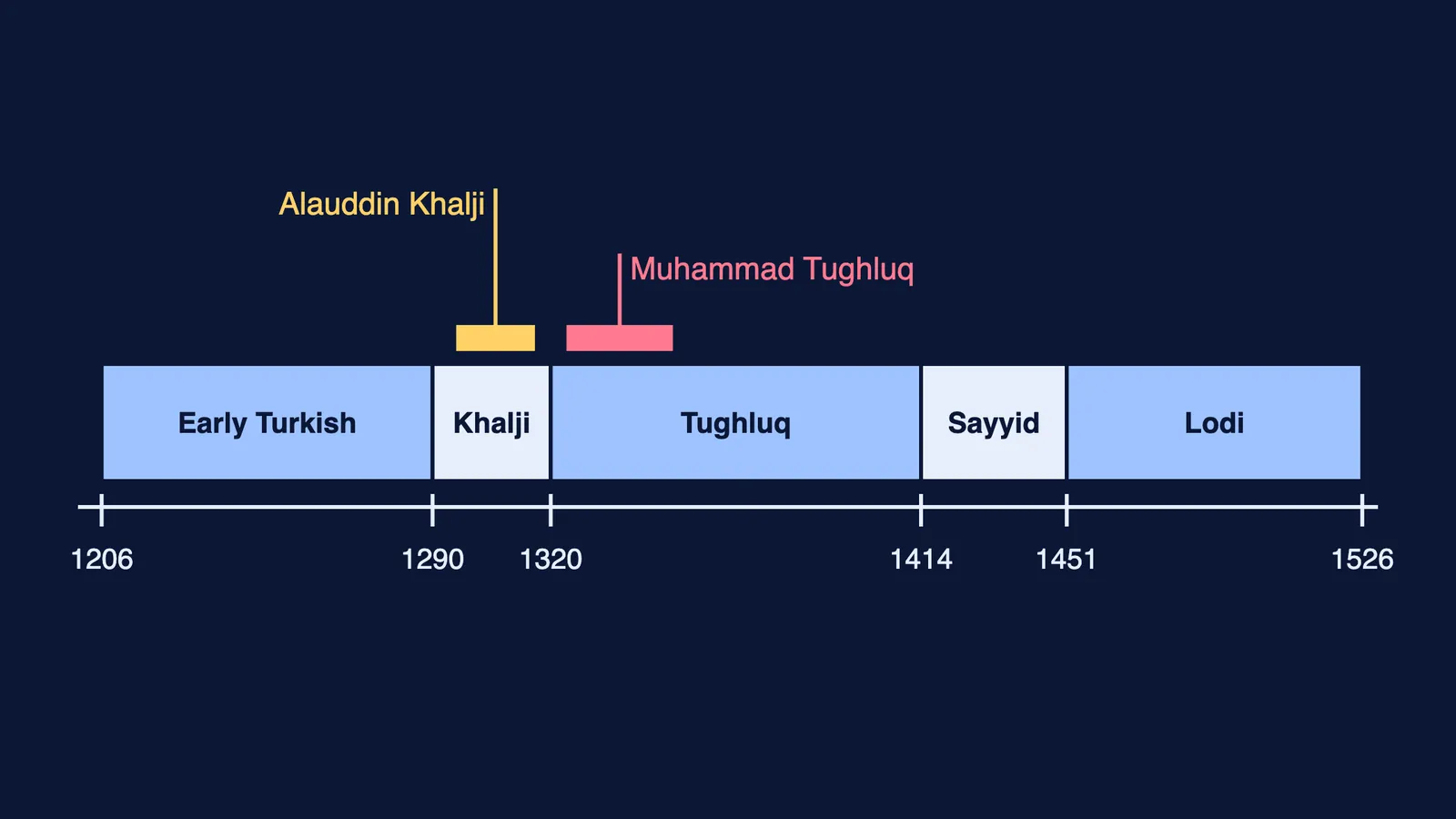
Delhi first became a capital under the Tomara Rajputs, who were defeated in the middle of the twelfth century by the Chauhans of Ajmer, the dynasty of Prithviraj Chauhan (NCERT Chapter 3). The Sultanate began in the early thirteenth century. Here are the five dynasties with the rulers the table names:
Early Turkish rulers, 1206–1290: Qutbuddin Aybak, Shamsuddin Iltutmish, Raziyya (1236–1240) and Ghiyasuddin Balban.
Khalji dynasty, 1290–1320: Jalaluddin Khalji and Alauddin Khalji (1296–1316).
Tughluq dynasty, 1320–1414: Ghiyasuddin Tughluq, Muhammad Tughluq (1324–1351) and Firuz Shah Tughluq (1351–1388).
Sayyid dynasty, 1414–1451: Khizr Khan.
Lodi dynasty, 1451–1526: Bahlul Lodi.
A memory hook that keeps the order: Every Kid Takes Some Lunch (Early Turkish, Khalji, Tughluq, Sayyid, Lodi). Then add one ruler to each letter.
What was an iqta in the Delhi Sultanate?
An iqta was a territory handed to a military commander to govern, and its holder was called an iqtadar or muqti (NCERT Chapter 3). The muqti led military campaigns and kept law and order in the iqta. In return, he collected the revenue of the land as his salary and paid his soldiers from it.
The Sultans kept muqtis in check in four ways, all listed in the same chapter:
The office was not inheritable, so a muqti could not pass the iqta to his son.
Iqtas were held for a short time before the muqti was shifted.
State accountants checked how much revenue each muqti collected.
Muqtis could collect only the taxes the state fixed, and had to keep the required number of soldiers.
Before this, the early Sultans, especially Iltutmish, preferred slaves bought for military service, called bandagan, as governors, because they depended entirely on their master. If you want to compare this with the Mughal system that came later, our guide to Mughal mansabdars and zabt for Class 7 covers the Mughal chapter.
How do Alauddin Khalji and Muhammad Tughluq compare?
Your chapter often names these two rulers together (NCERT Chapter 3):
Reign: Alauddin Khalji ruled 1296–1316; Muhammad Tughluq ruled 1324–1351.
Iqtas: the harsh conditions of service for muqtis were rigorously imposed under both of them.
Land revenue (Alauddin): the state took assessment and collection into its own hands, cancelled local chieftains' right to levy taxes, measured land and kept careful accounts. Kharaj, the tax on cultivation, was about 50 per cent of the peasant's produce, with further taxes on cattle and houses.
Officials (Muhammad Tughluq): he gave high administrative posts to people of humble birth, among them Aziz Khummar, a wine distiller, and Firuz Hajjam, a barber. The chronicler Ziyauddin Barani saw this as a sign the Sultan had lost his political judgement.
Mongols: attacks grew under Alauddin and in Muhammad Tughluq's early years, so both kept a large standing army in Delhi, which was a huge administrative challenge.
Forests: both could force control over forested areas held by local chieftains, but only for a short time.
How should you revise the Delhi Sultans for a test?
A 20-minute plan:
Write E-K-T-S-L from memory with dates and one ruler each. Check it against Table 1.
Define the chapter's keywords in one line each: iqta, tarikh, garrison, Mongols, gender, kharaj.
Write the Alauddin and Muhammad Tughluq comparison above without looking, then fill the gaps.
Answer question 7 from the exercises in four points, using the model below.
Model answer to "What were the steps taken to ensure that muqtis performed their duties?":
Their office was not hereditary.
They held iqtas for short periods and were then transferred.
Accountants appointed by the state checked the revenue they collected.
They could collect only the taxes the state prescribed and had to keep the required number of soldiers.
For the second half (why muqtis might defy the Sultan), give a reason in your own words, such as resenting frequent transfers. Chieftains who held out in forests and hills also appear in tribes, nomads and settled communities for Class 7, and the regional kingdoms that rose as Delhi weakened are in the making of regional cultures for Class 7.
If science is next on your revision list, Fermi's AI tutor can work out what you already know and build a plan for the session, so you start with a clear next step.


