

On this page
The Making of Regional Cultures is Chapter 7 of NCERT's Class 7 history book, Our Pasts II. It asks whether identities such as Tamil or Oriya have always existed. The answer in the NCERT chapter (PDF) is no. Frontiers between regions have changed over time, and what we now call a regional culture is often the product of local traditions mixing with ideas from other parts of the subcontinent.
What is the chapter 'The making of regional cultures' about?
The chapter makes one argument and illustrates it with six case studies. Some traditions look specific to one region, some look similar across regions, and some start in one place and take a new form somewhere else, according to the NCERT text. The cases are language in Kerala, the Jagannatha cult in Orissa (now Odisha), heroic traditions in Rajasthan, Kathak, miniature painting, and Bengal.
How did language and religion shape regions?
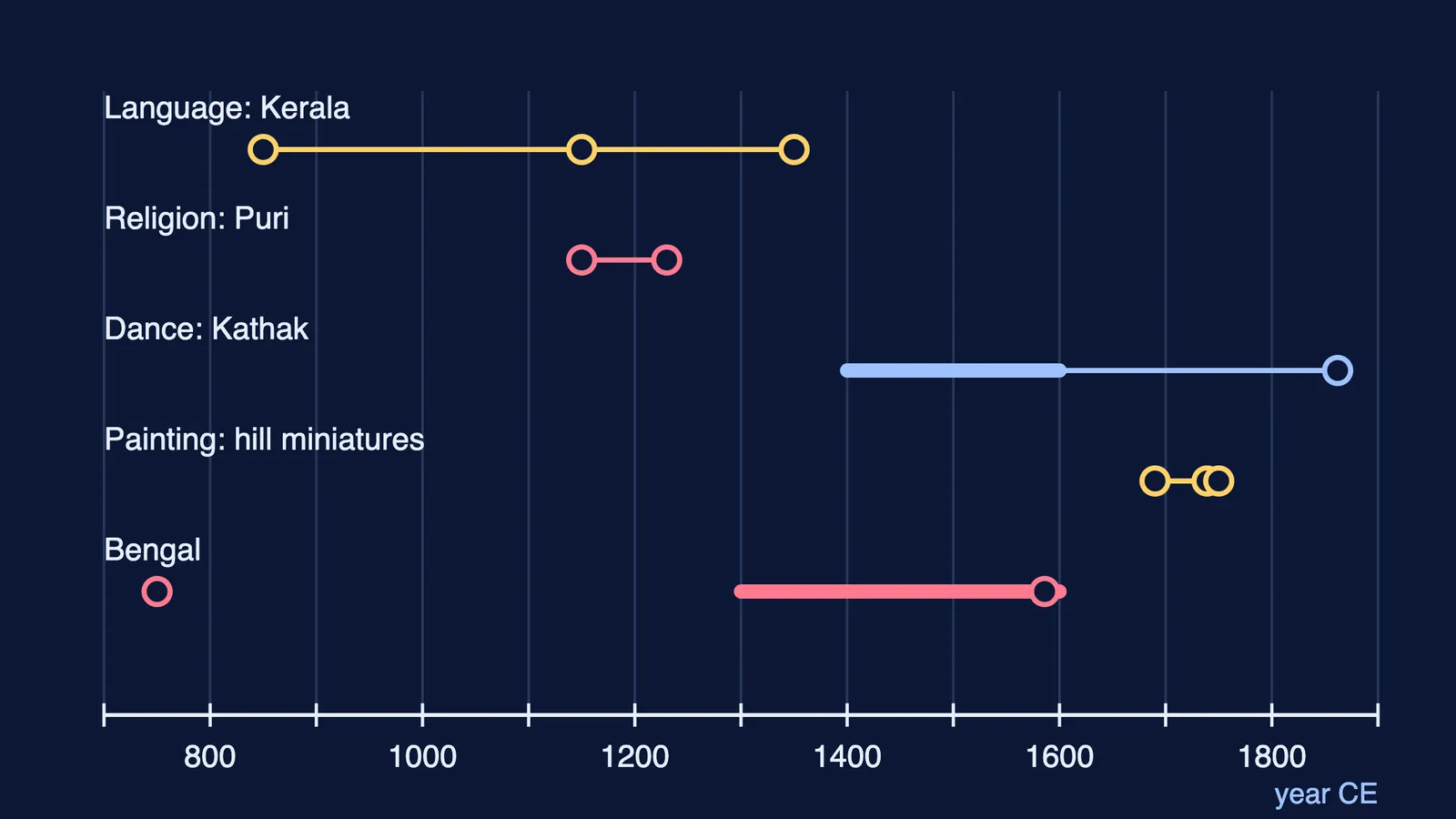
In Kerala, the Chera kingdom of Mahodayapuram was set up in the ninth century, and its rulers introduced the Malayalam language and script in their inscriptions, one of the earliest uses of a regional language in official records (NCERT). The Cheras still drew on Sanskrit: the first Malayalam literary works, dated to about the twelfth century, are directly indebted to it.
Manipravalam means 'diamonds and corals', referring to two languages, Sanskrit and the regional language. The fourteenth-century Lilatilakam, a text on grammar and poetics, was composed in it.
Orissa shows a culture growing around a religious tradition. Local tribal people still make the wooden image of Jagannatha at Puri, which suggests he began as a local god later identified with Vishnu. Anantavarman of the Ganga dynasty decided to build a temple for him in the twelfth century, and in 1230 Anangabhima III dedicated his kingdom to the deity and called himself the god's 'deputy'. Later conquerors of Orissa, including the Mughals, the Marathas and the English East India Company, tried to control the temple so that local people would accept their rule.
In Rajasthan, Rajput rulers prized the hero who fought valiantly, often choosing death over defeat, and specially trained minstrels recited those stories in poems and songs.
How did Kathak and miniature painting travel between regions?
The word kathak comes from katha, a word for story, and the kathaks were first a caste of story-tellers in north Indian temples (NCERT). Kathak began to become a distinct dance in the fifteenth and sixteenth centuries with the spread of the bhakti movement, then acquired its present features at the Mughal court. It developed two gharanas, Jaipur and Lucknow, and grew into a major art form under Wajid Ali Shah, the last Nawab of Awadh. Most British administrators disapproved of it, but it survived and became one of the six 'classical' dance forms recognised after independence.
Miniatures are small paintings, usually in water colour on cloth or paper. Akbar, Jahangir and Shah Jahan patronised painters who illustrated histories and poetry. As the Mughal Empire declined, many painters moved to regional courts in the Deccan and Rajasthan, where centres such as Mewar, Jodhpur, Bundi, Kota and Kishangarh kept their own characteristics. In the hills, a bold and intense style called Basohli had developed by the late seventeenth century. After Nadir Shah conquered Delhi in 1739, Mughal artists moved to the hills, and the patrons they found there led to the Kangra school, known for soft colours such as cool blues and greens.
What should you remember about Bengal?
Bengali is now seen as derived from Sanskrit, but early Sanskrit texts suggest people in Bengal did not speak Sanskritic languages (NCERT). Trade with Magadha may have spread Sanskrit's influence, and Gupta rule and Brahmana settlers strengthened it. After Akbar conquered Bengal in 1586, Persian was the language of administration while Bengali developed as the regional language.
Pir is a Persian word for a spiritual guide, and shrines to pirs are found everywhere in Bengal. Bengal's temples copied the double-roofed (dochala) and four-roofed (chauchala) thatched hut. And the thirteenth-century Brihaddharma Purana permitted Bengal's Brahmanas to eat certain fish.
How do you revise this chapter in 20 minutes?
Five minutes: draw the timeline from the image above from memory, one row each for Kerala, Puri, Kathak, miniatures and Bengal.
Five minutes: for each row, write one line on what was local and what came from outside.
Five minutes: answer the NCERT questions aloud, such as 'What is Manipravalam?' and 'Who were the major patrons of Kathak?'
Five minutes: check your answers against the chapter and mark every date you got wrong.
For the courts in this story, read our guides to the Mughal Empire from Akbar to Aurangzeb and eighteenth-century political formations. Syllabi change, so check your school's current NCERT syllabus before you plan.
For science subjects, Fermi's AI tutor works out what you already know and builds a plan for the session, so you start with a clear next step.


