

On this page
This chapter answers one question: why did society change differently in different places? The facts below come from the chapter itself, NCERT's Our Pasts II, Chapter 5. Chapter numbers differ between editions, so look for it by its title.
What does Tribes, Nomads and Settled Communities cover?
Learn these four definitions first. All come from the NCERT chapter.
Tribe: a society that did not follow the social rules and rituals laid down by the Brahmanas and was not divided into many unequal classes.
Clan: a group of families or households claiming descent from a common ancestor.
Nomads: wandering people. Many were pastoralists who moved from one pasture to another with their flocks and herds.
Itinerant groups: craftspersons, pedlars and entertainers who travelled from place to place practising their occupations.
Tribal people were found in almost every region, and large tribes usually lived in forests, hills, deserts and hard-to-reach places. With a few exceptions they kept no written records, so historians now use their oral traditions to write tribal histories.
Who were the Banjaras?
According to NCERT, the Banjaras were the most important trader-nomads, and their caravan was called a tanda. Sultan Alauddin Khalji used them to carry grain to city markets. They also carried food grain for the Mughal army, and with a large army there could be 100,000 bullocks carrying grain.
The chapter quotes Peter Mundy, an English trader of the early seventeenth century: "In the morning we met a tanda of Banjaras with 14,000 oxen." He wrote that a tanda could hold 600 to 700 people, whole families included, and that it travelled no more than 6 or 7 miles a day, in cool weather.
How did the Gonds build a kingdom?
The Gonds lived in a large forested region called Gondwana, "country inhabited by Gonds", and practised shifting cultivation: forest is cut and burnt, a crop is sown in the ashes, and when that land loses its fertility another plot is cleared and planted the same way. NCERT notes that the Akbar Nama records that the Gond kingdom of Garha Katanga had 70,000 villages.
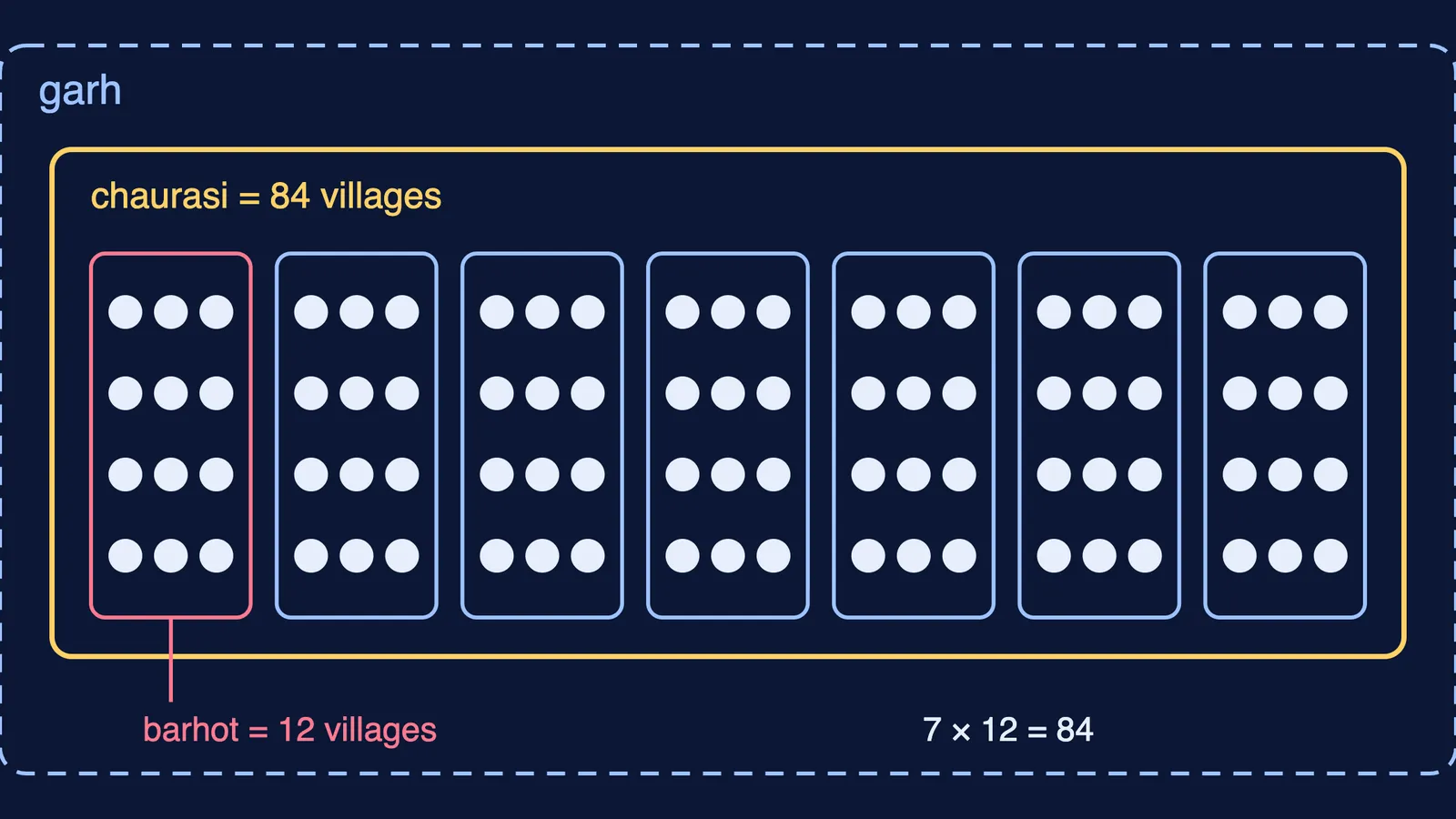
The kingdom was divided into garhs, each controlled by one Gond clan. A garh was split into chaurasis of 84 villages, and a chaurasi into barhots of 12 villages each.
As the state grew, a fairly equal society split into unequal classes. Brahmanas received land grants. The raja Aman Das took the title Sangram Shah. His son Dalpat married Durgawati, a Chandel Rajput princess. Rani Durgawati later ruled for her five-year-old son. In 1565 Mughal forces under Asaf Khan attacked, and she chose to die rather than surrender.
How was the Ahom state organised?
The Ahoms came to the Brahmaputra valley from present-day Myanmar in the thirteenth century, says the NCERT chapter. They annexed the Chhutiya kingdom in 1523 and Koch-Hajo in 1581. They used firearms as early as the 1530s and could make good gunpowder and cannons by the 1660s. In 1662 the Mughals under Mir Jumla attacked and defeated them, but direct Mughal control did not last long.
Paiks: people forced to work for the state. A census was taken and each village sent paiks in turn.
Khels: the clans that made up Ahom society. One khel often controlled several villages.
Buranjis: chronicles written first in the Ahom language and then in Assamese.
In the reign of Sib Singh (1714 to 1744) Hinduism became the main religion, though the kings kept some of their old beliefs.
How did society change?
As the economy grew, smaller castes called jatis appeared within varnas, and jatis rather than varna became the way society was organised. Many tribes joined caste society, but only leading tribal families joined the ruling class. Most joined the lower jatis. Many tribes in Punjab, Sind and the North-West Frontier took up Islam early and kept rejecting the caste system.
A 20-minute revision plan
Five minutes: write the four definitions from memory, then check them.
Five minutes: make two columns, Gonds and Ahoms, and fill in where they lived, how they were run, who attacked them and the year.
Five minutes: answer aloud, "Were the Banjaras important for the economy?" Use the army grain example.
Five minutes: on a blank map, mark where the Gonds, Ahoms, Bhils and Cheros lived, then check against Map 1 in the chapter.
For more Class 7 history, read our Mughal empire Class 7 summary and the eighteenth-century political formations study guide. For geography, see human environment: settlement, transport and communication.
If this chapter is under control but science or maths is piling up, Fermi's AI tutor can work out what you already know and build a plan for the session, so you start with a clear next step.


