

On this page
In the 2024-25 reprint of NCERT's Class 7 history book, *Our Pasts II*, Devotional Paths to the Divine is chapter 6 (NCERT chapter PDF). It is full of names, centuries and regions, so students mix them up. This guide sorts them into one picture, then gives you a one-page way to revise.
What is the chapter Devotional Paths to the Divine about?
Bhakti is generally understood as a person's devotion to his or her chosen deity, according to the NCERT Class 7 chapter. The chapter says anybody, rich or poor, of any caste, man or woman, could follow this path.
Keep one thread in mind as you read: devotion over ritual, and equality over caste. Almost every saint in the chapter is an example of it.
Who were the Nayanars and Alvars?
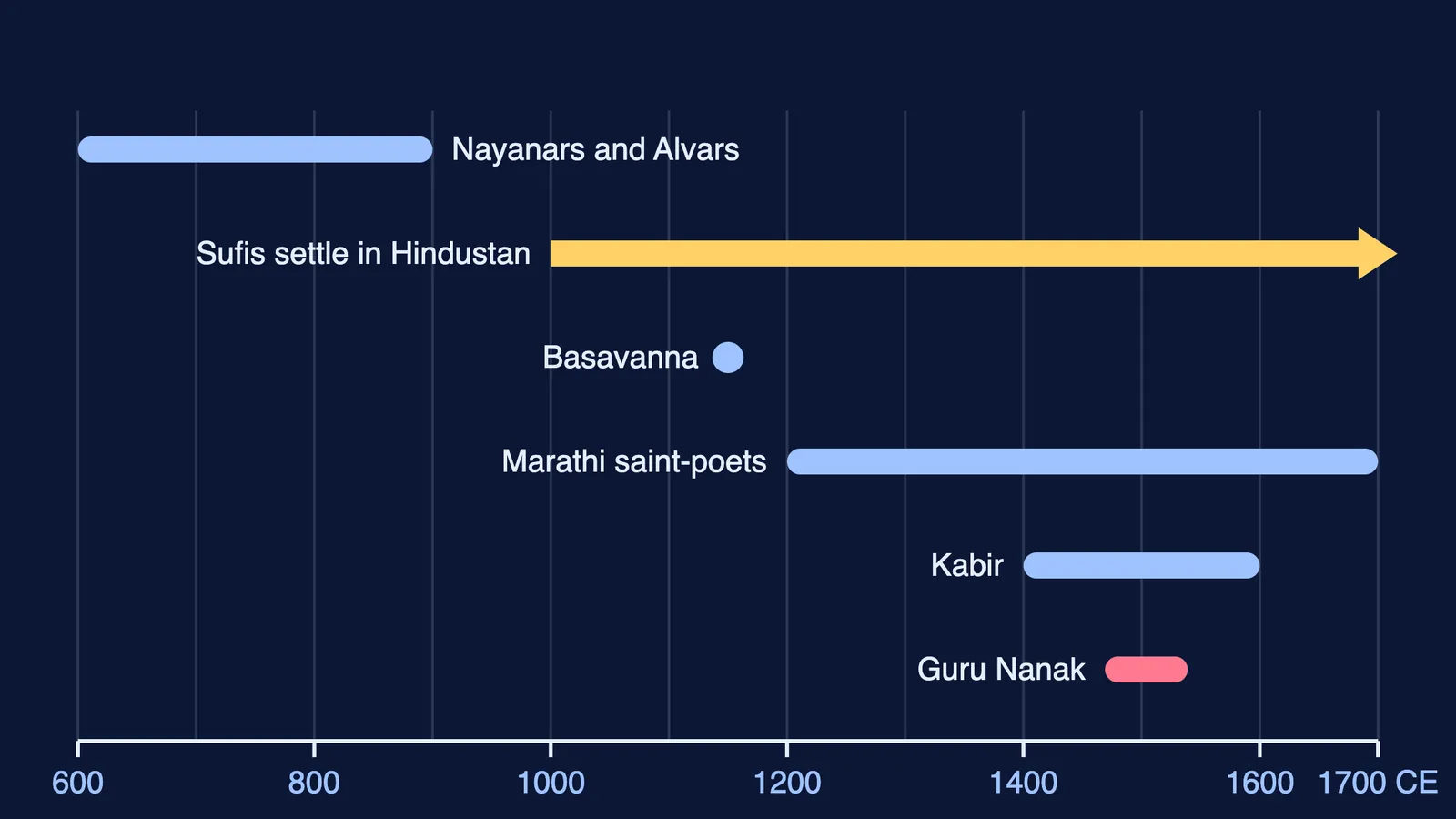
The Nayanars were saints devoted to Shiva and the Alvars were saints devoted to Vishnu; both led new religious movements in south India between the seventh and ninth centuries (NCERT). They came from all castes, including those considered "untouchable" such as the Pulaiyar and the Panars.
There were 63 Nayanars. The best known were Appar, Sambandar, Sundarar and Manikkavasagar; their songs are compiled in the *Tevaram* and *Tiruvacakam*.
There were 12 Alvars. The best known were Periyalvar, his daughter Andal, Tondaradippodi Alvar and Nammalvar; their songs are compiled in the *Divya Prabandham*.
What did Basavanna, Kabir and Guru Nanak teach?
All three appear in the same NCERT chapter, and questions often ask you to compare them.
Basavanna and his companions, such as Allama Prabhu and Akkamahadevi, began the Virashaiva movement in Karnataka in the mid-twelfth century. The Virashaivas argued for the equality of all human beings, against Brahmanical ideas about caste and the treatment of women, and against ritual and idol worship. In one *vachana* attributed to him, his body becomes the temple: "My legs are pillars, / The body the shrine".
Kabir probably lived in the fifteenth-sixteenth centuries and was brought up in a family of Muslim weavers (*julahas*) in or near Benares. He rejected the major religious traditions, believed in a formless Supreme God, and drew followers from both Hindus and Muslims.
Baba Guru Nanak (1469-1539) set up a centre at Kartarpur, where followers of every creed, caste and gender ate together in the common kitchen (*langar*). He used the terms *nam*, *dan* and *isnan* for the essence of his teaching: right worship, welfare of others and purity of conduct.
The Sikh story carries on into politics: Jahangir, from our guide to the Mughal Empire from Akbar to Aurangzeb, ordered Guru Arjan's execution in 1606, and the Khalsa returns in eighteenth-century political formations.
What were the Sufi orders, or silsilas?
Sufis were Muslim mystics who rejected outward religiosity and emphasised love and devotion to God and compassion towards all fellow human beings (NCERT). They trained the heart through practices such as *zikr* (chanting a name or sacred formula), *sama* (singing) and breath control, under a master called a *pir*. A *silsila* is a spiritual genealogy of Sufi teachers, each following a slightly different method, or *tariqa*.
Many Sufis from Central Asia settled in Hindustan from the eleventh century onwards. The Chishti *silsila* was among the most influential; its teachers included Khwaja Muinuddin Chishti of Ajmer, Qutbuddin Bakhtiar Kaki of Delhi, Baba Farid of Punjab, Khwaja Nizamuddin Auliya of Delhi and Bandanawaz Gisudaraz of Gulbarga. Masters met devotees in *khanqahs* (hospices), and a saint's tomb, or *dargah*, became a place of pilgrimage for people of all faiths.
How do you revise this chapter on one page?
Draw four columns: who; where and when; devoted to, or main idea; key texts and terms. Fill one line per saint or group, then cover the page and refill it from memory. Two lines filled in from the chapter:
Nayanars; south India, 7th-9th centuries; Shiva, 63 saints from all castes; *Tevaram*, *Tiruvacakam*.
Guru Nanak; Kartarpur, 1469-1539; one God, caste and gender irrelevant; *langar*, *nam, dan, isnan*.
A plan for the week before your test:
Day 1: fill the grid with the book open.
Day 2: refill it with the book shut and mark every gap in red.
Day 4: answer the chapter's question on how Kabir's poem compares with the ideas of Basavanna and Jalaluddin Rumi.
The day before: redraw the timeline at the top of this post from memory.
If you check dates against a chatbot's summary, follow our guide to checking AI answers on history dates and events, and trust the NCERT chapter where they disagree. For your Class 7 science chapters, the Fermi Concept Library covers every concept in physics, chemistry, biology, mathematics and computing, each with its own lesson.


