On this page
Your ledger accounts are balanced and the next page says "Trial Balance". Here is what CBSE expects in 2026-27, how to build one by the balances method, what a tally does and does not prove, and what to check when totals refuse to match.
What is a trial balance in Class 11 Accountancy?
The NCERT textbook defines a trial balance as a statement showing the balances, or total of debits and credits, of all the accounts in the ledger, to verify the arithmetical accuracy of posting (NCERT Class 11 Accountancy Part I, Chapter 6, Reprint 2026-27). Its three objectives: check arithmetical accuracy, help locate errors, and help prepare the financial statements.
In the CBSE Accountancy (055) curriculum for Class XI, 2026-27, "Trial balance: objectives, meaning and preparation" sits in Unit-2: Accounting Process, listed at 44 marks out of a theory paper of 80 marks. The curriculum sets the scope as "Trial balance with balance method only", so the totals method and the totals-cum-balances method fall outside the stated scope.
It is also the bridge to the next unit: revenue and expense balances go to the trading and profit and loss account, and the rest to the balance sheet, as our guide to final accounts of a sole proprietorship with adjustments shows.
How do you prepare a trial balance by the balances method?
Balance every ledger account and note whether the balance is debit or credit.
Write each account title once, with its balance in the Debit or Credit column. NCERT notes that individual debtors and creditors are usually shown as one figure each: sundry debtors and sundry creditors.
Total both columns. If they match, the trial balance tallies.
The quick rule for step 2: assets, expenses, losses and drawings carry debit balances; capital, liabilities, incomes, gains and returns outwards carry credit balances. Sales return is a debit; purchases return is a credit.
Worked example: a stationery shop's trial balance
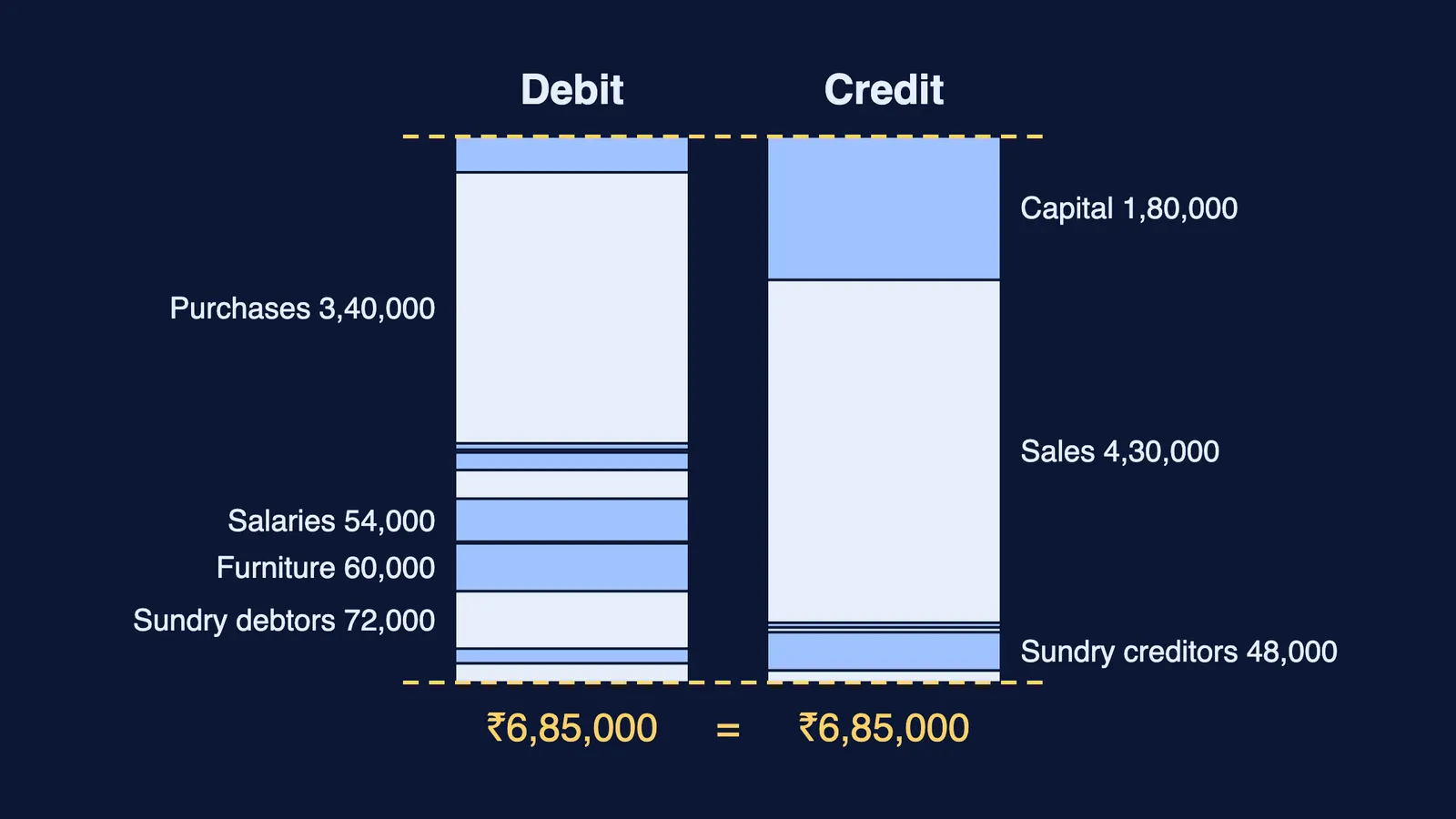
Meera runs a stationery shop. Her ledger balances on 31 March 2027 (in rupees; our own example, not from NCERT):
Debit balances:
Opening stock (1 April 2026): 45,000
Purchases: 3,40,000
Sales return: 8,000
Carriage inwards: 3,500
Wages: 22,000
Rent: 36,000
Salaries: 54,000
Discount allowed: 2,000
Furniture: 60,000
Sundry debtors: 72,000
Cash in hand: 18,500
Drawings: 24,000
Credit balances:
Capital: 1,80,000
Sales: 4,30,000
Purchases return: 6,000
Commission received: 6,000
Sundry creditors: 48,000
Bank overdraft: 15,000
Total of debit balances: 6,85,000. Total of credit balances: 6,85,000. The trial balance tallies.
The lines students most often misplace: drawings (debit, because it reduces capital), discount allowed (debit, an expense), commission received (credit, an income) and bank overdraft (credit, a liability).
What does a tallied trial balance not prove?
NCERT is direct about this: agreement of the trial balance is not an absolute proof of accuracy; it only shows, to a certain extent, that posting to the ledger is arithmetically correct (NCERT Chapter 6). The chapter groups errors into four kinds: commission, omission, principle and compensating.
Try it on Meera's books. Suppose a rent payment of 3,000 had been debited to Salaries instead of Rent. Rent would show 33,000 and Salaries 57,000, yet both totals would still be 6,85,000. The same holds if a transaction is omitted completely, if furniture bought is debited to Purchases (an error of principle), or if two equal mistakes cancel out.
What should you check when the trial balance does not tally?
NCERT's steps include re-adding both columns, comparing each account and amount with the ledger, rechecking each balance and rechecking postings from the books of original entry. Two number tricks from the chapter, tested on Meera's figures:
Halve the difference. If Discount allowed of 2,000 were written in the credit column, debits would total 6,83,000 and credits 6,87,000. The difference is 4,000, and half of it, 2,000, suggests an amount on the wrong side.
Divide by 9. If Cash in hand of 18,500 were copied as 15,800, debits would total 6,82,300, short by 2,700. That difference divides exactly by 9, a hint that two digits were transposed.
Once you find an error, our walkthrough of one-sided and two-sided errors and the suspense account shows how to fix it, and these habits that prevent ledger mistakes stop many of them reaching the trial balance at all.
If revision across your subjects feels hard to organise, Fermi's AI tutor works out what you already know and builds a plan for the session, so you start with a clear next step.
Your next step: cover Meera's list, write each account into the right column from memory, and see whether your totals reach 6,85,000.