On this page
Tourism is Chapter 11 of Kaushal Vikas, the NCERT Class 9 skill education textbook (book code 0916, First Edition, April 2026). It is a choice chapter in Unit III, Work in Human Services, taken after the mandatory Chapter 9. Your class plans and runs a small local tourism service.
What does the Tourism chapter cover in Class 9?
The book names five kinds of travel experience: homestays and eco-village stays; tribal and cultural heritage tourism; cycling and walking trails; river, lake and forest tourism; and spiritual and wellness journeys such as pilgrimages, yoga camps and Ayurveda centres.
Responsible tourism means leaving no waste, keeping noise low and protecting the habitat. Atithi Devo Bhava, treating a guest as equal to a god, sets the tone for how you treat visitors.
What are the steps to plan a tourism service?
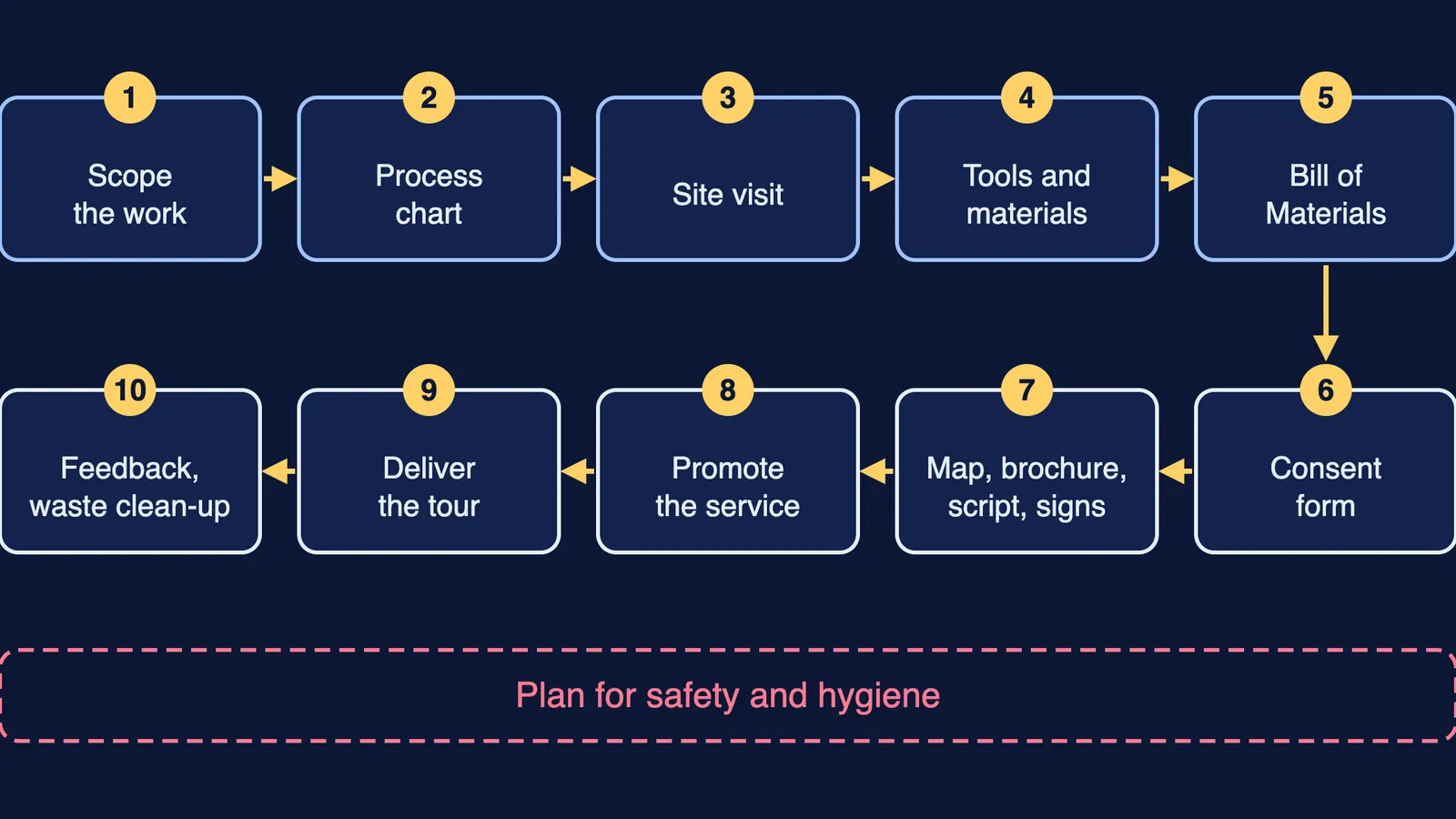
The diagram above shows the full flow. First:
Scope the work: pick a service that suits your area (a heritage walk, a festival, a mandi, a food street), list resources such as maps and community elders, and check it is useful, safe, accessible and nearby. Get permissions.
Process chart: each task with dates and who is responsible.
Site visit: with your teacher, ask a guide, homestay worker, museum attendant or artisan about tools, daily steps, safety, quality and technology.
Tools and materials: stationery, waste bags, reusable bottles, a first-aid kit (check expiry dates), a phone, a route checked in advance rather than GPS alone, and a speaker kept low.
How do you make a Bill of Materials for a tour?
The book's Bill of Materials counts effort as well as purchases. Each labour line is hours × hourly estimate × number of people; the caselet's total is ₹1,145.
Worked example (our numbers, not real prices). Your group runs a food-street walk for 28 visitors.
Materials: 8 chart papers at ₹6 = ₹48; 28 itineraries at ₹2 = ₹56; 2 packets of waste bags at ₹28 = ₹56. Subtotal ₹160.
Labour: preparation 3 h × ₹25 × 4 people = ₹300; guiding 2 h × ₹40 × 2 people = ₹160; clean-up 0.5 h × ₹40 × 4 people = ₹80. Subtotal ₹540.
Total ₹160 + ₹540 = ₹700, so ₹700 ÷ 28 = ₹25 per visitor.
Delays, weather and a short season add hidden costs, so state charges and refunds up front.
What goes into the consent form and safety plan?
The consent form sets out your service, the visitor's expectations and each side's duties. It is not a legal document; it builds trust. Cover four points: what you provide, safety expectations, charges and refunds, and permission for photographs.
The chapter's safety figure lists a first-aid kit and umbrellas, clean food and water, local norms, hygienic toilets, respectful language, and emergency numbers (police, helpline, fire service). For accessibility, walk the route first and find ramps, accessible toilets and easier paths (see disability etiquettes in Class 9 PE).
The book also notes that Article 51A(f) makes preserving heritage a fundamental duty, and that a 1958 Act on ancient monuments makes defacing a protected monument punishable.
How do you deliver the service and collect feedback?
Preparation has five parts:
Map: places of interest, facilities such as washrooms and water, and safe routes.
Brochure: history, timings, fees and emergency numbers, all verified.
Script: the place's story plus logistics, such as removing shoes at a place of worship. Rehearse it.
Signs: labels, rest points, unsafe spots, "Do Not Touch" and zero-waste.
Promotion: personal invitations for a few people; digital groups for many.
On the day, follow a timed itinerary and checklist. Dress neatly and decline off-route requests politely but firmly. Help elders and children.
Afterwards, collect feedback, restore the site and sort waste into dry and wet. Record visitor numbers, comments, challenges and what to improve. Share photos of people only with written consent.
How is Kaushal Vikas assessed in Class 9?
Kaushal Vikas is school-assessed. The CBSE assessment guidelines for 2026-27 set the weightage: paper-pencil test 40 per cent, demonstration and oral presentation or viva 20 per cent, site visit report 10 per cent, portfolio 20 per cent and teacher observation 10 per cent. The 40-mark test has objective (8), short answer (12), scenario or case-based (16) and reflective or decision-making (4) sections. These cover the whole subject (see internal assessment marks and projects).
The CBSE 2026-27 curriculum does not name the textbook; this chapter maps to its Work in Human Services themes (suggested 10 plus 26 hours for that whole form of work, not this chapter alone).
Practice questions (mark labels are our suggestion):
Arrange in order: promote the service, site visit, collect feedback, consent form. (1 mark)
Name the four points a tourism consent form covers. (2 marks)
Three guides each work 1.5 hours at ₹40 an hour. Find the labour cost. (2 marks)
Rain starts mid-walk and a visitor with a walking stick finds the path slippery. Give three steps your team should take. (4 marks)
Not sure where to start? Fermi's AI tutor works out what you already know and builds a plan for the session. For later study, see travel and tourism courses after Class 12.