On this page
Chapter 14 of *Khel Praveen*, NCERT's new Class 9 Physical Education and Well-being textbook (first edition, April 2026), opens with Rohan, who sees a new classmate, Arjun, a wheelchair user, stay back at lunch because the route to the playground is uneven. Rohan wants to help but fears making Arjun uneasy. The chapter answers that dilemma (NCERT Khel Praveen, Unit 4 PDF).
Where does this chapter fit in the 2026-27 syllabus?
The textbook puts Chapter 14 in its Unit 4, Sports for All, alongside Chapters 12, 13, 15, 16 and 17. The CBSE curriculum numbers units differently: "Disability Etiquette and STEP Model" is listed under its Unit 5, Sports for All, which is given 6 hours (3 theory, 3 practical) (CBSE Physical Education and Well-being curriculum, Grade 9, 2026-27).
The subject carries 100 marks: 20 theory and 80 practical. In the theory column, every one of the 8 units carries 2 marks (MCQ, objective or short answer), 16 in all, plus a 4-mark viva. Those 2 marks cover the whole Sports for All unit, not this chapter on its own. Assessment is continuous and done in school, through discussions, pen-and-paper tests, projects and demonstrations.
What is disability etiquette?
Etiquette is everyday good manners. Disability etiquette applies that courtesy to people with disabilities: respect without pity or overprotection, and seeing each person as an individual first, not their disability.
Five general principles:
Be respectful: give everyone dignity.
Be inclusive: do not judge what someone can or cannot do from how they look.
Ask before helping: never assume help is wanted.
Use person-first language ("person with a disability") when preferred; some people choose identity-first terms such as "autistic person", so follow the individual.
Do not stare, point or joke about anyone's disability.
How should you interact with people with different disabilities?
Two pointers per group, in our words:
Wheelchair users: ask before pushing the chair; talk to the person, not their companion.
People with visual impairments: say who you are as you come close, and offer your arm for guidance rather than grabbing them.
People with hearing loss: face them and speak clearly without shouting; gestures, writing or an app help.
People with speech difficulties: let them finish their own sentences, and ask them to repeat if needed.
People with cognitive or developmental disabilities: keep words plain and allow extra time.
People with invisible disabilities: never question whether the disability is real; respect their accommodations.
The chapter's dos and don'ts chart adds: avoid outdated terms, never move mobility aids without asking, and listen without interrupting or guessing.
What is the STEP model in Class 9 PE?
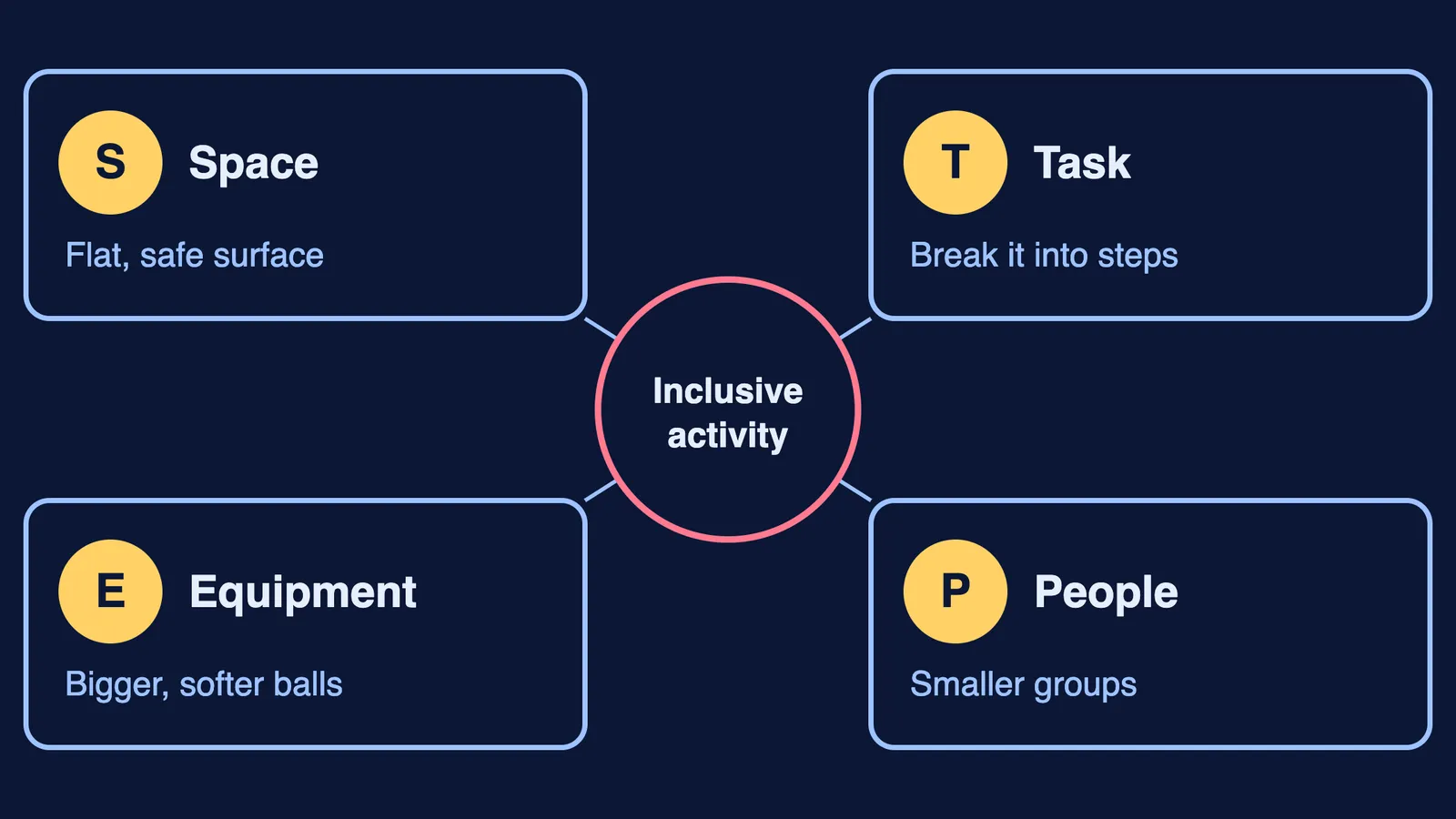
STEP adapts any activity so everyone, including persons with disabilities, can take part. It changes four things:
Space: a smaller play area, flat and safe ground, or less noise.
Task: simpler rules, smaller steps or more time.
Equipment: bigger and softer balls, bright or sound-making objects, or lighter gear.
People: pair someone who needs more support with a partner, or form smaller groups.
The book lists seven benefits, among them equality, confidence, teamwork, safety and preparation for an inclusive society.
Our worked example: a class relay race with two classmates, one who uses a wheelchair and one with a visual impairment.
Space: a smooth, level court away from noise.
Task: shorten each leg and allow extra time at every changeover.
Equipment: a brightly coloured baton fitted with a bell, easy to see and hear.
People: make mixed teams of equal size and fix partners in advance.
First, ask the two classmates what works for them. The book leaves Rohan's choice open; its "ask before helping" rule suggests one: he can ask Arjun if he would like company on the path, and accept the reply.
Practice questions for Chapter 14
Our own questions; marks are our suggestion, since the curriculum sets 2 theory marks for the whole unit.
Expand the letters of the STEP model. (1 mark)
A classmate with hearing loss joins your group. Which is most respectful? (a) Speak louder than usual (b) Face them and speak clearly (c) Pass messages through their friend (d) Avoid talking to them (1 mark)
During a sports period, a teammate starts pushing another student's wheelchair without asking. Name the principle being ignored and say what the teammate should have done. (2 marks)
A student with hearing loss joins a kho-kho practice where a whistle signals each chase. Suggest one change each under Task, Equipment and People, and one etiquette point the team should follow. (4 marks)
Answer hints: (1) Space, Task, Equipment, People. (2) b. (3) Ask before helping. (4) For example, a hand signal and a practice round; a coloured flag with the whistle; a partner who points out changes; face them and speak clearly.
For the senior-class version, see Physical Education and Sports for CWSN in Class 11 and the same chapter in Class 12. Olympism and Olympic values for Class 11 picks up the respect theme.
Juggling several subjects this term? Fermi's AI tutor works out what you already know and builds a plan for the session.