On this page
In CBSE Class 11 Physical Education, Olympism is Unit 2, called Olympic Value Education, and it carries 5 of the 70 theory marks in the 2025-26 curriculum (CBSE Physical Education syllabus 2025-26). Its answers are mostly definitions, names and dates, so exact learning pays. Here is the whole unit, sourced, with a one-week plan.
What does Olympism mean in Class 11 PE?
The Olympic Charter defines Olympism as "a philosophy of life, exalting and combining in a balanced whole the qualities of body, will and mind" (Fundamental Principle 1, quoted by the International Olympic Academy). It blends sport with culture and education into a way of life based on the joy found in effort.
CBSE names three Olympic values: excellence, friendship and respect. It lists five themes of Olympic value education: joy of effort, fair play, respect for others, pursuit of excellence, and balance among body, will and mind (CBSE syllabus). Learn both lists separately. A question on the three values wants three words, not five themes.
How were the ancient and modern Olympics different?
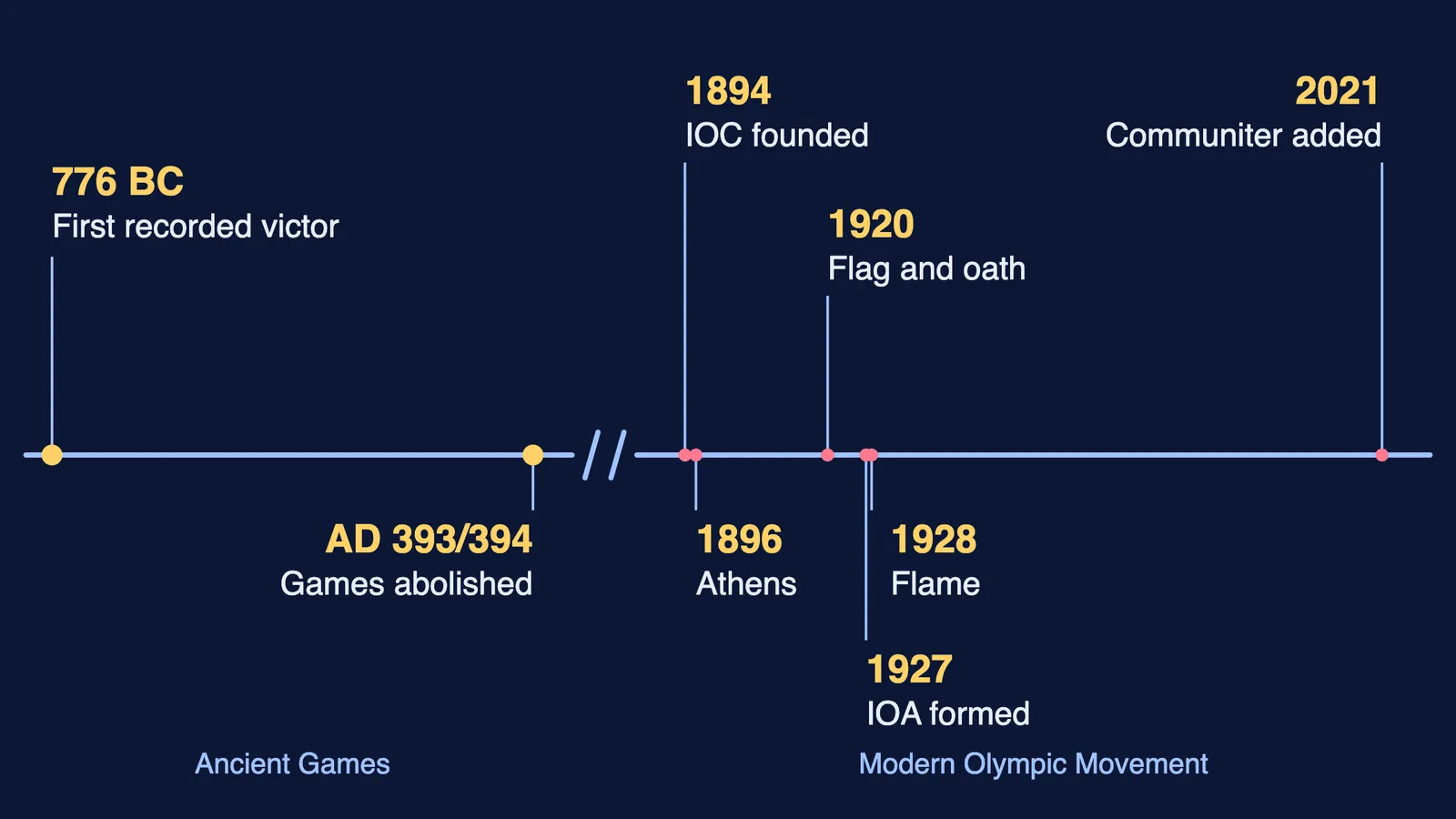
The ancient Games, held at Olympia, were first and foremost a religious celebration in honour of Zeus (Perseus Project, Tufts University). The first recorded victor, Koroibos of Elis, is traditionally dated to 776 BC. The four-year gap between Games, the Olympiad, became a way of dating events. Emperor Theodosius I abolished the Games in 393 or 394 AD.
For the first 13 Olympiads the only event was a footrace (Perseus FAQ). A winner received a crown made from olive leaves, not money (Perseus FAQ on prizes). Tradition says a sacred truce, the ekecheiria, stopped wars during the Games, though historians doubt it ever worked fully in that form (Olympedia: Olympic Truce).
The modern movement began when Pierre de Coubertin founded the International Olympic Committee in 1894, at the congress that re-established the Games (Olympedia: IOC). The first modern Games were held in Athens in April 1896, with 176 participants from 13 countries and 43 medal events (Olympedia: Athina 1896).
Worked example: a 3-mark difference answer
Purpose: ancient Games were a festival for Zeus; modern Games are run by the IOC on the ideas of Olympism.
Place: ancient Games always took place at Olympia; modern hosts change, from Athens in 1896 to Antwerp in 1920 and Amsterdam in 1928.
Events: one footrace for the first 13 Olympiads; 43 medal events already in 1896.
What are the Olympic symbols, motto, flag, oath and anthem?
Rings and flag: five interlocking rings on a white flag: blue, black and red above, yellow and green below. They are thought to stand for five continents. The flag was first flown in 1914 and made its Olympic Games debut at Antwerp in 1920 (Olympedia: Olympic Flag).
Motto: "Citius, Altius, Fortius", Latin for swifter, higher, stronger, adopted by Coubertin after hearing it used by Father Didon. In July 2021 the 138th IOC Session in Tokyo added "Communiter", meaning together (Olympedia: Olympic Motto).
Oath: first taken at Antwerp in 1920 by the Belgian fencer Victor Boin (Olympedia: Olympic Oath).
Flame: first used at the modern Games in Amsterdam in 1928; lighting it at Olympia and carrying it by torch relay began with Berlin in 1936 (Olympedia: Olympic Flame).
Anthem: composed for 1896 by Spyros Samaras with words by Kostis Palamas, approved by the IOC in 1958 and first used as the official anthem in Rome two years later (Olympedia: Olympic Anthem).
What do the IOC, NOCs and the IOA do?
The IOC has been based in Lausanne, Switzerland, since Coubertin moved it there during World War I (Olympedia: IOC). National Olympic Committees are "the bodies responsible for the Olympic Movement in their respective countries", and athletes can enter the Games only through one (Olympedia: NOCs).
India's NOC is the Indian Olympic Association, formed in 1927 with Sir Dorabji Tata as founding president and Dr A.G. Noehren as secretary (IOA history). India has competed at every Summer Olympic Games since 1920 (Olympedia: India).
How can you revise Olympism in one week?
Day 1: write the Charter definition and the three values from memory until word-perfect.
Day 2: learn the five themes with one sports example each, such as shaking hands after a loss for respect for others.
Day 3: build a timeline: 776 BC, 393/394 AD, 1894, 1896, 1920, 1927, 1928, 1936, 2021.
Day 4: draw the rings in colour order; write one line each on motto, oath, flame and anthem.
Day 5: draw the structure chart: IOC at the top, NOCs such as the IOA and IFs below.
Day 6: answer the worked example from memory, then two 5-mark textbook questions.
Day 7: cover your notes, say each fact aloud, reread only what you missed.
PE's Unit 8, Kinesiology and Biomechanics, applies physics principles to sport. If those ideas feel abstract, the Fermi Simulation Lab has interactive simulations for ideas that are easier to see than to read.
Start with Day 1 tonight: one definition, three values, ten minutes.