On this page
Unit 4 of Class 11 Physical Education is about children with special needs (CWSN): what disability means, how schools adapt PE, and who supports a student.
What does Unit 4 cover in Class 11 Physical Education?
The CBSE Physical Education (048) curriculum for 2026-27 lists five topics for Unit 4, Physical Education and Sports for CWSN:
Concept of disability and disorder
Types of disability, its causes and nature (intellectual disability, physical disability)
Disability etiquette
Aim and objectives of adaptive physical education
Role of various professionals for children with special needs
The same curriculum prints the Unit 4 weightage as 04+03b* marks in the 70-mark Class XI theory paper. Its note reads: "b*are the Concept based questions like Tactile diagram/data interpretation/ case base study for visually Impaired Child."
The curriculum prescribes the CBSE Physical Education Class XI textbook, and this guide follows it. The Paralympics, Special Olympics and Deaflympics are Class 12 topics; see our Class 12 guide to PE and sports for CWSN.
What is the difference between disability and disorder?
The Class XI textbook draws the line like this:
Disorder is a disturbance in normal functioning of body or mind, such as an anxiety disorder. The book stresses that a disorder can be treated, so it has a chance of being reversed.
Disability is a long-term impairment that limits everyday activities like eating, walking or self-care, and restricts participation in society.
Next to its section on the ICF framework, the book defines three related terms. An impairment is a problem in body function or structure; an activity limitation is difficulty doing a task; a participation restriction is a problem taking part in life, such as discrimination at work.
The textbook notes that India's Rights of Persons with Disabilities Act, 2016 recognises 21 disabilities, up from the seven recognised by the 1995 Act.
What are the types and causes of disability?
The textbook gives three types:
Physical disability: long-term loss of body function that limits mobility, dexterity or stamina. Examples include amputation, cerebral palsy, muscular dystrophy, and visual and hearing impairment.
Intellectual disability: limits in intellectual functioning and adaptive behaviour. The book discusses Down syndrome and autism spectrum disorder here.
Learning (cognitive) disability: difficulty with memory, attention or reading, as with dyslexia.
By timing, causes are pre-natal (pregnancy), perinatal (delivery) or post-natal (after birth). The book adds biological and psychological causes, delayed screening, the mother's lifestyle in pregnancy, accidents and war, poor healthcare access, lack of awareness, chemicals and illness.
What is disability etiquette?
Disability etiquette means interacting respectfully with people with disabilities. The textbook gives four parts:
Positive attitude: be warm and friendly, without pity.
Communication: speak directly to the person, not their interpreter; speak clearly and give time to respond.
Social etiquette: do not assume what someone can or cannot do; ask before helping, and ask how.
Physical etiquette: sit at eye level with a wheelchair user where possible; avoid touching someone's wheelchair or cane, which they treat as part of their personal space.
What are the aim and objectives of adaptive physical education?
Adaptive physical education (APE) modifies instruction, equipment and environment so PE suits a student with a disability as well as anyone else. The textbook gives its chief aim as giving every individual the chance to take part in PE and sport as per their need. Its seven objectives: meet individual needs, build lifelong functional activity, keep PE safe and accessible, move towards inclusion, build self-esteem, promote regularity and discipline, and promote sportsmanship.
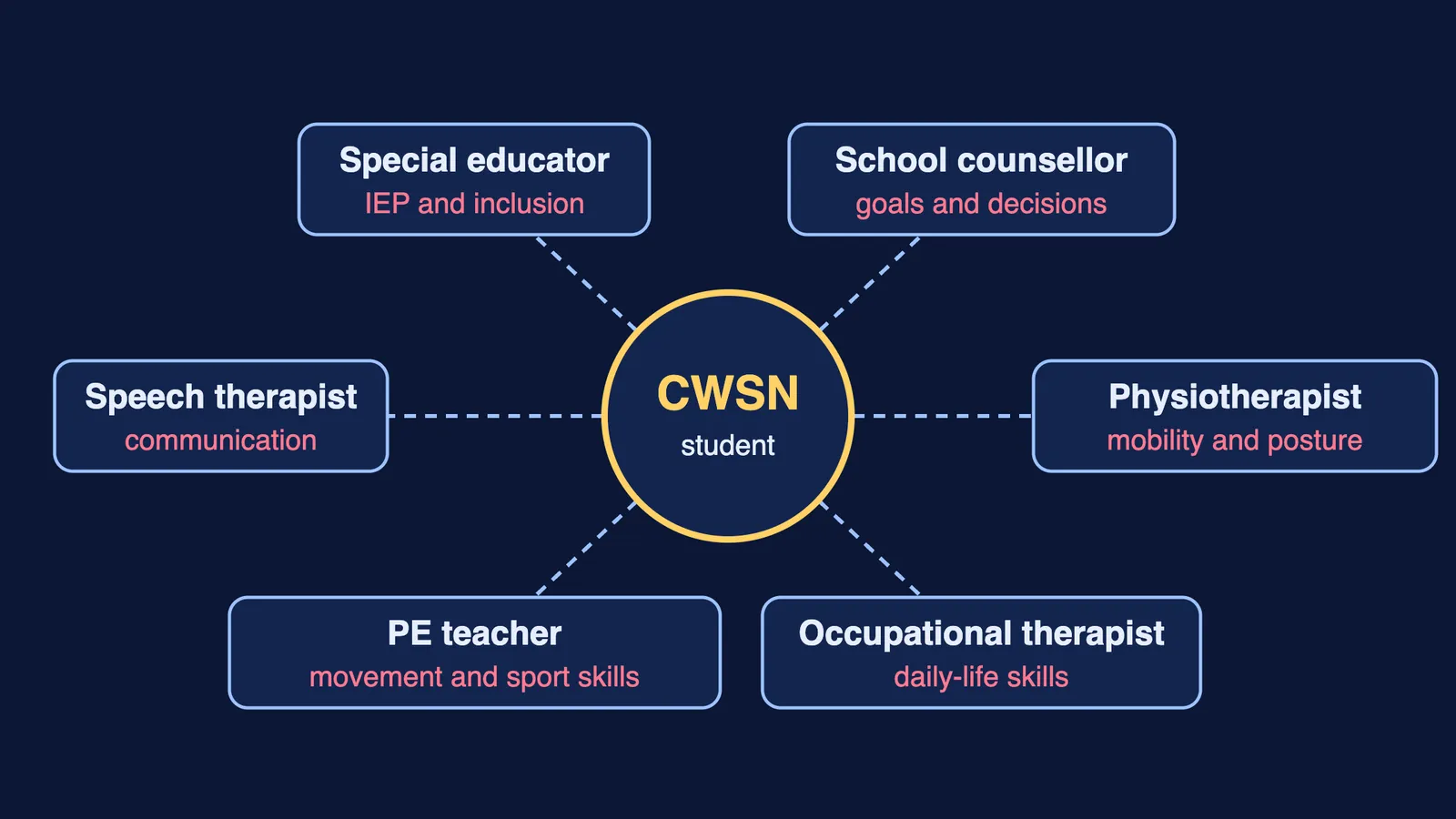
The book also lists six professionals, shown in the diagram above. The PE teacher assesses each student's abilities and supports them through general, modified or specially designed PE.
Worked example: adapting one relay lesson. A school plans a 4 x 50 m relay. Using adaptations the textbook describes:
A student with a visual impairment runs with a guide rope.
A student with autism gets a structured plan: fixed start and end times and visual cards showing each step.
A student with cerebral palsy gets physical help where needed to keep balance and finish the leg.
Everyone runs the same race: the move towards inclusion the objectives describe.
What questions can come from this unit?
Our own questions; mark labels are our suggestion.
(1 mark) Name the professional who trains CWSN in daily-life skills such as dressing and grooming.
(2 marks) Distinguish between a disorder and a disability, with one example of each.
(3 marks) Pick three objectives of adaptive physical education and give a school example for each.
(3 marks) A classmate who uses a wheelchair joins your PE class. Give three points of etiquette you would follow.
(5 marks) Describe the roles of the physiotherapist, speech therapist and PE teacher in supporting CWSN.
Next, revise Unit 1 with our guide to changing trends and careers in physical education.
Not sure where to start? Fermi's AI tutor, part of an AI-powered STEM learning platform, works out what you already know and builds a plan for the session.