

On this page
Your child's Class 10 result does not come from the board paper alone. A fifth of each main subject is earned in school across the year, through tests, projects, portfolio work and practicals. Here is what those marks cover, how they add up, and how you can help without picking up the pen.
How are Class 10 internal assessment marks split?
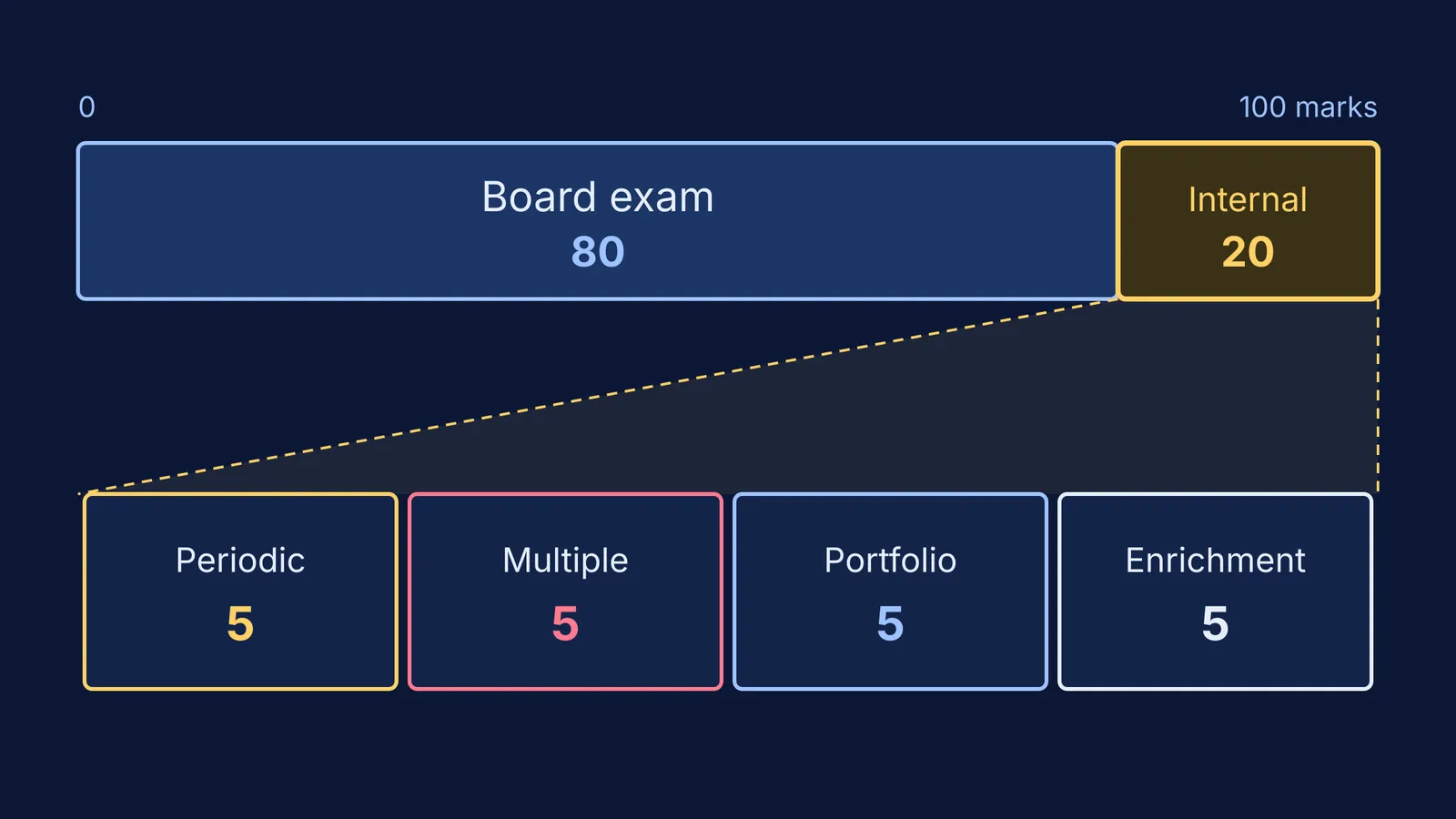
In CBSE's 2026-27 scheme, each main Class 10 subject carries 80 marks for the board exam and 20 marks for internal assessment, conducted by the school (CBSE Secondary School Curriculum 2026-27, Part 1). The final result combines both.
The internal assessment has four components, each worth 25% of the internal total, according to the same curriculum document. The CBSE Class X Science curriculum for 2026-27 lists them as 5 marks each:
Periodic assessment (5 marks): three periodic tests a year. The average of the best two counts, and at least one should be competency-based, for example case analysis or data interpretation.
Multiple assessment (5 marks): quizzes, oral presentations, discussions, experiments, projects, fieldwork and concept maps.
Portfolio (5 marks): a chosen collection of your child's work, such as written work, projects, reflections and experiment records.
Subject enrichment (5 marks): practical work in Science; listening and speaking in languages.
How much do internal marks matter in the final result?
Here is a worked example with made-up numbers. Aarav scores 58 out of 80 on his board Science paper. With 18 out of 20 in internals, his Science total is 76. With 12 out of 20, it is 70. Those six marks count exactly like six on the board paper, but they are earned over months rather than in one three-hour sitting.
Internal marks are also not optional. CBSE's curriculum says that to pass a subject, a student “must secure a minimum of 33% marks separately in external and internal assessments” (CBSE Secondary School Curriculum 2026-27). If you are unsure how your school applies this, ask the class teacher early in the year, not in February.
One detail many families miss: in Science for 2026-27, CBSE assesses some topics, such as the periodic classification of elements and evolution, only inside the school and not in the year-end exam. Teachers may ask for a short portfolio write-up on them for internal credit (CBSE Class X Science 2026-27). So “not in the board exam” does not mean “skip the chapter”.
What does the school look for in a portfolio?
CBSE says a portfolio should contain “a limited number of thoughtfully selected artefacts”, and that the emphasis is on “quality of engagement and growth rather than volume of compilation” (CBSE Secondary School Curriculum 2026-27). The elements it suggests teachers judge are organisation (neatness, creativity, visual appeal), completion of guided work, evidence of the student's growth, and completeness.
A thicker, glossier file does not earn more; a neat one that shows your child improving does.
How can parents help with projects without doing them?
A simple rule: you can handle materials, questions and deadlines. The thinking, writing, drawing and data belong to your child. A parent's handwriting erases the evidence of growth the marks reward. Our guide on how much help to give with a school science project goes deeper on where the line sits.
Fine for you to do:
Buy chart paper or seeds, and go with them to the library.
Help them plan the project timeline backwards from the due date.
Ask questions, and listen to the answers.
Not fine:
Writing the conclusion or “fixing” their sentences.
Redrawing their diagram so it looks better.
Finding and pasting data they did not collect or check.
Handing the report to an AI tool to produce.
When you feel the urge to take over, use one of these lines instead:
“Show me what the teacher asked for. What do they want you to show?”
“What is the one question your project answers?”
“Which part are you stuck on? Explain it to me as if I'm in Class 6.”
“What is the next small step, and when will you do it?”
If a project stalls because your child does not understand the idea underneath it, the Fermi Concept Library has a lesson for each concept in physics, chemistry, biology and mathematics. They can fix the gap, then write the explanation in their own words.
How do you keep notebooks on track through the year?
A short check once a week catches most problems early. Our post on checking school notebooks weekly has more; the short version:
Check that classwork dates match the timetable. Gaps mean notes to copy this week.
Read the teacher's comments on returned work, not just the score.
Keep one folder for portfolio pieces. Let your child choose what goes in and write one line on why.
Mark the periodic test dates on the family calendar.
Check that practical records are written up in the same week as the lab.
Start this Sunday with one subject, and add another each week.


