

On this page
A school science project is the one piece of homework where a parent can easily end up doing most of the work, sometimes the night before the exhibition. The useful question is not whether to help, but which jobs are yours and which belong to your child. Research points to a useful split.
What kind of help do most parents give?
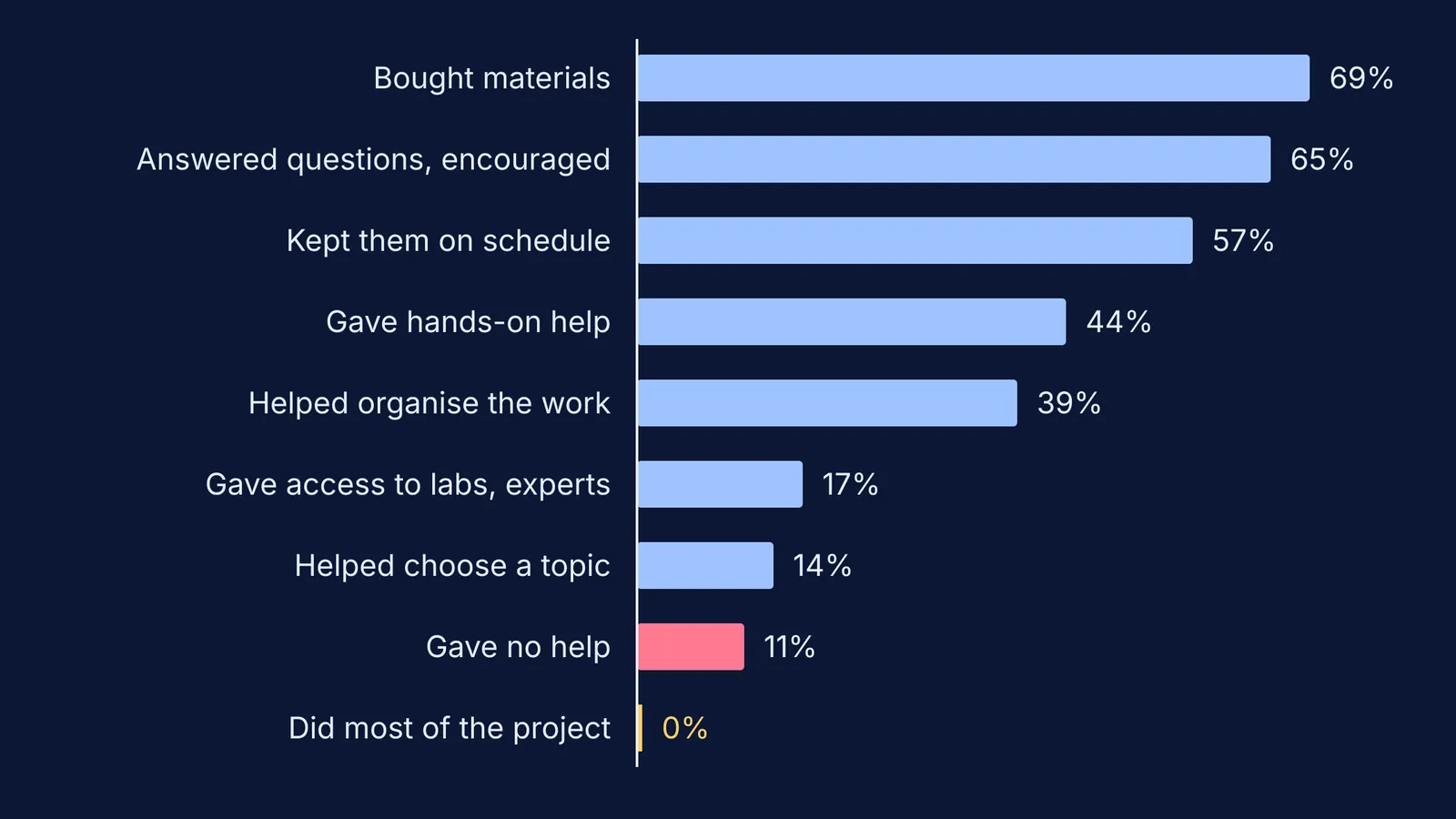
In a 2022 study in the School Community Journal, Erica Fields and colleagues surveyed 127 parents of sixth graders from 17 US schools about their children's science fair projects. 88% of parents gave logistic help, such as buying materials, keeping their child on schedule or offering encouragement. 58% gave substantive help, such as helping their child think through and organise the work or doing some of it hands-on. 11% gave no help at all, and no parent said they had done most of the project themselves.
The same study found that parents' income and education affected how much help they gave and what kind. A child whose parent studied science, or whose family can easily pay for materials, starts ahead. A project that is visibly an adult's work does not close that gap; it only hides it.
Does helping with homework actually improve learning?
It depends on the kind of help. A meta-analysis by Erika Patall, Harris Cooper and Jorgianne Civey Robinson found that training parents to be involved in homework led to higher completion rates and fewer homework problems among elementary school children. Across 22 samples from 20 studies linking involvement to achievement, parent rule-setting showed a stronger association than other strategies, and the link was positive in elementary and high school but negative in middle school.
A review of middle school research by Nancy Hill and Diana Tyson, as summarised in the Fields paper, found that "academic socialization" (conveying expectations, offering learning strategies and planning for the future) had the strongest positive link with achievement, while help with homework had the strongest negative one. These are correlations, and children who struggle may simply get more help. Still, they suggest that setting expectations and offering strategies matters more than helping with the task itself.
Who does what at each stage of a science project?
Use this as a role list for both of you.
Choosing the question. Your child lists three things they wonder about and picks one that can be tested with what is at home or school. You ask "How would you measure that?" and check that the idea is safe and affordable.
Planning the experiment. Your child writes the method, names what they will change, measure and keep the same, and decides how many trials to run. You help build a calendar backwards from the due date and ask "Why that many trials?"
Doing the experiment. Your child does the measuring and records every result in a notebook, including the odd ones. You supervise anything involving heat, sharp tools, mains electricity or chemicals, pay for supplies, and resist the urge to "fix" a strange reading.
Making sense of the results. Your child draws the graph and writes what the data show, and what they do not show. You ask "What surprised you?" and "What would you change next time?"
Report and display. Your child writes the text, designs the board and practises explaining it aloud. You hold the board steady, drive, and listen to a two-minute rehearsal. Their uneven lettering is better than your perfect lettering.
Our guide to turning a question into a fair science experiment walks through the first two stages in more detail.
Honest data matter more than a neat result. In a 2020 PLOS ONE survey of US high school students, Frederick Grinnell and colleagues found that about 10% of students who were required to take part and had no interest in science careers either used someone else's data or made up their own. A prediction that turned out wrong is still a complete project.
If the sticking point is the science behind a result, such as why a solution conducts or why a plant bends towards light, the Fermi Concept Library has a lesson for each concept in physics, chemistry and biology, so your child can look it up instead of you explaining it for them.
How do you know you have crossed the line?
Your child cannot explain a step without looking at you.
The handwriting, wording or graph style is yours.
You changed a result because it "looked wrong".
You are working on it while your child is doing something else.
If you tick one, hand the pen back. Try saying: "I'm not going to write this, but I'll sit with you while you write the first line." Or: "Tell me what you've tried, then I'll ask you one question." Or: "Let's look at the calendar. What's the smallest piece you can finish tonight?"
For the wider habit of stepping back without stepping away, read our pieces on knowing when to help with homework and autonomy-supportive parenting.


