

On this page
School projects can feel overwhelming, both for the student staring at the rubric and the parent watching the deadline approach. When an assignment spans several weeks, it is common for the work to be compressed into a frantic rush the night before. This happens not because of laziness, but because estimating time and breaking a large goal into manageable steps is a complex executive function skill that takes practice to develop.
Why do students underestimate how long assignments take?
The tendency to underestimate task completion times is a well-documented cognitive bias known as the planning fallacy. In a 1994 study, university students predicted their senior thesis would take an average of 33.9 days to complete, but it actually took 55.5 days (Buehler et al., 1994).
When planning, students often focus on a best-case scenario. They imagine a clear path from start to finish, ignoring the inevitable bumps: a website that won't load, a concept that takes longer to understand, or a draft that requires heavy revision. They also tend to view a large project as one single block of work, which makes it hard to accurately estimate the time required for each individual phase.
How do I help my child plan a school project deadline?
The most effective way to help your child plan a school project timeline is to teach them how to "chunk" the assignment. This means dividing the large project into smaller, specific tasks, each with its own mini-deadline.
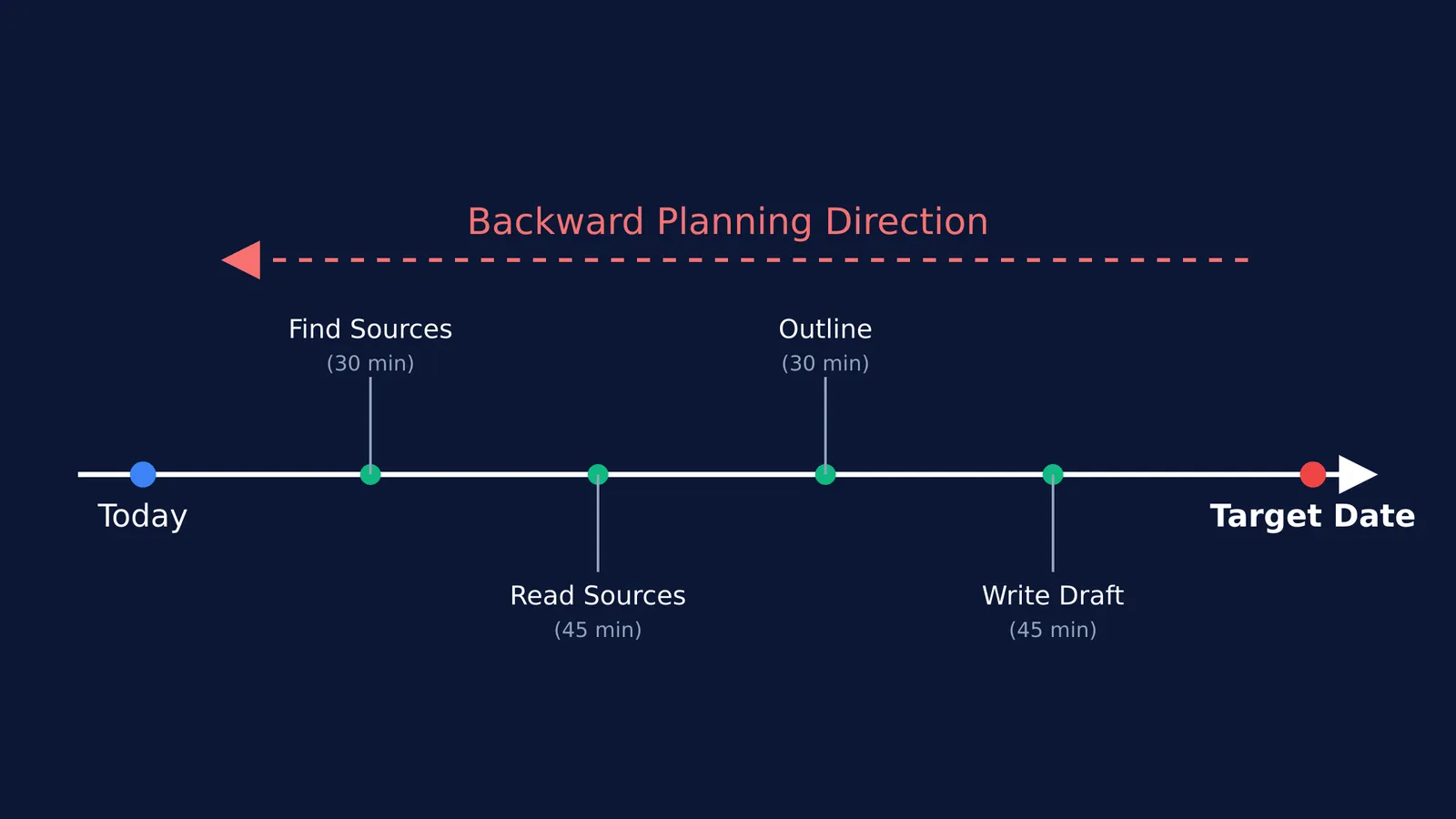
The best approach is backward planning. Instead of starting from today, start from the project's due date and work in reverse. Here is how to guide your child through the process:
Set an early target date: Agree to have the project completely finished a couple of days before the actual deadline. This creates a buffer for unexpected delays and last-minute proofreading.
List every micro-task: Ask your child to list every step required. For a science report, this might include picking a topic, finding a few sources, reading the sources, writing an outline, drafting the introduction, writing the body, writing the conclusion, and formatting the bibliography.
Estimate the time for each step: Have your child guess how long each micro-task will take. Encourage them to break tasks down until each one takes about half an hour. A task like "write the report" is too big; "write the introduction paragraph" is manageable.
Assign mini-deadlines on a calendar: Working backward from the early target date, place these short tasks onto a physical or digital calendar. Ensure that prerequisite tasks, such as reading sources, are scheduled before drafting begins.
What should I do when they get stuck?
Even with a detailed timeline, your child will likely hit roadblocks. This is the moment when a scheduled study session can easily turn into procrastination. When they are unsure how to start a specific step, ask them to explain the immediate goal in their own words. Sometimes just talking through the problem helps them find the next action.
Where the student is stuck on a specific subject, they can use Fermi's AI tutor. It works out what they already know and builds a plan for the session, which helps them tackle a step rather than staring at a blank page. If they encounter a difficult idea while researching, they can consult the Fermi Concept Library for a clear explanation before moving back to the assignment.
How can I let them lead the process?
It is tempting to take the rubric and build the calendar for your child, but doing so means you are doing the executive functioning for them. Instead, act as a consultant. Ask questions like, "What do you think should happen after you finish your outline?" or "How long do you think finding the images will take?"
Over time, comparing their time estimates to the actual time spent will improve their planning skills. They will begin to internalize how long their work really takes, transforming a daunting deadline into a clear, step-by-step path.
Read more about building strong study habits:


