On this page
Here are the key terms of Chapter 3, Tissues in Action, from the NCERT Class 9 textbook Exploration (First Edition 2026), grouped by topic. Each definition is in our own words and checked against the NCERT chapter text. For activities and the full walkthrough, see our Tissues in Action Class 9 chapter guide.
What is a tissue and why do cells form one?
Tissue: cells of a similar kind that cooperate on a single task. Example: muscle tissue moves the body. Don't confuse with: organ, which is built from more than one type of tissue.
Levels of organisation: the ladder in a multicellular organism: cells, tissues, organs, organ systems, organism.
Division of labour: different tissues taking on different jobs, so the whole body works more efficiently. Example: xylem carries water while phloem carries food.
Differentiation: the change by which a newly made cell stops dividing and becomes specialised for one function. Example: meristem cells becoming support or transport cells.
Which plant tissues make a plant grow?
Meristematic tissue: actively dividing cells: small, thin-walled, tightly packed, with a large nucleus, dense cytoplasm and usually no vacuole. Don't confuse with: permanent tissue, whose cells have stopped dividing.
Apical meristem: dividing tissue at the tips of roots and shoots that makes the plant longer. Example: onion roots stop growing in length once their tips are cut.
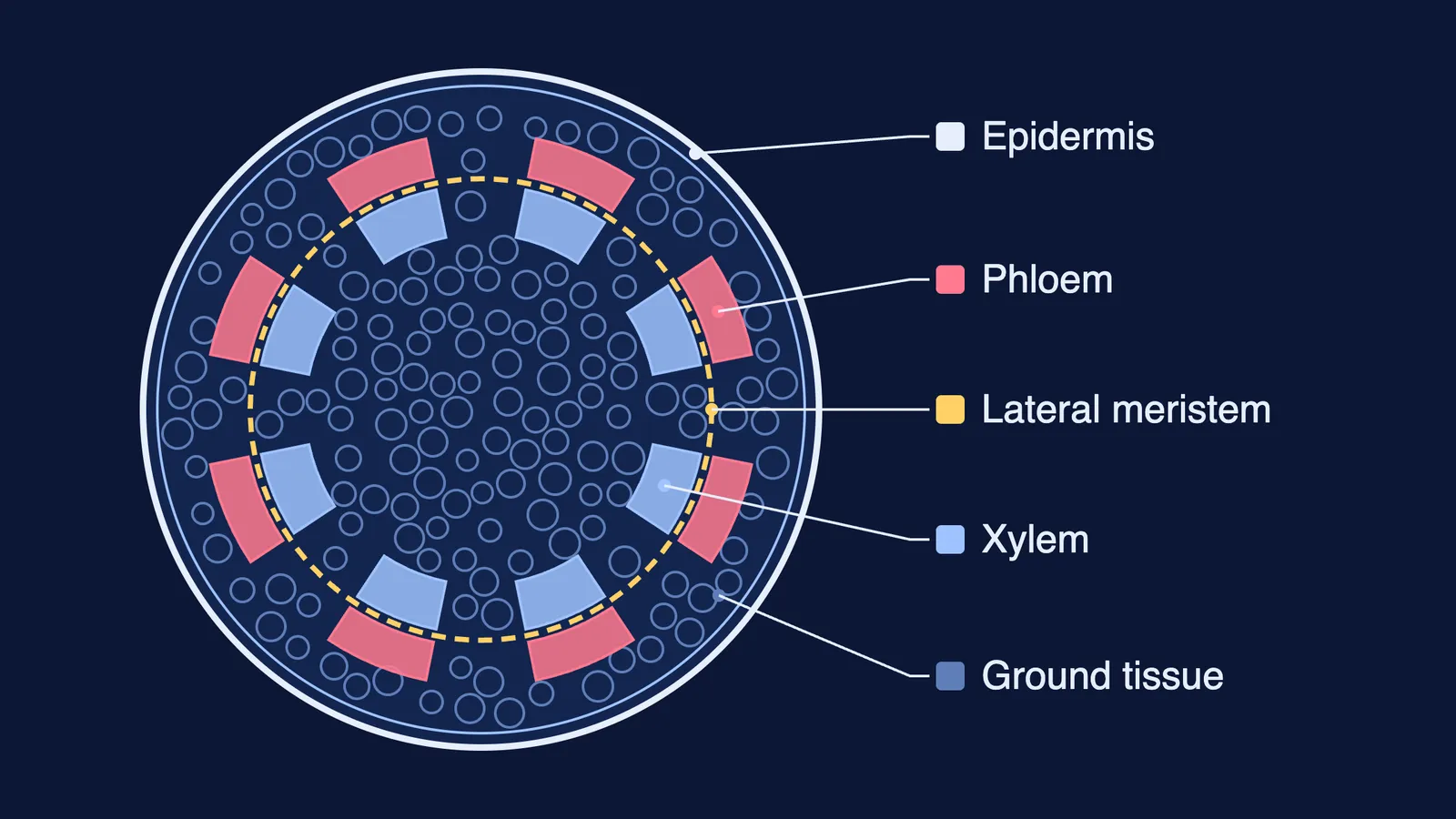
Lateral meristem: a ring of dividing cells in the stem that makes it thicker. Example: annual growth rings in a tree trunk.
Intercalary meristem: dividing tissue at the base of an internode, just above a node, that lets a plant regrow after cutting. Example: grass after mowing. Don't confuse node (where leaves arise) with internode (stem between two nodes).
What are permanent tissues in plants?
Permanent tissue: specialised cells that no longer divide. Simple permanent tissue has one cell type; complex has more than one.
Epidermis: the single, tightly packed outer cell layer, often coated with a waxy cuticle that cuts water loss. Example: thick cuticle in desert plants.
Stomata: leaf pores for gas exchange and transpiration, the loss of water vapour that pulls water up the xylem. Don't confuse with: root hair, the epidermal outgrowths that absorb water and minerals.
Parenchyma: living, thin-walled, loosely packed cells that store food and, in green parts, photosynthesise. Example: air spaces that help aquatic plants float.
Collenchyma: living cells thickened at the corners by pectin, giving support with flexibility. Example: a young stem or tendril that bends without breaking.
Sclerenchyma: mostly dead cells with thick walls hardened by lignin, giving strength. Example: coconut husk and walnut shell. Don't confuse with: collenchyma, which is living and flexible.
Xylem: carries water and minerals up from the roots; made of tracheids, vessels, xylem parenchyma (its only living part) and xylem fibres.
Phloem: mostly living tissue that carries food from leaves; made of sieve tubes, companion cells (which monitor the loading and unloading of sugars in sieve tubes), phloem parenchyma and phloem fibres. Don't confuse with: xylem, which moves water.
Tissue systems: dermal (outer cover), ground (parenchyma, collenchyma, sclerenchyma) and vascular (xylem, phloem).
Going further? See Anatomy of Flowering Plants Class 11.
What are the four types of animal tissue?
The figures below are from the NCERT chapter.
Epithelial tissue: closely packed cells covering the body and lining organs. Example: one layer of thin, flat cells lines blood vessels for fast gas exchange.
Connective tissue: joins and supports other tissues; its cells sit in a matrix, fluid in blood and hard in bone.
Blood: a fluid connective tissue made of plasma (55% of total volume) and formed elements (45% of total volume): red blood cells, white blood cells and platelets. Red blood cells live about 4 months; platelets help clotting.
Bone: hard connective tissue; calcium and phosphorus compounds in its matrix give strength.
Cartilage: flexible tissue with a jelly-like matrix that cushions bone ends. Example: your ear.
Tendon: connects muscle to bone and passes on its pull. Don't confuse with: ligament.
Ligament: connects bone to bone and limits how far a joint moves.
Skeletal muscle: voluntary muscle attached to bones, with long, unbranched, multinucleate, striated fibres. Example: lifting a bag.
Smooth muscle: involuntary muscle with spindle-shaped, single-nucleus, unstriated cells. Example: moving food through the intestine.
Cardiac muscle: involuntary heart muscle with branched, single-nucleus, faintly striated fibres that beat without tiring.
Neuron: a nerve cell: dendrites receive signals, the cell body holds the nucleus, and the axon carries messages to its terminals.
How do bones, muscles and joints work together?
Musculoskeletal system: bones, muscles, joints, cartilage, tendons and ligaments that support and move the body, under nervous control.
Joint: where two or more bones meet; muscles do the pulling.
Ball and socket joint: a rounded bone end in a hollow, moving in many directions. Example: the shoulder.
Hinge joint: a joint that bends in one direction only, like a door. Example: elbow and knee.
Pivot joint: a joint that lets one part turn on another. Example: skull on backbone when you shake your head.
Fixed joint: bones joined so they cannot move. Example: the skull bones protecting the brain.
Older notes may list areolar or adipose tissue; this chapter does not cover them. For an advanced look at animal tissues, see the Class 11 post Structural organisation in animals.
How to learn these terms
Learn in pairs: collenchyma vs sclerenchyma, xylem vs phloem, tendon vs ligament, smooth vs cardiac muscle.
Draw a stem cross-section and label epidermis, ground tissue, phloem, lateral meristem and xylem from memory, then check the textbook figure.
Map each meristem to a question: longer (apical), thicker (lateral), regrows after cutting (intercalary).
Use your body: bend your elbow, turn your neck, rotate your shoulder, and name the joint each time.
If one term will not stick, read its short lesson in the Fermi Concept Library, where each concept has its own lesson.